

























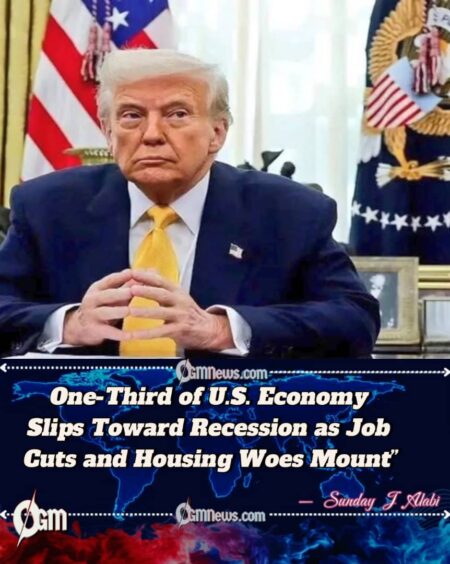
A growing share of the U.S. economy has already entered or is on the brink of recession, according to leading economist Mark Zandi. The chief economist at Moody’s Analytics revealed that states accounting for nearly a third of US GDP—including Virginia, Connecticut, and Delaware—are already in dangerous territory.
While states in economic decline are spread nationwide, Zandi noted that the broader Washington, D.C. region has become particularly vulnerable due to deep cuts in government-related employment. This trend reflects a troubling shift as federal downsizing begins to ripple through the job market.
By contrast, states such as Hawaii, New York, and California are holding steady. Meanwhile, several southern states, including South Carolina, Alabama, Kentucky, and Louisiana, continue to show growth—though Zandi cautioned that their momentum is slowing.
Trump’s Cost-Cutting Drive and Its Ripple Effects
Earlier this year, President Donald Trump, working closely with Elon Musk, launched an aggressive campaign to reduce the cost of the federal workforce. The move, described by supporters as necessary belt-tightening, led to widespread layoffs across federal agencies.
Critics, however, argue that the policy has had unintended consequences, particularly in states reliant on government employment. With entire communities dependent on federal jobs, the rapid downsizing has compounded economic instability in regions such as Virginia and Maryland, placing additional pressure on local economies already under strain.
The Trump administration has defended the policy as essential to curbing waste and reducing the federal deficit. Nonetheless, economists warn that the pace of cuts could intensify the risk of a broader national downturn.
Job Market Stress Signals
Zandi has consistently flagged payroll employment as the single most critical indicator of recession risk. He warned that if job numbers decline for more than a month consecutively, the U.S. economy will officially enter a downturn.
Recent data show that over half of U.S. industries are already reducing staff, with layoffs soaring by 140 percent compared to last year. Healthcare remains the only sector meaningfully adding to payrolls, underscoring the fragile nature of the recovery in other areas.
The rapid adoption of Artificial Intelligence has accelerated job losses, particularly in white-collar industries. Zandi emphasized that structural changes in the workforce are leaving many Americans vulnerable, as automation displaces traditional roles faster than new opportunities are being created.
Housing Market on the Brink
Beyond employment, Zandi issued a stark “red flare” warning for the housing market this summer. He cautioned that the slowdown in new construction, combined with falling sales and widespread price reductions, is creating a dangerous imbalance.
“Home sales are already uber depressed,” Zandi wrote in July, noting that many sellers are being forced to slash prices or withdraw their properties entirely. He warned that housing could soon become a major drag on the broader U.S. economy, exacerbating recessionary pressures in late 2025 and into early 2026.
Given that housing has historically been a leading driver of U.S. growth, Zandi’s warning highlights the risk of a cascading effect: weaker home sales leading to job losses in construction, retail, and finance, all of which amplify economic weakness nationwide.
U.S. Split Into Three Economies
According to Zandi’s analysis, the U.S. economy now falls into three distinct categories. Roughly one-third is already contracting or at high risk of recession, another third is holding steady, and the final third continues to grow, albeit at a slowing pace.
California and New York—together representing more than a fifth of U.S. GDP—remain pivotal to national stability. Their ability to withstand economic shocks could determine whether America avoids a full-scale recession. Meanwhile, the growth seen in parts of the South offers some optimism, though slowing demand may soon drag those states into the same struggles faced elsewhere.
The economist’s warning underscores a broader truth: while the recession may not yet be official, key indicators point to mounting trouble. For millions of American households already grappling with inflation, job insecurity, and housing stress, the economic pain is very real.
Outlook: Bracing for What’s Next
Zandi cautioned that recessions are often only recognized after they begin, making it difficult to pinpoint an exact start date. Nonetheless, the convergence of declining payrolls, weakening housing markets, and widespread layoffs presents what he calls a “clear red flag” for the months ahead.
With the U.S economy already fractured into distinct regions of growth and contraction, the challenge for Washington will be to stabilize confidence while addressing structural shifts in employment and housing. Whether the U.S. can avoid a deeper downturn may depend on how quickly policymakers adapt to these warning signs.
For now, economists agree on one thing: U.S is entering a period of turbulence where the difference between resilience and recession could hinge on just a handful of critical states and industries



[…] […]