

























Donald Trump declared that the United States has reached “a level that we’ve never thought we’d be at,” crediting tariffs as the central driver of this achievement.Trump insisted that his trade policies are not short-term tactics but long-term strategies designed to restore balance and fairness to global commerce.
Donald Trump emphasized that his vision for tariffs extends beyond economics. Donald Trump portrayed tariffs as a symbol of national strength, arguing that only decisive and bold policies can secure America’s place in the world.
Trump Champions Tariffs as Strategic Weapons
Trump described tariffs as a weapon of economic warfare that has redefined the terms of global trade. Donald Trump argued that the United States has been disadvantaged for decades, and tariffs are a corrective force restoring dignity to American industries.
Donald Trump imposed tariffs on products from China, Europe, and Canada, framing these actions as defensive measures against unfair practices. Donald Trump dismissed critics as short-sighted, claiming that the U.S. economy is resilient enough to withstand retaliatory pressure.
Trump Elevates Transparency as a Governing Principle
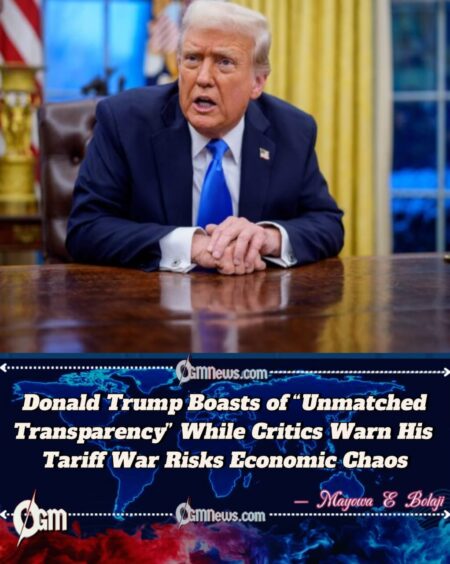
Donald Trump proclaimed that transparency is now at its highest level in American history.Trump asserted, “There’s never been transparency like we have,” presenting his administration as open and accountable in contrast to previous governments.
Donald Trump tied this transparency directly to tariffs, insisting that his policies are visible, confrontational, and easy for the public to follow. He maintained that by exposing trade disputes openly, Americans can clearly see how their government negotiates on their behalf.
Donald Highlights Tariff Effects on U.S. Industries
Donald Trump pointed to steel, aluminum, and other manufacturing sectors as evidence that tariffs are working. Donald argued that these industries have rebounded, gaining renewed confidence in domestic production.
Donald acknowledged that some sectors, particularly agriculture, have suffered due to retaliatory tariffs. Donald Trump nevertheless framed these sacrifices as necessary costs for achieving long-term independence from foreign markets.
Trump Responds to Global Pushback
Donald Trump confronted international backlash by presenting America as too strong to be bullied by foreign powers. Donald argued that countries such as China and the European Union must finally respect U.S. economic sovereignty.
Trump maintained that the tensions created by tariffs are deliberate and productive. Donald suggested that global rivals are now forced to negotiate on fairer terms, proving the success of his hardline approach.
Trump Faces Critics of His Tariff Policy
Trump rejected warnings from economists who argue that tariffs could destabilize global trade and harm consumers. Donald Trump insisted that the benefits outweigh the costs, and that Americans must endure temporary price increases for future security.
Donald brushed aside accusations that tariffs are reckless, branding critics as defenders of failed globalization. Donald Trump instead positioned himself as the only leader willing to confront an unfair system head-on.
Donald Makes Tariffs a Political Symbol
Donald Trump used tariffs to signal his determination to put America first, framing them as both economic tools and ideological statements. Donald Trump argued that tariffs prove his loyalty to ordinary citizens rather than to global elites.
Donald the tariff battles directly to his political identity in his second term. Donald claimed that his defiance of international norms demonstrates his strength as a leader willing to protect American sovereignty.
Trump Defines His Legacy Through Tariffs
Donald concluded that tariffs have pushed the nation to “a level we’ve never thought we’d be at.” Donald Trump portrayed this as proof that his presidency is rewriting the rules of global economics and asserting America’s dominance.
Trump insisted, “There’s nothing to hide,” presenting his vision as one of clarity, pride, and defiance. Trump’s gamble on tariffs remains one of the defining pillars of his second term, shaping both his domestic base and his global legacy.

[…] […]