





















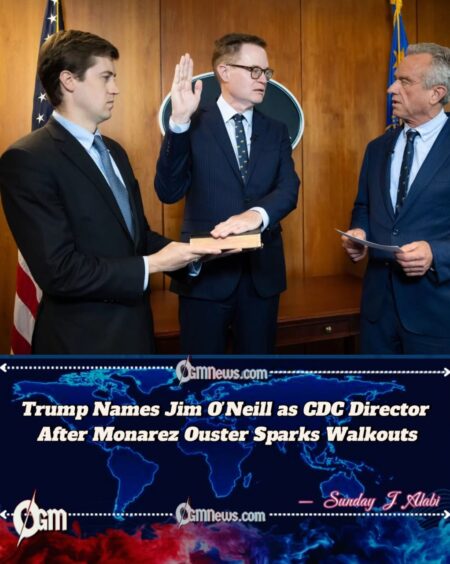
President Donald Trump has appointed Jim O’Neill, a longtime deputy to Health Secretary Robert F. Kennedy Jr., as the new director of the Centers for Disease Control and Prevention (CDC). The move comes just days after Trump dismissed Dr. Susan Monarez, who held the position for only three weeks.
Monarez’s ouster by Trump administration has plunged the agency into turmoil. She had clashed openly with Kennedy over his efforts to roll back vaccine approvals, warning that such policies risked “putting millions of American lives at risk.” Her refusal to comply ultimately led to her removal, sparking widespread alarm across the public health community.
Walkouts and Resignations Rock the Agency
Monarez’s firing triggered unprecedented unrest inside the CDC. Hundreds of staff staged a dramatic walkout from the Atlanta headquarters on Thursday, lining the sidewalks to applaud departing senior leaders who resigned in solidarity.
Among those stepping down were Chief Medical Officer Deb Houry, vaccine safety chief Dr. Daniel Jernigan, and vaccine guidance director Dr. Demetre Daskalakis. The three coordinated their resignations as a collective act of protest. “When the three of us do it together, it’s more powerful—it shows the state of our agency,” Houry explained.
Controversial Appointment by Trump Administration Raises Eyebrows
The choice of O’Neill, who lacks a medical background, has already raised concerns in Congress and among scientists. A former investment executive who once served in the Department of Health and Human Services under George W. Bush, O’Neill is better known for his libertarian health policy views than for any public health experience.
Old remarks have resurfaced that may complicate his tenure. In one video, he suggested Americans should be financially incentivized to donate organs, remarking there were “plenty of healthy spare kidneys walking around, unused.” He has also made unorthodox claims about the origins of COVID-19 and previously promoted controversial treatments such as ivermectin and hydroxychloroquine.
Bipartisan Alarm Over Vaccine Policies
The escalating crisis has sparked rare bipartisan concern on Capitol Hill. Two Republican senators have called for immediate congressional oversight into Kennedy’s vaccine policies, while Independent Senator Bernie Sanders has demanded a formal investigation. Several Democrats have gone further, urging Trump to dismiss Kennedy altogether.
At issue is Kennedy’s sweeping campaign to reshape the nation’s vaccine policy. He has already disbanded the CDC’s advisory committee on immunizations, replacing its members with skeptics more aligned with his views. Critics warn these actions could undermine decades of scientific consensus on vaccine safety and efficacy.
Monarez’s Defiance and Legal Challenge
Monarez, the first CDC director to be confirmed by the Senate, refused to resign when asked, setting up a tense standoff with the Trump administration. Her attorneys argued that Kennedy had no legal authority to demand her removal. “This is about the systematic dismantling of public health institutions and the dangerous politicization of science,” lawyers Mark S. Zaid and Abbe Lowell said in a statement.
Despite her resistance, the Trump administration ultimately informed Monarez she was being dismissed. She leaves behind a legacy of standing firm on evidence-based science during a brief but tumultuous tenure. Her departure underscores the growing rift between career scientists and political appointees within federal health agencies.
Staff Speak Out Against “Weaponization of Public Health”
Several departing officials denounced the administration in blunt terms. Dr. Daskalakis told colleagues he could no longer serve in an environment where “decisions of scientific importance are released via social media posts without consultation.” He accused Kennedy of “hamstringing and sidelining” Monarez, warning that political interference would “result in the death and disability of vulnerable children and adults.”
The resignations highlight a crisis of morale at the CDC, with staff describing an untenable atmosphere shaped by political loyalty tests rather than scientific integrity. Emails circulated internally portray deep frustration with abrupt policy shifts announced online rather than through established channels.
A Pivotal Moment for U.S. Public Health
As O’Neill assumes leadership, the CDC faces its gravest institutional challenge in decades. With Kennedy pushing to revise COVID-19 vaccine guidelines and restrict approval to older adults and high-risk groups, experts predict more internal conflict and potential resignations in the weeks ahead.
The shakeup marks a turning point for American public health. Supporters of Trump and Kennedy argue the changes reflect a long-overdue realignment of federal health policy. Critics counter that politicization is eroding trust in science and putting lives in danger. The coming months are expected to test both O’Neill’s leadership and the resilience of the CDC itself.


The vibes here are amazing and the winning streaks are real. It feels just like...