



















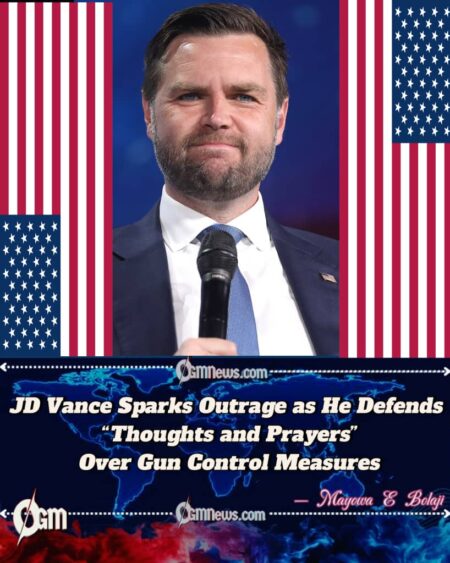
U.S. Vice President JD Vance has reignited a contentious national debate after defending the value of faith and reflection in times of tragedy. Responding to critics of “thoughts and prayers,” he declared, “When I see far-left politicians say how dare you offer thoughts and prayers, you need action. I don’t care about your prayers, I care about what you are going to do to prevent this from happening. Why does it have to be one or the other?”
JD Vance delivered the remarks during a press conference in Washington, where the nation continues to grapple with recurring mass shootings, acts of violence, and policy gridlock. His words immediately set off a firestorm of reactions from religious groups, political leaders, and advocacy organizations.
Faith Versus Policy: The Eternal Tug-of-War
JD Vance has long framed himself as a defender of cultural values rooted in faith, often clashing with progressive voices demanding policy over prayer. His latest statement underscored the struggle to balance spiritual responses with calls for urgent legislative change.
JD Vance challenged critics directly by asking why faith and action must be mutually exclusive. By doing so, he positioned himself as a bridge between religious Americans seeking comfort in prayer and activists demanding concrete reforms, though critics remain unconvinced.
Religious Communities Rally Behind Vance
JD Vance’s words found strong support among church leaders and faith organizations across the country. Many praised him for affirming the place of prayer in public life, insisting that it remains a vital source of comfort during national crises.
JD Vance’s defense of faith was echoed by religious advocacy groups, who warned that sidelining prayer from public discourse risks alienating millions of Americans. They argue that spiritual practices are not mere symbolism but part of the nation’s moral foundation.
Advocacy Groups Demand Tangible Action
JD Vance’s comments, however, drew sharp backlash from advocacy groups calling for stronger gun control laws. Critics said his emphasis on prayer amounted to political deflection rather than addressing the root causes of mass shootings.
JD Vance’s attempt to combine faith and policy was rejected by reform activists who renewed calls for universal background checks, bans on assault weapons, and tougher red-flag laws. They argue that compassion must translate into legislative action if lives are to be saved.
White House Balances Compassion With Policy
JD Vance’s remarks have stirred complex discussions within the Trump administration, which has sought to balance faith-based appeals with policy considerations. While he defended prayer, questions linger about how far the administration will go on gun reform.
JD Vance has aligned closely with President Trump’s emphasis on faith as a cornerstone of American life. Yet insiders acknowledge the White House is wary of alienating conservative voters who strongly oppose restrictions on firearms.
Media Reactions Reflect Polarization
JD Vance quickly became the focal point of media coverage, with reactions split along partisan lines. Conservative outlets framed his remarks as compassionate and balanced, while liberal commentators accused him of dodging responsibility.
JD Vance’s defense of prayer was lauded in editorials sympathetic to faith-based values, while progressive newspapers dismissed it as rhetoric without resolve. The polarized coverage reflects America’s broader divisions on the role of faith in policymaking.
Public Opinion Splits Along Familiar Lines
JD Vance’s statement appears to have crystallized existing divides among the public. Early polls indicate conservatives support his defense of prayer, while progressives overwhelmingly see it as an inadequate response to national tragedies.
JD Vance’s ability to appeal to faith-driven voters may strengthen his standing among the Republican base, but it also reinforces criticism from reform advocates who accuse him of avoiding hard choices on gun violence.
The Road Ahead: Policy, Prayer, or Both?
JD Vance has posed a question that continues to reverberate through political and social circles: can the United States reconcile prayer with policy in moments of grief? His challenge highlights the difficulty of balancing compassion with reform.
JD Vance’s call to avoid choosing between prayer and action may resonate with millions of Americans. Yet whether his framing can translate into bipartisan consensus or remain another flashpoint in a polarized debate remains uncertain.
Casinoabc999? Good Site. The interface is sleek, and there is a lot of stuff to...