















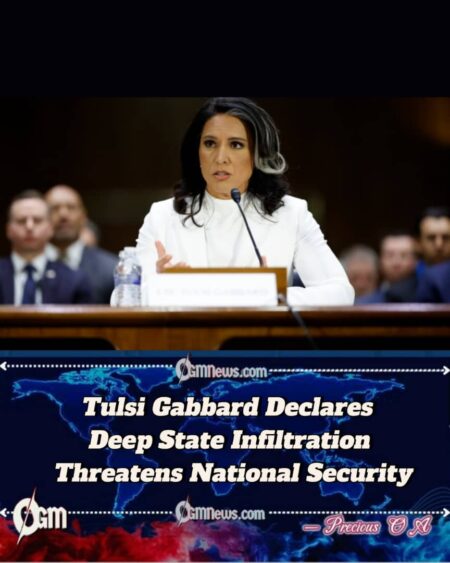
Tulsi Gabbard, the U.S. Director of National Intelligence, has sounded a strong alarm over what she describes as the infiltration of America’s intelligence community by deep state actors. She warned that partisan officials are embedding their personal agendas into intelligence assessments and official reports, undermining the objectivity and reliability of national security products.
Tulsi Gabbard stressed that intelligence—meant to be factual and unbiased—is instead being manipulated to serve political ends. She accused certain officials of “inserting their own partisan political opinions and views” into classified materials, a practice she said misleads policymakers and works directly against the interests of the American people.
Tulsi Gabbard explained that the intelligence community’s duty is to provide U.S. leaders with factual, objective assessments of threats ranging from terrorism and cyberattacks to geopolitical rivalries. These reports form the foundation of foreign policy and military decisions.
Tulsi Gabbard cautioned that if intelligence reports are compromised by political bias, U.S.
leaders risk making decisions based not on reality but on the ideology of analysts. Such distortions, she argued, could have dangerous consequences for defense planning, diplomatic negotiations, and counterterrorism efforts.
Tulsi Gabbard’s remarks have renewed public focus on the concept of a “deep state”—an unelected bureaucracy accused of shaping policy from behind the scenes. Critics have often dismissed the idea as conspiracy theory, but her direct warning has brought renewed legitimacy to the charge.
Tulsi Gabbard noted that trust in federal institutions has already been eroding, and allegations of hidden agendas within intelligence circles may deepen public skepticism. For many Americans, her statements echo growing fears that entrenched power structures operate beyond democratic accountability.
Tulsi Gabbard’s concerns appear closely aligned with President Trump’s long-standing criticisms of bias within the intelligence community. The President, now serving his second term, has consistently warned that political interference distorts national security decisions.
Tulsi Gabbard’s statement is expected to strengthen the administration’s push for reform.
White House officials have echoed her concerns, pledging to introduce oversight measures that ensure intelligence products remain factual, impartial, and free from partisan influence.
Tulsi Gabbard warned that if partisan bias is influencing intelligence reports, the consequences extend far beyond Washington. She argued that distorted intelligence could lead to misjudging adversaries such as China, Russia, or Iran, thereby fueling misguided policies or unnecessary escalation.
Gabbard stressed that politicized intelligence creates blind spots that weaken U.S. defenses and erode credibility with allies. If left unchecked, she cautioned, America could suffer both strategically and diplomatically on the global stage.
Tulsi Gabbard’s warning has already triggered responses on Capitol Hill.
Lawmakers from both parties are demanding a closer look into how intelligence products are reviewed and whether systemic political interference exists.
Gabbard’s testimony could pave the way for congressional hearings and greater oversight. While some lawmakers agree with her calls for reform, others argue that framing the issue in political terms risks further damaging the morale of the intelligence community.
Tulsi Gabbard urged reforms that would draw a sharp line between intelligence analysis and political interpretation. She called for independent reviews of reports and stricter accountability measures for any officials found to have compromised neutrality.
Tulsi Gabbard emphasized that restoring credibility is vital to the intelligence community’s survival.
Without trust from both policymakers and the American people, she warned, intelligence products lose their value, and national security itself is placed at risk.
Gabbard has placed the intelligence community at a crossroads: either reforms are enacted to ensure objectivity and accountability, or allegations of deep state influence will continue to erode public trust.
Gabbard’s warning has forced the issue into the national spotlight, ensuring it will remain a pressing question for both policymakers and citizens. Whether the U.S. intelligence community emerges stronger and more transparent—or further mired in suspicion and controversy—may depend on how swiftly leaders act on her call for reform.
Yo, just tried out that ad786game site. Pretty smooth experience, feels legit. Worth checking out...