





























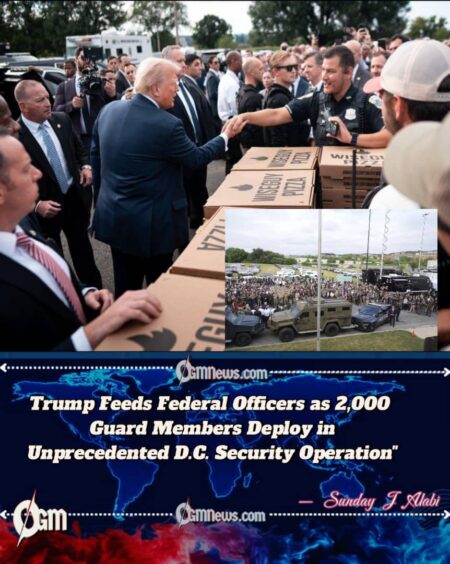
President Trump personally thanked federal law enforcement officers with hamburgers and pizza Thursday as his administration’s controversial anti-crime initiative continues to flood Washington, D.C. with thousands of additional police and National Guard personnel.
President Trump Makes Rare D.C. Visit to Support Federal Agents
President Trump visited a U.S. Park Police facility in Southeast Washington on Thursday, where he distributed food to federal law enforcement officers as part of his administration’s ongoing security surge in the nation’s capital. The president handed out hamburgers prepared at the White House and pizza from a local restaurant to the assembled crowd of federal agents.
“You’re incredible people. You make the country run, frankly,” Trump told the officers during his visit. The president used the occasion to outline ambitious plans for the district, promising that the capital city will be “maxxed out in terms of beauty” within the next six to 12 months. His vision includes cleaning graffiti, repairing park grass, and fixing road medians throughout the city.
The president was joined by several high-ranking administration officials, including Attorney General Pam Bondi and Interior Secretary Doug Burgum, who also addressed the federal officers. The visit represents one of Trump’s few ventures into the district outside of official speeches or visits to his former Pennsylvania Avenue hotel during his first term.
Massive Security Deployment Transforms Capital Landscape
The Trump administration has deployed approximately 2,000 National Guard personnel from Washington, D.C. and several GOP-led states to the capital, alongside a significant surge of officers from federal agencies including the FBI and Drug Enforcement Administration. This unprecedented security operation has fundamentally altered the law enforcement landscape in the nation’s capital.
Since the initiative began, federal authorities have made 630 arrests and seized 86 illegal firearms, according to Attorney General Bondi’s latest figures. The operation represents one of the largest federal law enforcement deployments in Washington outside of major national security events.
The previous day, Vice President JD Vance, Defense Secretary Pete Hegseth, and White House deputy chief of staff Stephen Miller visited National Guard members stationed at Union Station, demonstrating the administration’s high-level commitment to the operation. Trump himself announced plans to personally patrol the city alongside law enforcement and Guard members, telling radio host Todd Starnes, “I’m going to be going out tonight, I’m going to keep it a secret.”
Federal Takeover Sparks Constitutional Confrontation
Trump’s assertion of federal control over the D.C. Metropolitan Police Department has triggered significant pushback from local politicians who argue the move threatens the city’s autonomy. The unprecedented federal intervention in local policing has raised constitutional questions about the balance of power between federal and local authorities.
The Justice Department initially attempted to name an emergency local police chief but backed down following a lawsuit from D.C. officials last week. This legal challenge highlights the complex jurisdictional issues surrounding the administration’s approach to policing in the federal district.
Local officials have characterized the federal intervention as both unnecessary and constitutionally problematic, arguing that it undermines the principle of local governance. The dispute represents a broader tension between the Trump administration’s federal law enforcement priorities and traditional local autonomy in policing matters.
Crime Statistics Become Political Battleground
Trump has dismissed D.C. crime statistics as “phony numbers” and promised his administration would investigate their accuracy, despite official data showing significant improvements in public safety. According to local police data, violent crime in D.C. has been declining for the past year and a half after experiencing a spike in 2023.
Current statistics paint a picture of improvement rather than deterioration. As of August 11, robberies are down 28% compared to the previous year, and overall violent crime has decreased by 26%. The Justice Department reported that last year, violent crime in the capital city reached its lowest level in more than 30 years.
However, Trump has maintained that people he knows feel safer in the city than before, claiming earlier this week that “people that haven’t gone out to dinner in Washington, D.C., in two years are going out to dinner.” Local officials dispute both the necessity of the federal intervention and the president’s characterization of the city’s safety challenges.
Unprecedented Presidential Engagement in Local Policing
Trump’s hands-on approach to D.C. policing represents a departure from traditional presidential involvement in local law enforcement matters. His promise to personally patrol the streets with police and military personnel breaks conventional boundaries between federal executive authority and local policing operations.
The Metropolitan Police Department reported no homicides in the district for over a week leading up to Trump’s visit, though it remains unclear whether this improvement is directly related to the federal surge or part of the broader declining crime trend. The president’s direct engagement with street-level law enforcement operations marks an unusual expansion of presidential involvement in local public safety.
This personal approach extends beyond policy directives to include direct interaction with officers in the field, as demonstrated by his food distribution visit and planned patrol activities. The strategy reflects Trump’s broader philosophy of high-visibility federal intervention in traditionally local governance areas.
Long-term Implications for Federal-Local Relations
The Washington D.C. security operation may establish precedents for future federal intervention in local law enforcement across the country. The scale and scope of the current deployment, combined with the assertion of federal control over local police departments, could reshape expectations about federal authority in municipal governance.
Legal experts are closely watching how courts resolve the constitutional questions raised by the federal takeover of local policing functions. The outcome of ongoing legal challenges may determine whether similar interventions are possible in other jurisdictions facing public safety challenges.
The initiative also raises questions about resource allocation and sustainability, as maintaining thousands of federal personnel in a single city requires significant ongoing investment. The long-term political and practical implications of this approach to federal law enforcement may extend well beyond Trump’s current term in office


Casinoabc999? Good Site. The interface is sleek, and there is a lot of stuff to...