


























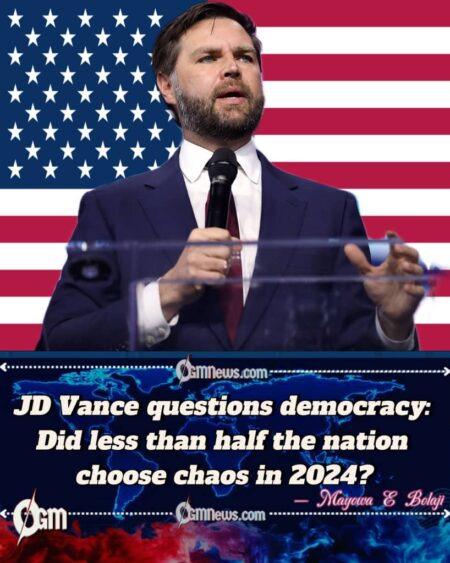
Vice President JD Vance has ignited a wave of controversy after questioning why Americans have collectively tolerated “crazy people yelling at our kids.” His remark, made during a public appearance, struck a chord with both critics and supporters, many of whom interpreted it as a broader commentary on cultural polarization in the United States.
Vice President JD Vance’s words revived longstanding debates about free speech, public conduct, and the role of elected leaders in shaping national discourse. His framing, however, has been criticized for being dismissive and inflammatory at a time when the country continues to grapple with social and political divisions.
A Remark That Resonated and Backfired
Vice President JD Vance’s language appeared designed to provoke, tapping into voter frustration over what some perceive as an erosion of civility in public spaces. Yet the phrasing also risked alienating Americans who feel targeted by such rhetoric, particularly activists, parents, and community organizers.
Vice President JD Vance’s choice of words underscores the fine line public figures walk when attempting to express populist frustrations while balancing inclusivity. Instead of uniting audiences around shared concerns for children’s well-being, the comment fractured opinions across the political spectrum.
Less Than Half the Nation Voted in 2024 — A Stark Reminder
Vice President JD Vance’s remarks have also drawn renewed attention to voter participation in the 2024 presidential election, in which less than half of eligible Americans cast ballots. Critics argue that this low turnout has left the nation divided under leadership chosen by a minority of the electorate.
Vice President JD Vance has thus inadvertently highlighted a deeper democratic crisis — one where disillusionment and apathy have allowed strong rhetoric, rather than broad consensus, to dominate the political stage.
Framing the Debate Around Children and Values
Vice President JD Vance placed children at the center of the argument, adding another layer of sensitivity to the issue. By tying the debate to young Americans, he tapped into a universal emotional concern but also sharpened the cultural wedge.
Vice President JD Vance’s framing won applause from some parents, who said it reflected their own worries about aggressive activism in schools and public spaces. Others, however, denounced his rhetoric as manipulative, arguing that children are being used as shields in broader ideological battles.
The Role of Leadership in Shaping Rhetoric
Vice President JD Vance’s words have reignited debate about the responsibility of leadership in shaping the nation’s rhetoric. When elected officials use charged terms such as “crazy people,” it not only signals division but also legitimizes harsher exchanges in public life.
Vice President JD Vance’s rhetorical style has been described as part of a wider political trend, where sharp soundbites and confrontational language often overshadow nuanced dialogue. Critics say his statement epitomizes this shift and risks normalizing disrespectful discourse.
Supporters Defend Vance’s Message
Vice President JD Vance’s allies insist that his comments are grounded in legitimate concerns about public order and cultural integrity. They argue that his words reflect the frustration of ordinary Americans who feel their values are under siege in a rapidly shifting society.
Vice President JD Vance, according to his supporters, has been unfairly targeted for criticism, with opponents focusing on tone rather than substance. They maintain that his bluntness appeals to citizens who appreciate directness in politics.
Opponents Warn Against Dangerous Precedent
Vice President JD Vance’s opponents caution that his words risk emboldening hostility toward activists, minority groups, and individuals with unconventional beliefs. They argue that exclusionary language undermines the democratic principle that all voices — even unpopular ones — deserve to be heard.
Vice President JD Vance’s remarks, legal experts warn, blur the line between criticism and stigmatization. By fostering an environment where marginalized groups face heightened vulnerability, they argue his rhetoric could have a chilling effect on civic participation.
What This Moment Reveals About America’s Future
Vice President JD Vance’s controversy reflects a nation caught between competing visions of its cultural and political identity. For some, his bluntness embodies a rejection of political correctness; for others, it symbolizes a dangerous descent into divisive populism.
Vice President JD Vance’s words now stand as a stark reminder of the larger question: how will America reconcile its democratic ideals with the abrasive rhetoric increasingly defining public life? The answer may determine not only the tone of future political debates but also the health of the republic itself.
[…] […]