

























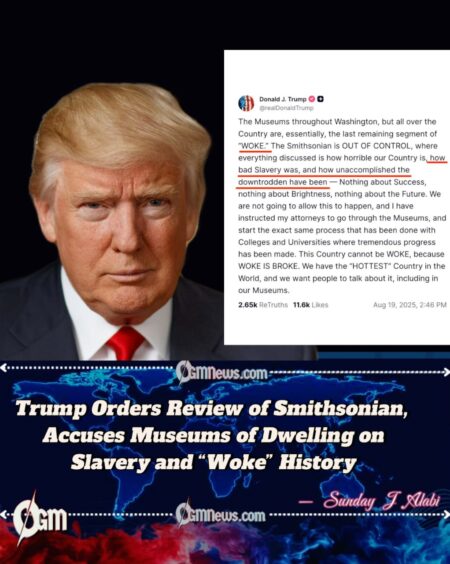
President Donald Trump has launched a fresh attack on Washington’s cultural institutions, accusing the Smithsonian of being “OUT OF CONTROL” and overly focused on America’s faults—particularly slavery. In a post on his Truth Social platform on August 19, Trump said the museums highlight “how horrible our Country is, how bad Slavery was, and how unaccomplished the downtrodden have been—Nothing about Success, nothing about Brightness, nothing about the Future.”
Trump described Smithsonian exhibits as the “last remaining segment of ‘WOKE’” and vowed, “We are not going to allow this to happen.” He revealed that he has instructed his attorneys to conduct a review of the institution’s operations and displays, echoing the administration’s broader push to reshape how American history is taught and presented.
Trump’s Executive Order and Policy Context
The president’s remarks align with his March 27 executive order, Restoring Truth and Sanity to American History, which directs federally funded museums to eliminate what he calls “divisive narratives” and emphasize themes of unity and exceptionalism. The order also permits federal agencies to withhold funds from institutions deemed noncompliant.
This mandate builds on earlier initiatives targeting U.S. colleges and universities. Earlier this year, Harvard University lost federal support after rejecting Trump’s demand to eliminate diversity, equity, and inclusion programs. Analysts warn that a similar approach may soon be taken against the Smithsonian, which relies on government appropriations for much of its funding.
Congressional and Public Reactions
Trump’s threat to reshape the Smithsonian drew swift backlash on Capitol Hill. Congresswoman Sydney Kamlager-Dove of California, the Congressional Black Caucus Whip, condemned the president’s comments, writing on social media: “Slavery WAS bad, Donald. It’s absurd that this even needs to be said. We don’t whitewash history—we learn from it.” She pledged that the Black Caucus would resist efforts to rewrite the historical record.
Historians and civil rights advocates have also raised alarms, warning that minimizing slavery’s role in American history risks distorting the past. Critics argue that acknowledging the country’s darkest chapters is essential to understanding present-day inequities and ensuring progress toward justice.
The Smithsonian Under Pressure
The Smithsonian Institution, which oversees 21 museums and cultural centers, has long prided itself on preserving both the achievements and struggles of the American story. From the National Museum of African American History and Culture to the American History Museum’s “A Glorious Burden” exhibit on the presidency, slavery and systemic racism are central themes in many of its displays.
But according to insiders, the White House’s pressure is already being felt. Last month, curators were reportedly instructed to erase references to Trump’s two impeachments from an exhibit on the presidency. Staff members, speaking on background, described the intervention as unprecedented and deeply concerning.
What Comes Next?
Trump’s directive sets the stage for a potential standoff between the executive branch and the Smithsonian, an institution that traditionally enjoys curatorial independence. Legal scholars note that while the federal government provides funding, attempts to directly control exhibition content could face constitutional challenges on grounds of free speech and academic freedom.
For now, museum officials have remained publicly silent, but behind the scenes, staff are preparing for intensified scrutiny. If the president follows through with his threat to cut off funding, the future of several Smithsonian programs—and possibly entire museums—could be at risk. The controversy also raises broader questions about how America chooses to tell its own story at a time of deep political division.
[…] […]