





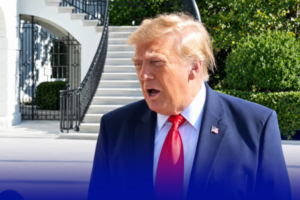

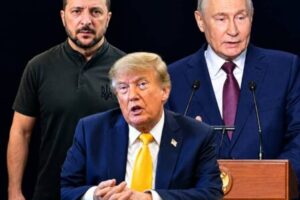





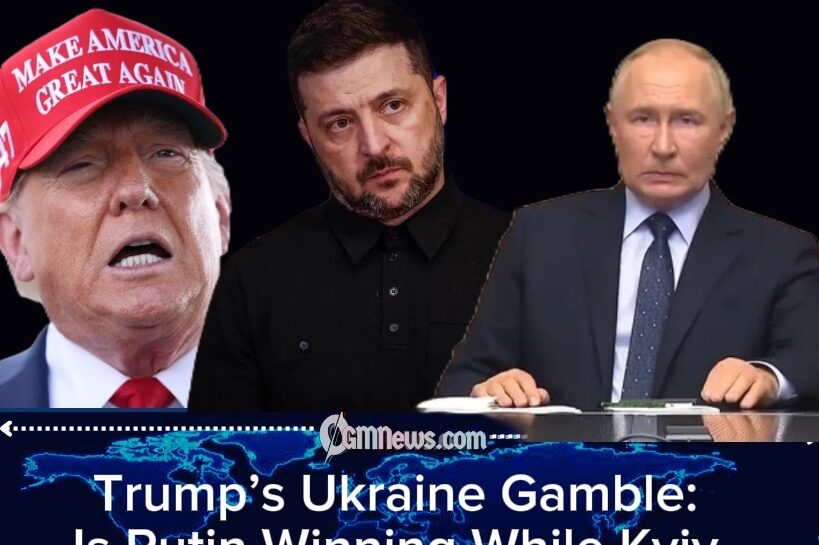






President Donald Trump has called Russian leader Vladimir Putin to propose a meeting with Ukrainian President Volodymyr Zelensky, following intensive White House talks aimed at charting a path toward peace in Ukraine. The call came after Trump hosted Zelensky and several European leaders in Washington, where discussions centered on a potential U.S.-coordinated “security guarantee” for Ukraine.
Zelensky described his meeting with Trump as the “best” discussions so far in efforts to end the war, while the U.S. president hailed them as “very good.” Trump’s outreach to Putin underscores a new phase of diplomacy, with Washington seeking to directly broker talks between Kyiv and Moscow.
White House Talks Mark Turning Point in Ukraine Peace Efforts
At the White House on Monday, President Trump met with Zelensky, UK Prime Minister Keir Starmer, German Chancellor Friedrich Merz, and Polish Prime Minister Donald Tusk to deliberate on how to halt the war. According to Trump, the discussions focused heavily on security guarantees for Ukraine that could involve both the United States and European allies.
Zelensky, visibly upbeat after the talks, called them the “best so far,” signaling Kyiv’s optimism about a breakthrough. Trump echoed that sentiment, describing the exchanges as “very good” and suggesting that Washington and Europe were moving closer to a unified position on Ukraine’s future security.
Trump’s Call with Putin: Next Steps in Negotiations
Shortly after the White House discussions, Trump held a 40-minute phone call with Putin. Kremlin aide Yuri Ushakov confirmed the talks, noting that both leaders explored the possibility of raising the level of direct negotiations between Ukrainian and Russian delegations.
The Kremlin described the exchange as “frank and highly constructive,” with Putin and Trump considering a face-to-face meeting between Zelensky and Putin. French President Emmanuel Macron has already suggested Geneva as a potential neutral venue for such high-level talks.
Defining a “Security Guarantee” for Ukraine
One of the central outcomes of the Washington talks was Trump’s indication that the United States could help coordinate security guarantees for Ukraine once hostilities end. He suggested Europe could take the lead, with U.S. backing, to provide assurances against future Russian aggression.
However, the details remain uncertain. Security analysts note that guarantees could range from intelligence-sharing to troop deployments. Trump’s envoy, Steve Witkoff, claimed Russia had shown openness to arrangements similar to NATO’s Article 5, but Trump clarified that such a proposal had not been discussed in Washington. Zelensky has said guarantees could be finalized within 10 days, alongside a planned $90 billion weapons package from the United States.
Fresh Russian Attacks Underscore Urgency
Despite the diplomatic push in Washington, Russia launched one of its largest overnight assaults on Ukraine in months, with 270 drones and multiple missiles striking infrastructure. Ukraine’s foreign minister, Andrii Sybiha, said the attacks highlighted the “critical” need to end the war and secure binding security assurances.
The country’s energy minister reported widespread fires in the Poltava region after drones targeted a gas transportation system. The strikes left several civilians injured and caused extensive damage to energy facilities, demonstrating the continued toll of the war even as negotiations intensify.
European Leaders to Convene “Coalition of the Willing”
In parallel with Trump’s outreach to Putin, UK Prime Minister Keir Starmer will chair a virtual meeting of the “coalition of the willing” on Tuesday. The group—comprising the UK, Germany, France, and Poland—will review the Washington talks and discuss a framework for Ukraine’s future security.
German Chancellor Friedrich Merz confirmed that security guarantees would be on the agenda, while Polish Prime Minister Donald Tusk is expected to press for robust military commitments. Russia’s former president Dmitry Medvedev dismissed the coalition as “anti-Russian warmongering,” insisting it failed to outmaneuver Trump on U.S. soil.
Outlook: Fragile Hope Amid Escalation
Trump’s attempt to bring Putin and Zelensky together marks one of the boldest diplomatic interventions of his second term, but questions remain about the feasibility of a lasting peace. Ukraine’s insistence on strong security guarantees and Russia’s continued bombardment underline the fragile balance between hope and escalation.
With European leaders preparing to formalize commitments and Washington signaling willingness to coordinate a broader framework, the coming weeks may prove decisive. Whether Trump’s mediation can bridge entrenched divides—or whether Moscow’s strikes will harden positions—remains to be seen.

https://webtoolsreview.substack.com/p/why-screenshots-arent-the-best-way