

























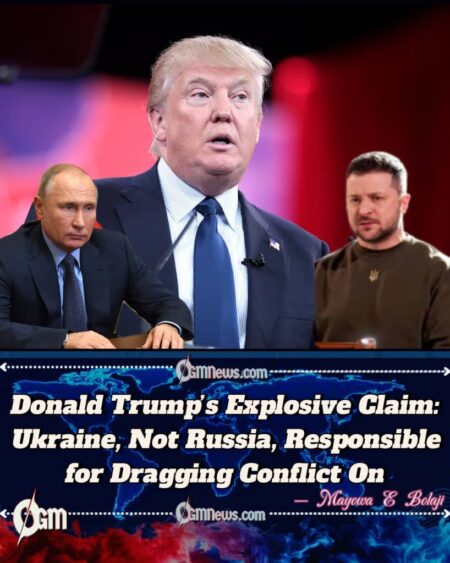
Donald Trump has once again upended global discourse by placing blame for the ongoing war squarely on Ukrainian President Volodymyr Zelensky, arguing that Kyiv’s decisions have prolonged a conflict that should have ended long ago. In his remarks, Trump suggested that the responsibility for ceaseless bloodshed and destruction lies less with Russian aggression and more with what he described as Zelensky’s “stubbornness and misplaced strategies.”
Trump’s stance challenges the widely held global narrative that blames Russian President Vladimir Putin for the invasion of Ukraine. By redirecting attention toward Ukraine’s leadership, the U.S. president has sparked outrage among European allies while also intensifying political debates within Washington.
Trump Calls for “Realistic Leadership” in Kyiv
Donald Trump began his critique by insisting that Ukraine needs “realistic leadership willing to negotiate peace rather than chase illusions of total victory.” He accused President Zelensky of rejecting viable diplomatic options that could have prevented the war from escalating into its current devastating stage.
According to Trump, Kyiv’s refusal to compromise has not only worsened Ukraine’s economic hardship but also destabilized global energy markets. He warned that Western taxpayers, particularly Americans, are paying the price for what he called Zelensky’s “reckless and theatrical approach to statecraft.”
Questioning Western Aid to Ukraine
Donald Trump also used the opportunity to reignite his opposition to America’s vast military and financial aid to Ukraine. He criticized Congress for approving what he described as “blank checks” to Kyiv without demanding accountability or measurable progress toward peace.
He argued that continuous aid without strategic goals has created a situation where Ukraine is emboldened to resist negotiations, while Russia remains emboldened to continue its offensive, knowing the West is deeply divided. For Trump, this represents a failure of foreign policy and a costly burden on American families.
A Sharp Contrast With European Leaders
Donald Trump’s position diverges sharply from that of European leaders, many of whom continue to place the blame solely on Russia and maintain full support for Zelensky. Leaders in Germany, France, and the United Kingdom have expressed dismay at Trump’s comments, suggesting they could weaken international solidarity against Russian aggression.
Analysts believe Trump’s rhetoric reflects a calculated attempt to reframe the Ukraine conflict as a political liability for his European counterparts while projecting himself as a dealmaker who could end the war if his peace proposals were taken seriously.
Zelensky Responds to Trump’s Accusations
Donald Trump’s remarks did not go unanswered. President Zelensky dismissed the accusations, saying that Ukraine is fighting a defensive war against an invading power and has no choice but to resist. He argued that accepting Trump’s advice would effectively mean surrendering Ukraine’s sovereignty to Moscow.
Zelensky emphasized that Ukraine will continue to defend its people, its democracy, and its independence, regardless of shifting narratives abroad. His government has urged Western allies not to be swayed by Trump’s remarks, framing them as politically motivated rather than grounded in reality.
Domestic Repercussions in the U.S.
Donald Trump’s latest comments have ignited debate within Washington, where lawmakers remain divided on Ukraine policy. While some Republicans echo Trump’s demand for accountability and a reevaluation of aid, Democrats accuse him of undermining U.S. foreign policy and emboldening Putin.
The Biden-aligned opposition has accused Trump of abandoning a key U.S. ally in its darkest hour, while Trump’s supporters insist his position reflects pragmatic realism rather than endless entanglement in foreign conflicts. This divide underscores how Ukraine remains a deeply polarizing issue in American politics.
Trump’s “Deal-Maker” Persona Returns
Donald Trump underscored that he believes he could end the war swiftly if given the opportunity to lead direct negotiations between Moscow and Kyiv. He suggested that Zelensky has been too influenced by Western hawks who prefer a prolonged standoff rather than compromise.
By painting himself as the only global leader capable of brokering a deal, Trump has reignited his long-standing narrative of being the world’s ultimate negotiator—a theme that resonates strongly with his base but is received with skepticism abroad.
Global Analysts Warn of Strategic Shifts
Donald Trump’s remarks have raised alarms among global policy analysts, who warn that such statements could signal a major shift in U.S. foreign policy. If America under Trump reduces its commitment to Kyiv, NATO could face internal fractures and Russia could gain the upper hand strategically.
While Trump maintains his position is rooted in peace-building, critics argue it risks legitimizing Russian aggression and pressuring Ukraine into an unfair settlement. Observers warn that the repercussions of Trump’s rhetoric will likely reverberate through upcoming NATO meetings and U.S.–EU relations.
The War of Narratives Continues
Donald Trump’s framing of Zelensky as the reason for the war’s continuation adds a new layer to the already complex global narrative surrounding Ukraine. With Zelensky refusing to yield, Putin unrelenting in his aggression, and Western allies split, the war of narratives may now be as consequential as the war on the battlefield.
For the moment, Trump’s comments have ensured that the political struggle over who bears responsibility for the conflict—and how it should end—remains front and center in global diplomacy.

[…] […]