
























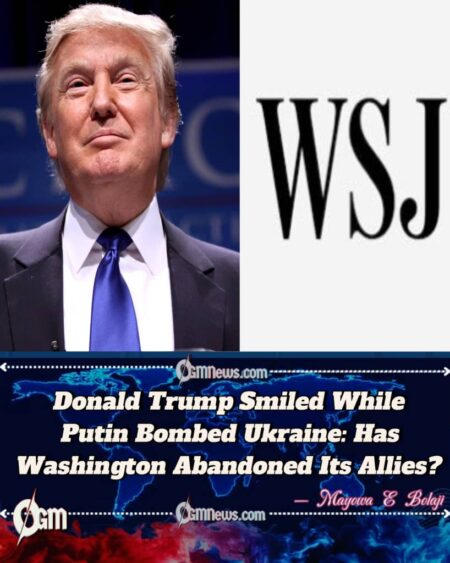
Donald Trump has come under fierce criticism from the conservative Wall Street Journal Editorial Board after his recent summit with Russian President Vladimir Putin. In an unusually harsh assessment, the Journal argued that Trump failed to secure any concessions while granting Putin the legitimacy he craved on the international stage.
Trump, according to the editorial, walked away from the talks with little to show for his efforts, while Putin successfully ended his isolation from the West. The piece declared that the U.S. president had been “played like a fiddle,” a phrase that has quickly dominated political debate in Washington.
Donald Trump Praised by Putin but Offered No Tangible Gains
Donald Trump listened as Putin showered him with flattering remarks, including agreement with Trump’s claim that the Ukraine war would not have erupted if he had been in power in 2022. The Russian leader also spoke of expanding U.S.-Russia business ties, appealing to Trump’s instincts as a dealmaker.
Trump, however, appeared to receive little beyond praise. Putin gave up nothing in return, securing international legitimacy while continuing to bombard Ukrainian cities and press forward with his territorial ambitions.
Donald Trump Leaves Summit Without Cease-Fire or Concessions
Donald Trump had publicly vowed that he would be “angry” if the meeting with Putin failed to produce a cease-fire. Yet when no such agreement emerged, he showed no visible frustration, leaving many to question whether he had lowered expectations or prioritized optics over outcomes.
Trump thus found himself facing difficult questions back home: What did the United States gain from the talks? The Wall Street Journal concluded bluntly—nothing.
Donald Trump Alarms U.S. Allies in Europe
Donald Trump’s approach to the summit has unsettled allies across Europe, particularly in Eastern capitals already wary of Russia’s military aggression. Officials in Kyiv, Warsaw, and Vilnius warned that the meeting undermined years of coordinated Western pressure against Moscow.
Trump, by welcoming Putin back into the fold without conditions, effectively provided the Russian leader with diplomatic rehabilitation. European leaders fear that this move could fracture NATO’s unified stance and embolden Moscow’s next steps in Ukraine.
Donald Trump Sparks Political Shockwaves at Home
Donald Trump’s performance at the summit has triggered fresh divisions in Washington. While many Republicans remain loyal, the Wall Street Journal’s critique carries weight as one of the most influential conservative voices. Democrats have seized on the editorial as evidence that Trump prioritizes image over substance in foreign affairs.
Trump may now face growing unease within his own party. Several GOP lawmakers worry that his willingness to grant Putin symbolic victories without extracting concessions risks both American credibility and national security interests.
Donald Trump Entertains Business Over Geopolitics
Donald Trump appeared receptive to Putin’s emphasis on expanding business ties between the two nations, echoing his belief that economic cooperation can strengthen diplomacy. This framing, however, has sparked criticism that he is sidelining the human cost of Russia’s invasion in favor of potential corporate gains.
Trump, the Journal noted, cannot justify allowing Russia to continue its assault on Ukrainian cities while dangling vague promises of trade. Critics warn that putting business above geopolitical security could have devastating consequences for U.S. alliances.
Donald Trump Confronted by Conservative Self-Criticism
Trump rarely faces such stinging rebukes from within conservative media, making the Journal’s editorial especially significant. The paper accused him of indulging Putin rather than negotiating with strength, warning that his performance marked a dangerous precedent.
Trump, according to the editorial, gave Putin everything he sought: legitimacy, time, and an open stage. By contrast, the U.S. president left with no concrete gains to show the American public.
Trump Leaves Unanswered Questions for Future U.S.-Russia Relations
Trump’s summit has left the future of U.S.-Russia relations clouded with uncertainty. Will he seek another meeting with Putin? Can Washington rebuild NATO confidence after what many see as a diplomatic concession? And will Russia accelerate its offensive in Ukraine now that Putin has secured a symbolic victory?
Trump may have unwittingly shifted the balance of power. Analysts warn that by enabling Putin’s rehabilitation without cost, the president has tilted the playing field in Moscow’s favor, setting the stage for further challenges ahead.
[…] […]