

























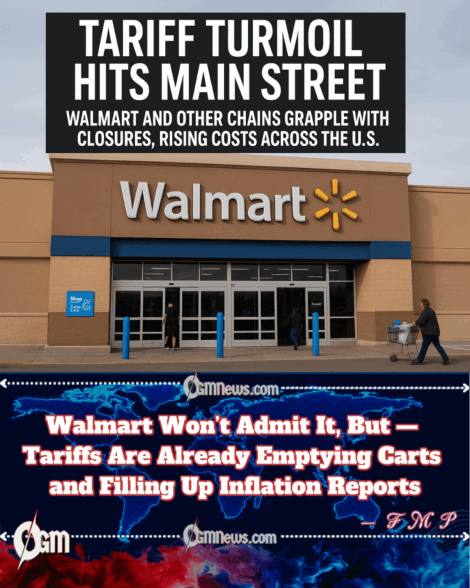
Tariff Turmoil Hits Main Street — OGMNews.COM | There is clear, well-documented evidence that the 2025 tariff actions enacted under President Donald Trump disrupted imports, raised costs for major U.S. retailers, and forced firms to alter sourcing, pricing and logistics plans. That disruption is visible in port and container data, company statements and early inflation readings. However, the most sensational social-video claims — that Walmart “shut its doors across the U.S.” en masse because of tariffs — are not supported by credible mainstream reporting or company statements; local closures and routine rationalizations occurred, but they are not the same thing as a coordinated, tariff-driven nationwide shutdown. ReutersX (formerly Twitter)
Key empirical datapoints (May → Aug 2025): what the numbers show
Tariff Turmoil Hits Main Street — OGMNews.COM | Through June and into August 2025, multiple data series and trade-industry reports document a meaningful slowdown in inbound cargo and shifts in shipment patterns. U.S. ports handled roughly 1.96 million twenty-foot equivalent units (TEUs) in June — an 8.4% year-over-year drop — a decline trade groups and analysts linked in part to tariff uncertainty and changing importer behaviour. Those drops were large enough to prompt updated forecasts that project weaker cargo flows for the remainder of 2025. Reuters
Complementary trade-data analyses show a large fall in China-origin container volumes for the same period, consistent with importers pulling forward or postponing shipments while they reassess tariff exposure and logistics costs. By late July, tariff turmoil hits main street as price data began reflecting some pass-through of higher import costs into retail prices: core inflation measures showed upticks that economists and journalists tied in part to the tariff shock. Those data points form the backbone of the empirical case that tariffs have real, measurable effect on flows and prices. ReutersAP News
Tariff Turmoil Hits Main Street — OGMNews.COM | What major retailers said publicly — warnings, guidance cuts, and responses
As tariff turmoil hits main street throughout May and June, major retail executives and trade groups publicly warned the White House and investors that sweeping tariffs would push up costs and strain supply chains. Walmart, Target, Home Depot, TJX and others flagged tariff exposure in earnings commentary, investor calls and press statements — some went further and revised guidance or described sourcing experiments (for example, more direct factory sourcing or alternative-country sourcing) to blunt tariff impact. These are on-record acknowledgements that the tariff program changed corporate planning. ReutersAP News
Tariff Turmoil Hits Main Street — OGMNews.COM |That said, corporate responses varied. Walmart publicly warned it might raise prices to manage tariff costs while maintaining broader operational plans; Target explicitly trimmed guidance and described supply-chain shifts. Many firms emphasized mitigation — absorbing costs where possible, changing SKUs, shifting suppliers — rather than mass store closures as the primary response. Those mitigation steps, however, still translate into higher prices or reduced assortment for consumers. ReutersAP News
Why the “Walmart shut its doors across the U.S.” story is exaggerated
Tariff Turmoil Hits Main Street — OGMNews.COM | A wave of viral videos and tabloid pieces in mid-2025 used dramatic footage and alarming headlines to assert that Walmart had shut stores nationwide because of the tariffs. Journalistic and company fact-checks show this narrative does not hold up: Walmart denied claims of a coordinated, tariff-driven national shutdown and flagged circulating lists of closures as inaccurate or out of date. Independent reporters who traced viral clips found many were repurposed local footage, footage of unrelated planned closures from earlier rounds, or clips lacking a verifiable time-and-place connection to the tariff story. X (formerly Twitter)The Times of India
That distinction matters: real local closures and normal commercial rationalizations (lease exits, underperforming stores, pre-planned conversions) are not equivalent to an industry-wide operational collapse stemming directly from one government policy. Sensational social posts mixed legitimate evidence with recycled or unrelated material, creating an outsized impression that mainstream outlets and primary company statements do not support. X (formerly Twitter)
Tariff Turmoil Hits Main Street — OGMNews.COM | Timeline of key events and public moments (May → Aug 2025)
Tariff Turmoil Hits Main Street — OGMNews.COM | Mid-May: Major retailers, including Walmart, publicly warned that tariffs would push prices higher and that companies were reassessing sourcing strategies; the comments sparked public reactions from the White House and TV news segments. By late May and June, CEOs and trade bodies (NRF) met with Administration officials and publicly warned about empty-shelf risk and rising costs. Those meetings were widely reported and recorded in mainstream outlets. Reuters+1
June → July: Trade-data firms and analysts reported steep drops in China-origin TEUs and other container flows; retailers began announcing mitigation steps (sourcing re-routes, logistics changes, selective SKU cuts). By late July, Reuters and other outlets published analyses tying tariff policy to first-round cost pass-through into prices, while inflation readings started to show modest tariff-related effects. August: additional tariff announcements and continued policy uncertainty kept business planning under strain and raised the risk of deeper price impacts into the holiday season. ReutersAP News
Video evidence: credible clips versus viral noise
Tariff Turmoil Hits Main Street — OGMNews.COM | There is credible mainstream video evidence documenting corporate statements and White House exchanges about tariffs — short segments from PBS, ABC and Reuters capture on-the-record comments by retailers and Administration spokespeople describing the same tensions noted above. Those clips are useful primary materials for understanding what firms actually said in real time. (If desired, these provide direct timestamps for investor calls and news segments.) Reuters+1
By contrast, a large volume of social-video claims alleging mass Walmart shutdowns lack verifiable sourcing. Many reposts aggregate older footage or local stories and present them as contemporaneous national events. Responsible verification requires linking footage to a named store, local official confirmation and a contemporaneous company statement — steps most viral claims fail to meet. Journalistic checks have flagged several widely shared clips as misleading. X (formerly Twitter)
Assessment and political critique: policy, accountability, and the foreseeable costs
Tariff Turmoil Hits Main Street — OGMNews.COM | The evidence supports a stark policy conclusion: the tariff program implemented by President Trump in 2025 has real economic consequences. Container flows declined, firms signalled—publicly and privately—that tariffs raise costs, and early price statistics indicate the beginning of tariff pass-through into consumer prices. These are not mere coincidences; they are predictable outcomes of raising import taxes on a large set of goods without immediate compensating measures to shield consumers or streamline alternative sourcing. ReutersAP News
Politically, the Administration’s posture — alternating between urging retailers to “eat the tariffs” and defending tariffs as a long-term industrial strategy — raises questions about accountability and planning. If tariffs are intended to re-industrialize supply chains, the transition strategy must include clear mitigations for short-term harm to consumers and small businesses. The available record for May–August 2025 shows insufficient buffering: retailers are scrambling to adjust, some consumers face higher prices, and misinformation has flourished in the gap between firm statements and political rhetoric. That combination of real economic pain and avoidable confusion is a fair and necessary critique of current policy execution. Reuters+1
What to watch next — verified steps a journalist or policymaker should take
Tariff Turmoil Hits Main Street — OGMNews.COM | For reporters: compile and publish a retailer-by-retailer spreadsheet listing dates of company statements, concrete actions (price changes, guidance revisions, announced store openings/closures) and source links; cross-check viral videos against local news and company press releases before publishing dramatic claims. I can assemble that spreadsheet and pull verbatim video timestamps on request. ReutersX (formerly Twitter)
For policymakers: require transparent cost estimates and a phased implementation plan for tariffs that includes consumer relief measures (targeted tax credits, rebates, or transitional support for supply-chain shifts) and clear lines of accountability for how the Administration will measure and mitigate domestic price impacts. Without such measures, the political aim of reshoring risks an avoidable economic sting for ordinary households. The evidence through August 2025 makes that warning plainly. ReutersAP News


[…] […]