






















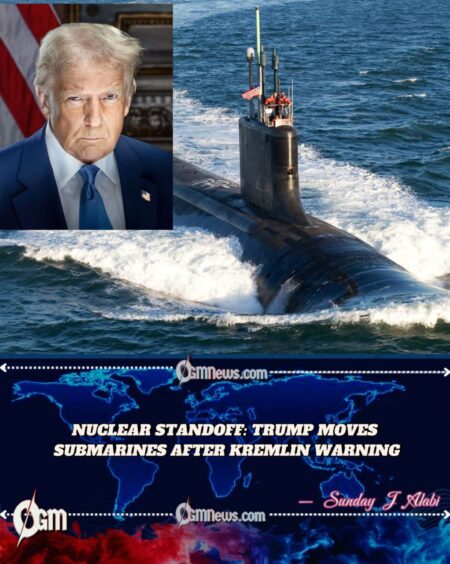
President Donald Trump has directed the deployment of two U.S. nuclear submarines to undisclosed “appropriate regions” following incendiary remarks by Dmitry Medvedev, the former Russian president and current Deputy Chairman of the Russian Security Council. The decision marks a sharp escalation in rhetoric and readiness between Washington and Moscow.
“Based on the highly provocative statements of the Former President of Russia… I have ordered two Nuclear Submarines to be positioned in the appropriate regions,” Trump posted on Truth Social Friday morning. Without revealing exact locations, the president emphasized the move was precautionary, meant to deter any miscalculation amid worsening rhetoric from the Kremlin’s inner circle.
Medvedev’s Remarks Ignite Strategic Concerns
Medvedev’s comments—shared via his official Telegram channel—warned of the potential use of Russia’s “Dead Hand” system, a Cold War-era nuclear retaliatory mechanism. The threat came in response to Trump’s ultimatum to the Kremlin: accept a ceasefire in Ukraine within ten days or face expanded U.S. sanctions.
“Trump’s playing the ultimatum game with Russia… Each new ultimatum is a threat and a step towards war,” Medvedev wrote, accusing Trump of bringing the world closer to direct U.S.-Russia conflict. In another message, he compared Trump’s strategy to that of President Biden, mocking both with his “Sleepy Joe” jab.
Trump: “We’re Gonna Protect Our People”
Speaking to reporters Friday afternoon, President Trump reaffirmed the seriousness of the threat and defended the military action. “Well, we had to do that,” Trump said. “We just have to be careful. A threat was made and we didn’t think it was appropriate.” He underscored that the U.S. would not hesitate to act in defense of its people.
The president’s response has raised eyebrows among diplomats and analysts alike, many of whom interpret the move as a calculated show of strength intended to remind Moscow of America’s nuclear capabilities amid escalating diplomatic standoffs.
Ultimatums and Ceasefire Pressure
Earlier this week, Trump had announced a ten-day window for Russia to accept a ceasefire in Ukraine, a tightening of a previously extended 50-day proposal. The revised deadline drew immediate condemnation from Medvedev and other Russian officials, who view the ultimatum as a direct challenge to Moscow’s sovereignty and military strategy.
The White House has declined to comment on the submarine deployments or clarify the details of the ceasefire proposal. However, sources familiar with the administration’s thinking suggest that Trump sees aggressive deadlines as necessary leverage to force diplomatic movement on the battlefield.
Nuclear Messaging and the Danger of Words
Trump, while forceful, acknowledged the gravity of escalating language. “Words are very important, and can often lead to unintended consequences,” he wrote. “I hope this will not be one of those instances.” His remarks highlight the razor’s edge both superpowers walk as mutual threats become more frequent in public exchanges.
National security experts warn that nuclear posturing, especially in response to ambiguous rhetoric, risks misunderstandings that could spiral out of control. “The Dead Hand reference was chilling,” said a former Pentagon advisor. “It’s a message meant to spook the U.S., but responding with submarines ups the ante in a dangerous way.”
Global Reactions and Strategic Silence
So far, U.S. allies have been cautious in reacting. NATO has not issued an official statement, though defense ministers are reportedly in communication. China, which maintains strategic ties with both the U.S. and Russia, has remained notably silent, likely monitoring for further escalations before positioning itself diplomatically.
Within the U.S., lawmakers remain divided. Some Republicans praised Trump’s decisiveness, while critics expressed concern over the lack of transparency and potential for miscommunication. “This is no time for vague threats or impulsive escalations,” said one senior Democratic senator. “The world is watching.”
A Tense Chapter in U.S.-Russia Relations
This latest standoff marks one of the most acute flashpoints in U.S.-Russia relations since the Cold War. With the Ukraine conflict dragging on and diplomatic channels narrowing, the potential for miscalculation looms large. Trump’s submarine directive signals a readiness to escalate further, even as he insists he prefers peace.
Whether Medvedev’s rhetoric was bluster or a signal of Moscow’s true intentions remains unclear. But for now, America’s most powerful undersea weapons are quietly on the move—watching, waiting, and sending a message beneath the surface.
[…] […]