




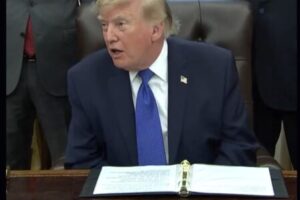
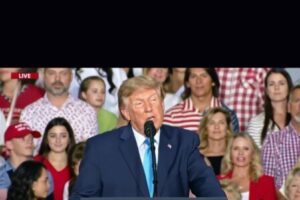
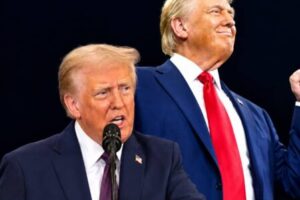















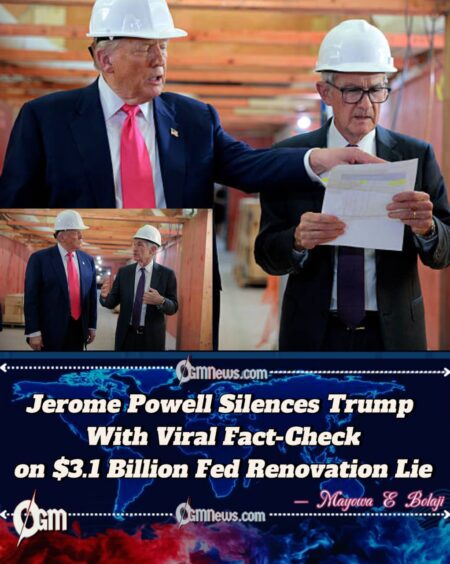
Jerome Powell began the interaction with grace: “It was an honor to host him,” he said, referencing President Trump’s rare stop at the Federal Reserve. In a move that surprised even long-time Fed watchers, the president’s visit came amid mounting tensions over monetary policy, inflation control, and Trump’s increasingly personal attacks on Powell’s leadership.
Powell continued, “It’s not something that happens very often at the Federal Reserve to have a president come over.” The tone was measured, even welcoming, despite the subtext of political pressure. Trump, dissatisfied with the Fed’s resistance to lowering interest rates, may have hoped for a confrontation. Instead, he was met with Powell’s signature professionalism.
“Our focus is the work, not the noise,” Powell emphasizes, refusing to take Trump’s bait
Jerome Powell reiterated his discipline: “Our focus is the work, not the noise.” In response to questions about whether Trump’s sudden attention to building renovations was a proxy for monetary frustration, Powell declined to speculate. His message was clear—he would not be baited.
Powell expanded, “I was quite pleased to have the President say multiple times that what he really wanted to see was us getting this construction completed as soon as possible.” With this response, Powell not only defused the president’s criticisms but also signaled that the Fed’s mandate remains economic stability—not political theater.
“I’m not aware of that,” Powell tells Trump, fact-checking him to his face in viral exchange
Jerome Powell didn’t flinch: “I’m not aware of that,” he responded bluntly when President Trump claimed that renovation costs had ballooned to $3.1 billion. The moment was caught on video and rapidly circulated online, as Powell dismantled the claim piece by piece.
Powell continued, “You’re including the Martin renovation. You just added in a third building… It’s not new.” With quiet authority, he highlighted Trump’s factual error, correcting a president who attempted to invent a narrative to justify potential action against Powell. It was a stunning and decisive moment of public accountability.
“We’ll do what we need to do,” Powell declares, standing firm on interest rate policy
Jerome Powell didn’t mince words: “We’ll do what we need to do to keep inflation under control.” As Trump presses for interest rate cuts to buoy his economic agenda, Powell has remained resolute. The Fed recently voted to keep rates unchanged, citing data rather than politics.
Powell reaffirmed the Fed’s independence: “The decisions we make are based on what’s best for the economy, not on political considerations.” This stance stands in direct contrast to Trump’s transactional approach to monetary policy and further isolates Powell as a guardian of institutional norms.
“Tariffs are showing up in the data,” Powell confirms, subtly rebuking Trump’s trade war
Jerome Powell offered a subtle rebuke: “Higher tariffs have begun to show through more clearly into prices of some goods.” Though he didn’t name Trump directly, the implication was unmistakable. The president’s trade wars are now materially affecting economic forecasts.
Powell clarified, “Their effects on inflation could prove to be short-lived, but it is possible the inflation effects could be more persistent.” That ambiguity is exactly why Powell refuses to cut rates prematurely, knowing that external shocks—many of them political—can distort the Fed’s long-term objectives.
“We answer to the American people—not to power,” Jerome Powell implies as Trump drafts firing letter
Jerome Powell’s posture suggests defiance without drama: “We answer to the American people—not to power.” Behind closed doors, reports confirm that Trump has floated a draft letter seeking Powell’s removal, using the renovation budget as a pretext. The move comes despite a Supreme Court ruling limiting presidential authority to dismiss a Fed chair without cause.
Powell remains undeterred: “Our mandate is clear, and I intend to fulfill it,” he reportedly told close associates. For now, Trump’s plan remains speculative—but the threat of political retaliation continues to hover over the Fed’s independence.
“I’m here to ensure stability,” Powell says, emerging as a pillar of calm amid presidential chaos
Jerome Powell reaffirmed his role: “I’m here to ensure stability.” As Trump’s chaotic style of leadership tests the boundaries of every institution, Powell’s consistency stands in stark contrast. His refusal to respond emotionally or politically is a deliberate strategy to preserve the Fed’s credibility.
Powell elaborated, “In moments like this, the best thing we can do is stay grounded in our mission.” His measured presence continues to win bipartisan praise—even from those who disagree with his policies—because it represents a bulwark against authoritarian overreach.
“Facts matter. Institutions matter,” Powell affirms, as public opinion rallies behind him
Jerome Powell drew a line in the sand: “Facts matter. Institutions matter.” Following the viral moment with Trump, Powell’s approval soared in economic and political circles. Social media lit up with support, hailing him as a rare figure who stands up to misinformation with grace and precision.
Jerome Powell’s restraint has not gone unnoticed: “The central bank should not be a political tool,” he said in an earlier testimony. That message continues to resonate across party lines, even as Trump works to undermine it for short-term gain.
“We build trust by not playing politics,” Powell concludes, sealing his legacy in leadership
Jerome Powell closed the episode with a forward-looking statement: “We build trust by not playing politics.” As the Fed continues its renovation—both physically and symbolically—Powell’s leadership represents a restoration of institutional norms under siege.
Jerome Powell’s handling of Trump’s visit may one day be remembered not just as a viral moment, but as a turning point: “At the end of the day, our work will speak louder than any headline,” he said. In a second Trump term filled with uncertainty, Powell’s cool-headed defiance may be what prevents the U.S. economy from veering off course.
[…] […]