

























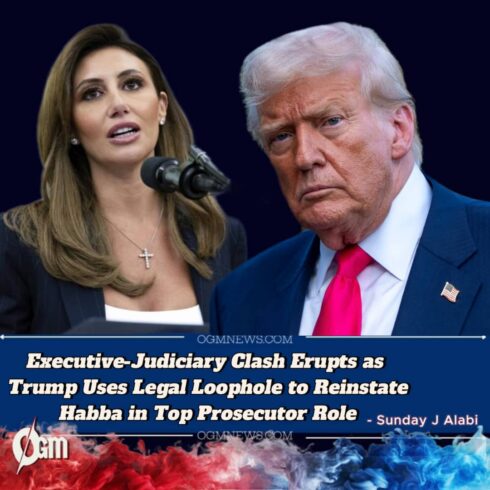
President Donald Trump on Thursday withdrew his nomination of Alina Habba to serve as U.S. attorney for the District of New Jersey, a move that enables her to assume the role in an acting capacity, bypassing legal restrictions that had barred her from holding the position while awaiting Senate confirmation.
The decision follows a contentious back-and-forth between the executive branch and federal judges in New Jersey, who earlier declined to extend Habba’s interim appointment and instead named her former deputy, Desiree Leigh Grace, to lead the office. With the nomination now withdrawn, the Federal Vacancies Reform Act no longer blocks Habba from temporarily taking the helm.
A Justice Department official confirmed the withdrawal and emphasized that Habba now serves lawfully as acting U.S. attorney. “President Trump continues to have full confidence in Alina Habba and her commitment to serve the people of New Jersey,” White House spokesperson Harrison Fields said.
Judges’ Appointment of Grace Sparks Executive Pushback
The dispute began after a federal district court in New Jersey exercised its authority to appoint Grace, then first assistant U.S. attorney, as Habba’s successor upon the expiration of Habba’s 120-day interim term. Chief Judge Renée Bumb formalized Grace’s appointment in a court order, citing the statutory deadline.
But Attorney General Pam Bondi swiftly rebuked the court’s move, accusing the judges of interfering with executive authority. “This Department of Justice does not tolerate rogue judges — especially when they threaten the president’s core Article II powers,” Bondi posted on social media.
In retaliation, Bondi removed Grace as first assistant, disqualifying her from succeeding Habba under federal vacancy rules. The leadership battle escalated as Habba publicly asserted her new role on X, posting: “I am now the Acting United States Attorney for the District of New Jersey.”
Legal Maneuvering Anchored in the Vacancies Act
Trump’s withdrawal of Habba’s formal nomination deftly sidesteps a key provision of the 1998 Federal Vacancies Reform Act, which bars nominees from serving in an acting capacity once their names are submitted to the Senate. Trump had nominated Habba on June 30, limiting her ability to remain in office once her interim term expired on July 22.
By rescinding the nomination and having Habba resign from the interim post, then reappointing her as first assistant, Bondi enabled her to step into the acting role legally. Under the Vacancies Act, a first assistant is eligible to serve as acting officer when the top post becomes vacant.
Justice Department leaders argue the move is entirely within legal bounds. Deputy Attorney General Todd Blanche wrote on social media that Grace had been ousted “pursuant to the president’s authority,” asserting that the executive branch retains the power to determine who leads a U.S. attorney’s office.
Senators Oppose Habba, Fueling Political Undercurrents
Habba’s nomination had faced stiff resistance from New Jersey’s Democratic senators, Cory Booker and Andy Kim, who objected to her selection and signaled they would oppose her confirmation. Their opposition made it unlikely that Habba would be confirmed through regular Senate procedures.
Despite the political hurdles, Trump and his allies have rallied behind Habba, citing her loyalty and legal competence. Habba previously served as a defense attorney for Trump in various civil litigation matters and joined the White House as a counselor following his re-election in 2024.
“Alina is eminently qualified to be U.S. attorney, and she’s doing a fine job of it,” said Armen Morian, a lawyer who worked alongside her in a 2023 New York fraud case. Critics, however, point to her lack of prosecutorial experience, raising questions about her readiness to lead one of the nation’s most prominent U.S. attorney’s offices.
Constitutional Tensions Surface Over Judicial and Executive Authority
The clash over Habba’s role reveals broader tensions between the judiciary and executive branches over the limits of appointment power. In a 1979 legal opinion, the DOJ’s Office of Legal Counsel concluded that the president maintains constitutional authority to remove court-appointed U.S. attorneys, though this interpretation has rarely been tested in court.
Legal experts note the rarity of such disputes. “There have been very few judicial decisions about the removal of interim U.S. attorneys, especially when the attorney general disagrees with a court’s appointment,” said Professor Jared Berry, a legal scholar specializing in federal appointments.
As Habba resumes control of the office in an acting capacity, her tenure is now limited to 210 days under the Vacancies Act — unless Trump nominates another candidate or reconfirms her once political conditions are more favorable.
What Comes Next for the U.S. Attorney’s Office in New Jersey?
For now, the leadership of New Jersey’s U.S. attorney’s office remains under Alina Habba’s command — a position bolstered by the executive branch and the DOJ’s top brass. Her tenure may spark additional legal challenges or political resistance, particularly from Senate Democrats.
The White House has signaled that Habba remains in consideration for a permanent appointment, pending political developments. However, with the Senate unlikely to confirm her in the near term, the administration appears content to use the Vacancies Act to maintain her presence in the role for the time being.
The outcome could set a precedent for how future administrations navigate conflicts between courts and the executive over interim appointments — a constitutional question with far-reaching implications for federal law enforcement.
[…] […]