



























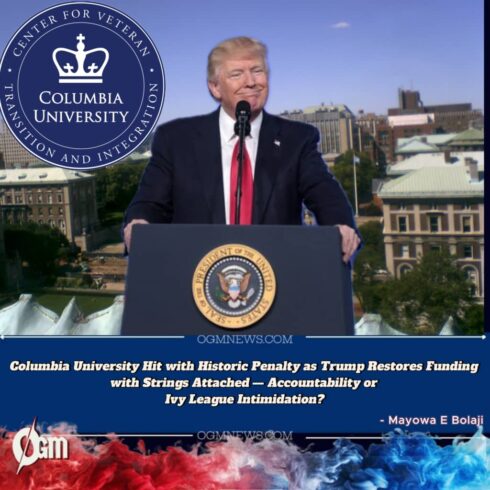
Columbia University has reached a historic settlement with the Trump administration, agreeing to pay more than $220 million to resolve allegations of financial misreporting related to federal research grants. The deal will lift the federal funding freeze that had paralyzed several high-profile research initiatives at the Ivy League institution.
Columbia University will also be subjected to long-term compliance oversight as part of the agreement, which administration officials are framing as a milestone in holding elite institutions accountable for misuse of public funds.
Federal Investigation Uncovers Research Irregularities
Columbia University came under federal scrutiny in 2023 after internal whistleblowers alerted authorities to discrepancies in the institution’s billing practices for federally sponsored research. A multi-agency probe, led by the Department of Education and the Department of Health and Human Services, concluded that millions in federal grant money had been improperly claimed through inflated indirect cost rates.
Columbia University was found to have failed in providing accurate documentation for a significant portion of its biomedical research expenditures, raising alarms over potential violations of the False Claims Act. Though the university denies any deliberate fraud, it acknowledged the presence of “systemic reporting failures.”
Settlement Terms: Monetary Penalty and Oversight Expansion
Columbia University has agreed to pay $225.5 million in penalties over the next five years, with an immediate $125 million payout and the remainder scheduled in annual installments. The settlement, one of the largest of its kind involving a U.S. university, effectively closes the investigation without litigation.
Columbia University must also establish an internal compliance division reporting directly to the U.S. Department of Justice. An external auditor, approved by the federal government, will oversee the university’s federal grants for the next seven years, ensuring that funding is allocated and reported within regulatory bounds.
Trump Administration Frames the Deal as Victory for Accountability
Columbia University has been positioned by the Trump administration as a cautionary example in its broader effort to enforce financial integrity within elite educational institutions. President Trump, speaking from the White House, emphasized that “no university, regardless of status or prestige, should misuse taxpayer money.”
Columbia University, according to Education Secretary Angela Bailey, will now serve as a “compliance benchmark” for other universities seeking federal research support. The administration hailed the settlement as a model for restoring public trust in academic stewardship of government resources.
Columbia University Responds with Cautious Acceptance
Columbia University, in a public statement by President Minouche Shafik, expressed “deep regret” over the administrative oversights that led to the settlement. While denying intentional misconduct, the university acknowledged shortcomings in its oversight of grant-related financial practices.
Columbia University announced a sweeping overhaul of its Office of Research Administration and will implement new training protocols for faculty and staff. “This agreement allows us to refocus on academic excellence while ensuring our operations meet the highest standards,” Shafik stated.
Impact on Academic Research Nationwide
Columbia University has inadvertently triggered a nationwide reassessment of how federally funded research is managed within higher education. Legal and academic institutions are now reviewing internal grant procedures to preempt federal intervention.
Columbia University’s situation has drawn comparisons to prior compliance breaches at other elite universities, though legal analysts note that the focus in this case was administrative—rather than scientific—misconduct. The implications, however, may extend into the culture of grant administration nationwide.
Critics Warn of Chilling Effect on Scientific Innovation
Columbia University’s case has raised concerns among researchers that increased regulatory pressure could hamper innovation. Critics argue that fear of bureaucratic entanglement may discourage scholars from seeking federal funding for ambitious or unconventional projects.
Columbia University researchers, some speaking anonymously, expressed frustration over what they described as “punitive oversight” that may prioritize paperwork over progress. Others fear the new measures will slow project approvals and dampen interdisciplinary initiatives.
Political Undertones and Ivy League Scrutiny
Columbia University has found itself at the center of a political clash between the Trump administration and elite academic institutions often critical of federal policy. Some analysts view the enforcement action as part of a broader strategy to confront what the administration perceives as “ideological bias” in higher education.
Columbia University joins a growing list of Ivy League schools under enhanced federal review, not only for financial practices but also for endowment transparency, campus speech policies, and foreign partnerships. The timing of this enforcement has led some to question whether political motives played a role.
Federal Funding to Resume Under Watchful Eye
Columbia University will once again be eligible to receive federal grants following the signing of the settlement agreement. However, all new and ongoing projects will undergo strict compliance checks, with approval contingent on third-party audits.
Columbia University has already submitted revised protocols for review, and administration officials indicated that previously frozen grants may resume within the next quarter. The university’s ability to meet these new conditions will be monitored closely by both federal agencies and peer institutions.
What Comes Next for Columbia and the Nation’s Universities
Columbia University now faces the dual challenge of rebuilding public trust and navigating a far more complex regulatory environment. University leadership has pledged to make compliance a pillar of its operational culture going forward.
Columbia University’s case is likely to become a defining precedent for the relationship between academia and federal oversight. Whether this ushers in an era of transparency or triggers institutional retrenchment will depend on how the university—and others like it—respond to this moment of reckoning.



[…] […]