


























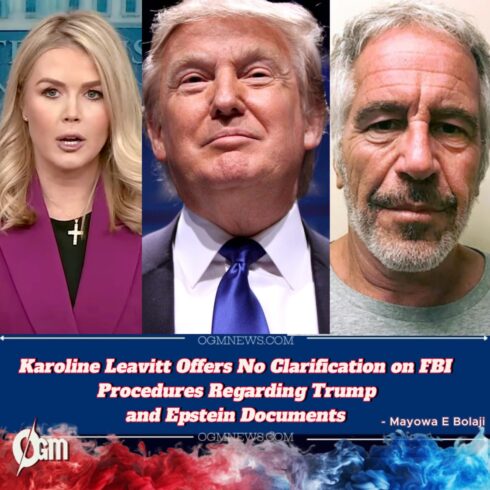
Karoline Leavitt, the Press Secretary to President Donald J. Trump, ignited a storm of speculation and outrage during Tuesday’s White House press briefing when she declined to deny reports that FBI agents were instructed to flag President Trump’s name in all Jeffrey Epstein-related documents. Her brief response—“You would have to ask the FBI”—has become a national flashpoint, raising urgent questions about transparency, federal overreach, and political accountability.
Karoline Leavitt’s Evasion Sends Shockwaves
Karoline Leavitt stood before a packed briefing room when the question was raised: “Is it true the FBI has been told to flag President Trump’s name wherever it appears in the Epstein files?” Leavitt’s answer was stark in its brevity and ambiguity: “You would have to ask the FBI.” The room, anticipating either a denial or clarification, fell into stunned silence.
Leavitt offered no follow-up explanation, no effort to clarify the administration’s awareness or stance on the matter. Her statement was taken by many in the press corps as a deliberate refusal to confront a politically explosive issue. Critics argue that her reticence is part of a broader culture of silence surrounding Epstein-related revelations.
Karoline Leavitt Declines to Defend FBI or Confirm Reports
Karoline Leavitt declined to speak on whether the White House was aware of or approved such FBI directives. When pressed further by a second journalist, she reiterated, “That’s a question for the Bureau,” and moved on to unrelated topics. The exchange, though brief, sent ripples throughout Washington and beyond.
Karoline Leavitt’s failure to defend or dispute the FBI’s reported conduct has led to widespread interpretations. Some see it as a subtle confirmation of the reports; others interpret it as an intentional firewall to prevent the administration from being tied directly to what could be construed as improper surveillance tactics or political protection.
Karoline Leavitt’s Words Raise Legal and Ethical Questions
Karoline Leavitt’s vague reply has drawn criticism from legal scholars and watchdog organizations. They argue that her lack of a firm denial could indicate awareness of internal procedures that may infringe upon legal boundaries or civil rights protections, especially when involving the name of a sitting president.
Leavitt’s choice of words is now under analysis from constitutional experts who question whether the reported flagging practice—if true—could violate legal standards on impartial investigations or be considered an attempt to either shield or disproportionately monitor a public official.
Karoline Leavitt Becomes the Center of Political Fallout
Leavitt’s remarks have quickly become fodder for political operatives on both sides. Republicans have lauded her for refusing to dignify what they call “conspiracy-driven press hysteria.” Meanwhile, Democrats have seized on her silence, calling it emblematic of an administration unwilling to be transparent about Epstein’s connections to the powerful.
Leavitt has not issued a follow-up statement or clarification in the aftermath of the controversy. White House sources suggest she is unlikely to do so unless directed by senior officials or the president himself, underscoring the strategic caution now dominating communications around the matter.
Karoline Leavitt Deflects While Epstein Questions Resurface
Leavitt’s stonewalling has re-energized public scrutiny over the Epstein case, which remains a symbol of unresolved elite impunity. With many figures implicated in Epstein’s trafficking network still uninvestigated publicly, the idea that one of them—President Trump—might be flagged by the FBI is both explosive and politically fraught.
Leavitt’s refusal to engage with those implications has further fueled calls from media outlets, victims’ advocates, and civil society groups for total transparency of the Epstein files. Several petitions have now surfaced demanding that all names be disclosed without preferential treatment.
Karoline Leavitt Offers No Guidance on Transparency
Karoline Leavitt, when asked whether the president supports full public disclosure of all names in the Epstein files, declined to comment. “That’s not my decision to make,” she said, quickly pivoting to discuss President Trump’s upcoming foreign trip to Asia.
Leavitt’s unwillingness to address broader transparency concerns has intensified frustration among journalists and press freedom organizations. The Committee to Protect Journalists issued a statement calling the press secretary’s posture “deeply disappointing” and “harmful to democratic accountability.”
Karoline Leavitt’s Silence Leaves the FBI Holding the Bag
Karoline Leavitt’s insistence that the issue lies solely with the FBI has drawn attention to the Bureau’s own silence. Neither the FBI nor the Department of Justice has commented on the alleged directive, nor have they denied its existence. As a result, the weight of public speculation and political heat continues to build.
Karoline Leavitt’s refusal to take a firm position, combined with the Bureau’s non-response, creates a vacuum of trust in both the executive branch and federal law enforcement. Analysts warn that unless clarity emerges soon, conspiracy theories and institutional suspicion will only deepen.
Leavitt Unwittingly Fuels Social Media Firestorm
Leavitt’s ten-word answer became a viral moment within hours, dominating headlines and trending across major platforms under hashtags like #FlaggedForTrump and #EpsteinCoverup. Users across ideological lines are demanding answers, some accusing the administration of complicity, others claiming political targeting by federal agencies.
Karoline Leavitt has yet to acknowledge the social media backlash, maintaining a business-as-usual approach in subsequent appearances. But the online discourse continues to evolve, now branching into broader questions of elite accountability and the future of public trust in law enforcement.
Karoline Leavitt Faces Growing Pressure as Congress Circles
Leavitt may soon be called to clarify her remarks before a Congressional oversight committee. According to sources close to House leadership, bipartisan members are considering formal requests for testimony regarding what the White House knows about the FBI’s handling of the Epstein files.
Leavitt, though not under formal subpoena yet, is becoming an unlikely central figure in a narrative that refuses to die down. With new documents, whistleblowers, or FOIA revelations potentially on the horizon, her role in deflecting—or illuminating—the truth may prove pivotal in the weeks to come.


[…] […]