





























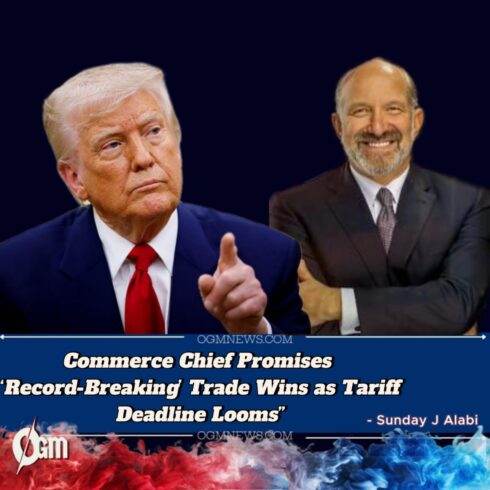
Commerce Secretary Howard Lutnick on Sunday projected an imminent wave of transformative trade deals, declaring that the Trump administration is poised to deliver major victories on the global economic stage. Speaking on Face the Nation, Lutnick said the next two weeks will be “for the record books,” as President Trump’s trade ultimatum to dozens of countries approaches its hard Aug. 1 deadline.
President Trump has sent formal notifications to 25 key trading partners—including Canada, Mexico, and the European Union—warning of sharply increased tariffs unless new trade agreements are finalized. While only a few deals have been publicly announced thus far, Lutnick said the threat of punitive tariffs has successfully driven foreign negotiators to the table. “They are going to open their markets or they’re going to pay the tariff,” he declared.
Aggressive Tariff Strategy Targets Major Partners
The White House’s approach hinges on a high-pressure tactic: impose—or threaten—stiff tariffs unless countries comply with U.S. trade demands. Trump’s letter to U.S. allies and rivals alike outlines tariffs as high as 35% on imports, particularly from large economies like the EU, Canada, and Mexico.
With the European Union, the stakes are especially high. The U.S. traded nearly $1 trillion in goods with the bloc last year, and Trump has warned of a 30% tariff on EU exports if an agreement isn’t reached by the start of next month. European negotiators, while hopeful for a deal, have prepared retaliatory tariffs of their own should talks fail.
Canada and Mexico—America’s largest non-EU trading partners—face similarly steep tariff hikes, set to rise to 35% and 30%, respectively. President Trump has linked these tariffs to non-trade issues such as fentanyl trafficking and border security. However, goods covered by the U.S.-Mexico-Canada Trade Agreement remain exempt, preserving critical economic flows.
Aug. 1: No Extensions, No Exceptions
Lutnick underscored that the Aug. 1 tariff hike is a firm deadline, reaffirming the administration’s earlier stance that “no extensions will be granted.” This date marks the end of a 90-day grace period following the president’s “Liberation Day” tariff threats in April.
“Imports that don’t meet our new terms will face higher tariffs beginning that day,” Lutnick said. “That’s a promise.” Nevertheless, he hinted that negotiations could still continue after the deadline, suggesting the administration remains open to late deals.
Despite warnings from economists and market analysts about inflation and slower growth, the Trump administration remains unwavering. Trump argues that his tariff strategy is already revitalizing U.S. manufacturing and closing trade deficits, and that the long-term benefits will outweigh short-term disruptions.
Inflation Fears Dismissed Amid Economic Tensions
Rising consumer prices and potential fallout from global retaliation have fueled criticism of the president’s approach. The latest inflation report showed prices rose 2.7% year-over-year, a jump from the previous month’s 2.4%, sparking concern about potential economic overheating.
But Lutnick pushed back against those concerns, insisting that American consumers will actually see “shockingly low” prices and that the tariffs will ultimately benefit domestic manufacturers. “The idea that importers are more important than American workers is just the wrong way to think about it,” he said.
He maintained that tariffs will not lead to runaway inflation, directly challenging the warnings from mainstream economists and the Federal Reserve. Instead, Lutnick painted a picture of a recalibrated global trade system designed to prioritize U.S. industrial strength and worker protection.
Lutnick Joins Trump in Attacking Fed Chair Powell
In a striking turn, Lutnick also took aim at Federal Reserve Chair Jerome Powell, accusing him of “torturing America” by maintaining high interest rates amid a turbulent trade environment. While the Fed has held off on cutting rates this year, President Trump has openly urged the central bank to act more aggressively to stimulate growth.
The Fed’s decisions are made collectively by its board, but Powell has been the public face of resistance to rate cuts, citing inflation risks and global uncertainty. Trump, frustrated with Powell’s caution, reportedly asked Republican lawmakers whether he should fire the Fed chair—a move without clear legal precedent.
Lutnick avoided commenting on Powell’s job security but called his monetary policy decisions “the worst,” echoing Trump’s broader frustration with what the administration views as an unnecessarily tight economic leash. “I don’t know why he’s torturing America this way,” Lutnick added, heightening the administration’s public campaign against the Fed.
All Eyes on Trump as Deadline Approaches
With just days remaining until the Aug. 1 tariff deadline, the world is watching to see whether President Trump’s aggressive strategy yields deals or escalates into a global trade clash. The president has staked a significant portion of his economic legacy on tariff leverage and American manufacturing revival.
Lutnick’s remarks signaled a confident, forward-leaning posture from the White House—one that views economic nationalism as both a campaign promise and a governing philosophy. “The American people are going to love these deals,” he said.
But with tensions rising and retaliation threats looming, the Trump administration faces a narrow window to prove its tariff strategy can deliver more than just tough talk.
Casinoabc999? Good Site. The interface is sleek, and there is a lot of stuff to...