

























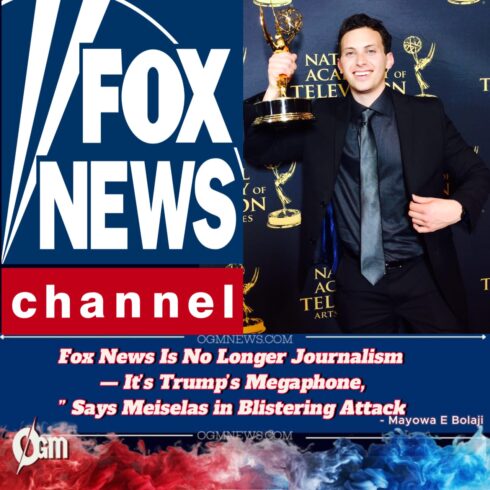
Brett Meiselas, co-founder of the progressive political action committee MeidasTouch, ignited controversy this week after stating during a live interview that Fox News operates as an extension of President Donald Trump’s administration. His remarks have intensified debates over the network’s journalistic integrity, especially amid ongoing concerns about media partisanship.
Speaking on a national podcast, Brett Meiselas alleged: “They are like operatives of the Trump administration, of the Republican party. They have their talking points each day. They are coordinated, in my opinion, with what’s going on.” He went further, accusing Fox of cloaking political propaganda in the guise of journalism: “They use all these trappings of a news organization in order to do so much damage to the country.”
Fox News Fires Back: “Baseless and Offensive”
In a swift and strongly worded rebuttal, Fox News dismissed Meiselas’ claims as “baseless and offensive,” asserting that its programming remains independent and committed to journalistic principles. A spokesperson for the network stated, “Mr. Meiselas’ accusations reflect a partisan smear campaign with no factual basis. Our newsroom operates with editorial independence and diversity of thought.”
However, media watchdogs and journalism ethicists are divided. While some critics argue Fox has increasingly served as a messaging platform for Republican narratives, others maintain that the network still hosts dissenting voices and remains protected by press freedom, regardless of political leanings.
Trump’s Second Term and the Media Ecosystem
Since returning to office in January 2025, President Trump has embraced a combative stance toward media organizations that criticize his administration, while praising outlets that reinforce his positions—chiefly Fox News. The symbiotic relationship between the Trump White House and Fox’s primetime programming has deepened during his second term.
Several high-profile members of the administration have previously held positions at Fox News, and vice versa. Critics say this revolving door has blurred lines between political leadership and media commentary, raising alarm over a potential consolidation of narrative control.
The Rise of Coordinated Messaging?
Meiselas’ comments point to a broader concern within the political discourse: the possibility of coordinated messaging across right-wing media outlets. Daily talking points, similar framing across shows, and synchronized narratives are now common observations among media analysts tracking Fox’s content strategy.
A recent study by Media Matters showed that nearly 80% of Fox News segments featuring political content echoed positions previously laid out by the Trump campaign or administration in press briefings. While such alignment could be coincidental, critics argue it suggests deliberate coordination—possibly undermining public trust.
Democrats Rally Behind Meiselas
In the wake of the interview, several Democratic lawmakers and progressive organizations have come to Meiselas’ defense, praising him for “speaking truth to power.” Senator Elizabeth Warren tweeted, “Brett Meiselas is saying what millions of Americans are seeing with their own eyes. Fox News is not journalism—it’s Republican propaganda.”
Others have called for a renewed focus on media literacy and accountability. Representative Alexandria Ocasio-Cortez emphasized the importance of distinguishing between opinion-based entertainment and fact-based journalism, warning that “disinformation in the media poses a greater threat than foreign interference.”
Calls for Congressional Oversight Resurface
The controversy has revived discussions within Congress about the role of media conglomerates in shaping public discourse. Several House Democrats are now advocating for hearings on “partisan broadcasting,” arguing that platforms like Fox wield outsized influence without appropriate oversight.
Proposals include increased transparency in media ownership, mandatory disclaimers on political commentary, and reforms to Section 230 to address partisan misinformation. While unlikely to gain traction in a Republican-controlled House, the conversation underscores growing pressure to address media influence in democratic processes.
Free Press vs. Propaganda: A Constitutional Dilemma
The U.S. Constitution’s First Amendment offers broad protections to media outlets, regardless of political orientation. However, as media landscapes evolve, legal scholars warn of a gray area where propaganda masquerades as news without legal consequences. This, they say, creates a loophole through which partisan entities can shape public opinion under the shield of press freedom.
Professor Laura Bennett of Columbia Journalism School remarked, “The law protects Fox News’ right to broadcast, but ethical journalism is another matter. We need to differentiate between what’s legally permissible and what’s socially corrosive.”
The Battle for Public Trust Continues
As Meiselas’ remarks trend across social media platforms and partisan news cycles, the battle for public trust in media deepens. Polls show declining confidence in mainstream outlets across the board, with many Americans relying on ideologically aligned sources for information.
The question now is whether Meiselas’ explosive accusations will spark institutional change—or simply add fuel to the fire in an already polarized media environment. As the Trump administration tightens its messaging machinery ahead of the 2026 midterms, scrutiny of media alliances is unlikely to fade anytime soon.
What’s News and What’s Noise?
Brett Meiselas’ criticism of Fox News opens a crucial debate about the role and responsibility of media in a democracy. Whether his words are viewed as courageous truth-telling or partisan hyperbole, they shine a spotlight on a media ecosystem increasingly defined not by facts, but by factions.
With a second Trump term now in full swing, the line between political advocacy and journalism continues to blur—raising fundamental questions about the integrity of information and the future of democratic discourse in America.

[…] […]