


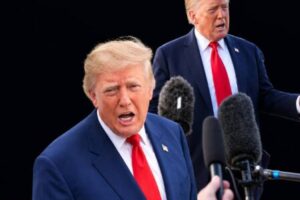













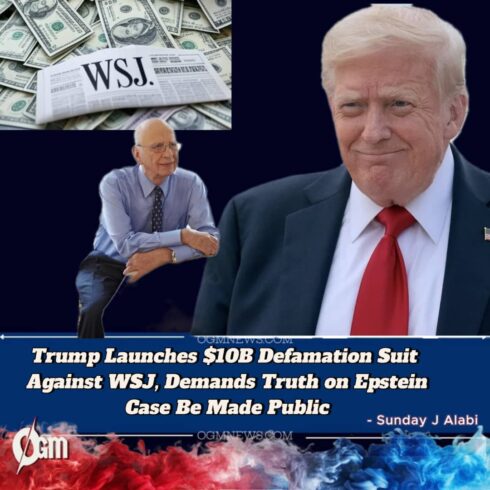
President Donald J. Trump on Friday filed a $10 billion libel lawsuit against the Wall Street Journal and its parent company, News Corporation, over a controversial story linking him to a “bawdy” birthday letter allegedly sent to the late Jeffrey Epstein. The lawsuit, filed in the Southern District of Florida, names several defendants including Wall Street Journal owner Rupert Murdoch, CEO Robert Thomson, and reporters Joseph Palazzolo and Khadeeja Safdar.
The suit challenges the Journal’s claim that Trump signed a sexually explicit birthday message to Epstein in the early 2000s. According to the report, the letter was included in a commemorative book of messages presented to Epstein for his 50th birthday in 2003. The president has categorically denied the existence of the letter, calling it a “complete fabrication” and labeling the publication as a “FAKE” in a fiery post on his Truth Social platform.
Allegations Called ‘False, Defamatory, and Disparaging’
Trump’s legal team asserts that the story published by the Journal is “false, defamatory, unsubstantiated, and disparaging.” The suit accuses the defendants of reckless journalistic conduct, alleging the Journal “knowingly published or acted with reckless disregard for the truth” in violation of journalistic ethics and the law.
In particular, the complaint highlights what it calls “clear journalistic failures,” arguing that the Journal provided no verifiable evidence of the letter’s authenticity, nor did it make a good-faith effort to corroborate the signature or illustrations it claimed were from President Trump. Trump’s lawyers are seeking not only monetary damages but also a full retraction and public apology.
Murdoch, Dow Jones Executives, and Journal Reporters Named
Beyond the publication itself, the suit directly names News Corp patriarch Rupert Murdoch, Dow Jones CEO Robert Thomson, and the two bylined reporters as individual defendants. It alleges that the editorial leadership either approved the story or failed to prevent its publication despite knowing it was based on dubious evidence.
“Their goal was to damage President Trump’s reputation through sensationalism, not journalism,” the suit argues. It further claims that the story was timed for maximum political harm, coming amid renewed public interest in Epstein-related investigations. A spokesperson for Dow Jones responded briefly, saying, “We have full confidence in the rigor and accuracy of our reporting, and will vigorously defend against any lawsuit.”
High Legal Bar for Defamation Claims Against Public Figures
Legal analysts note that Trump faces a steep challenge in court. Under U.S. defamation law, public figures must prove not only that a claim is false, but that it was published with “actual malice”—meaning the publisher knew it was false or acted with reckless disregard for the truth.
However, Trump has expressed confidence in the strength of his case, calling it a “historic legal action” and a “POWERHOUSE Lawsuit.” In recent years, defamation suits involving public figures have rarely succeeded without evidence of deliberate misconduct or editorial negligence. If successful, this lawsuit could redefine media accountability in politically charged reporting.
Trump Orders DOJ to Unseal Epstein Grand Jury Testimony
Separately but relatedly, President Trump on Thursday ordered Attorney General Pam Bondi to seek the unsealing of grand jury testimony tied to Jeffrey Epstein. Hours later, the Justice Department filed a motion to make the documents public, a move seen as part of Trump’s broader effort to bring transparency to the Epstein saga.
The documents may provide further context to longstanding questions about Epstein’s connections and dealings with high-profile individuals. Trump has previously acknowledged knowing Epstein in the early 2000s but maintains the two had a “falling out” and were not close.
Epstein’s Legacy of Scandal and Federal Scrutiny
Jeffrey Epstein, a financier with ties to global elites, was arrested in 2019 on federal child sex trafficking charges. He died later that year in a Manhattan jail cell, a death ruled a suicide. His associate, Ghislaine Maxwell, was later convicted for her role in Epstein’s crimes.
Recent documents released by the DOJ and FBI state that Epstein did not maintain an incriminating “client list” and was not engaged in blackmail—a conclusion that has stirred skepticism across party lines, including among Trump supporters. Critics have called for further transparency, and Trump’s directive to unseal grand jury testimony marks a sharp pivot toward public disclosure.
White House Silent, Political Fallout Mounts
The White House has not issued an official comment on the lawsuit, though administration officials are reportedly monitoring the legal and political implications closely. Trump’s decision to pursue the case during an election cycle may signal a broader push to confront media narratives and reframe ongoing investigations involving Epstein.
Meanwhile, media watchdog groups and legal experts are divided over the case’s merits. Some warn it could chill press freedom, while others argue that media outlets must be held to account for publishing unverified allegations with potentially ruinous reputational impact.
As the lawsuit proceeds, it promises to rekindle debates over press responsibility, defamation standards, and the lingering shadows of Jeffrey Epstein’s disturbing legacy.


The vibes here are amazing and the winning streaks are real. It feels just like...