



























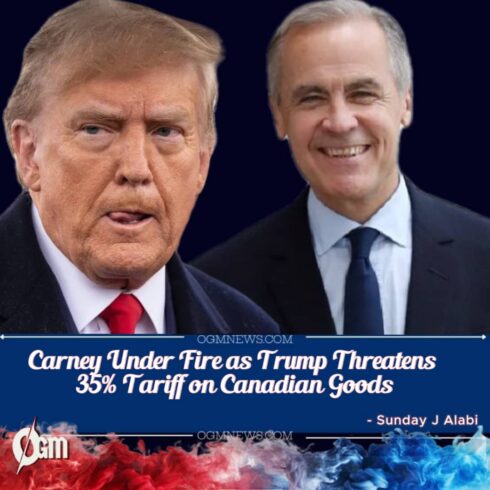
The already strained trade relations between Canada and the United States took another hit this week, as President Donald Trump issued a stark warning of a 35% tariff on Canadian goods starting August 1. The announcement, made via an official White House letter on Thursday, has upended the tone of ongoing negotiations meant to forge a new trade and security agreement between the neighboring nations.
The timing of the threat has sparked both confusion and criticism in Ottawa. Talks had been intensifying, with Canada recently walking back on a planned Digital Services Tax (DST) under U.S. pressure. That concession was meant to smooth negotiations—but instead, it seems to have emboldened Washington’s demands. “Canada caved,” the White House stated bluntly, leaving Prime Minister Mark Carney to fend off criticism that he is failing to secure a fair deal for Canadians.
From “Elbows Up” to Elbows Down? Carney’s Rhetoric Faces Reality Check
Carney swept to power in April’s general election with a pledge to keep his “elbows up” in trade talks with the U.S., a metaphor borrowed from ice hockey to convey toughness. But critics now say that stance is beginning to look like political posturing rather than a sustainable negotiating strategy.
Political commentator Robyn Urback mocked the prime minister’s approach as a “chicken dance,” highlighting what she sees as an inconsistent policy oscillating between assertiveness and submission. Meanwhile, political scientist Blayne Haggart argued that Canada’s strategy has yielded “less than nothing,” particularly as the DST retreat appears to have achieved no meaningful U.S. concessions. The prime minister’s reluctance to retaliate after Trump doubled tariffs on Canadian steel and aluminum last month further fuels the narrative of capitulation.
Trump’s Tariff Gambit: A Hard Bargain with Global Implications
President Trump’s aggressive approach to trade is not confined to Canada. Similar warnings have been issued to more than 20 countries as Washington seeks to restructure international agreements to favor American manufacturing and economic priorities. The Canada file, however, is of particular significance, given the tight economic integration between the two countries.
Despite Canada’s C$1.3 billion pledge earlier this year to strengthen border security and the appointment of a “fentanyl czar” in response to U.S. drug concerns, Trump’s letter revisited the opioid issue and again raised the possibility of punitive trade actions. The latest tariff threat, if enacted, could impact billions of dollars in goods not covered under the USMCA trade agreement.
Domestic Pressure Mounts on Carney to Hold Firm
At home, Carney is under growing pressure from both opposition parties and provincial leaders to adopt a firmer stance. Conservative leader Pierre Poilievre pledged on Thursday that his party would support efforts “to secure the best deal for Canada,” while British Columbia Premier David Eby framed Trump’s threat as a call for national unity.
Still, Carney maintains that negotiations are ongoing and that Canada will not be drawn into a tit-for-tat war. In a measured response to the 35% tariff threat, the prime minister said his government remains committed to protecting Canadian businesses and workers while seeking a fair and lasting agreement with the U.S.
Canada’s Leverage: Not as Weak as It Seems?
Despite the power imbalance between the U.S. and Canada, some experts argue that Ottawa is not without leverage. Fen Hampson, a professor of international affairs at Carleton University, noted that American consumers—and not Canadians—will ultimately bear the burden of tariffs. He also pointed out the U.S. reliance on key Canadian exports, such as steel and aluminum.
Additionally, Canada has taken steps to diversify its international relationships. Carney’s administration recently signed an arms deal with the European Union and is working to accelerate key infrastructure projects and dismantle domestic trade barriers—measures aimed at reducing long-term dependency on the U.S. market.
Next Deadline: All Eyes on August 1
With the new deadline for a deal set for August 1, the coming weeks will be crucial. Industry Minister Mélanie Joly, when pressed on Friday, reiterated that Canada “does not negotiate in public” and defended the government’s approach. “We’re dealing with a very unpredictable U.S. administration,” she said, adding, “we’re not the only ones.”
Whether Carney can turn the tide and convert his “elbows up” promise into a diplomatic win remains to be seen. For now, the prime minister is walking a tightrope—facing pressure at home, an unrelenting counterpart in Washington, and the looming prospect of a trade war that neither country can afford.


[…] […]