


























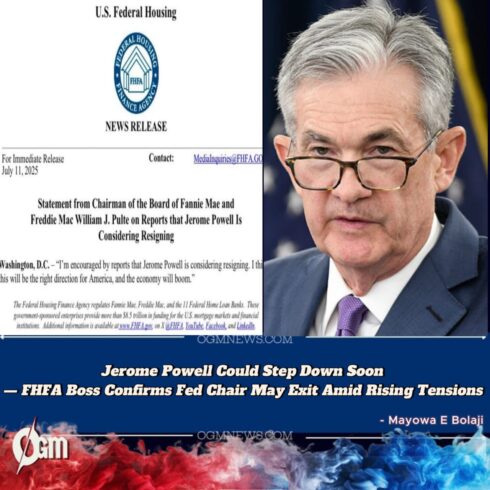
Jerome Powell is reportedly considering stepping down from his role as Chairman of the Federal Reserve, according to Federal Housing Finance Agency (FHFA) Director Dr. Alicia Vaughn. During a classified congressional briefing earlier this week, Vaughn stated unequivocally that Powell has been “deliberating a potential resignation” in light of increasing political pressure and policy clashes with President Trump’s economic team.
Powell has not officially commented on the matter, but the disclosure by Vaughn has sparked immediate waves across Washington and Wall Street. Senior Federal Reserve officials have neither confirmed nor denied the revelation, but insiders describe Powell as “deeply frustrated” by ongoing interference in monetary policy decisions.
Jerome Powell’s Silence Jolts Global Markets
Jerome Powell has yet to release a statement, but markets have already begun reacting. Stocks fell sharply within hours of Vaughn’s statement becoming public, with the Dow shedding over 400 points and the S&P 500 tumbling 1.3%. The uncertainty over the Federal Reserve’s leadership has rattled investor confidence and intensified calls for clarity.
Powell has been a stabilizing force since 2018, leading the Fed through crises including the COVID-19 pandemic, inflation surges, and geopolitical shocks. His departure would leave a significant vacuum in global monetary leadership—raising questions about what direction the Trump administration will take on interest rates, inflation control, and economic growth.
Jerome Powell at Odds with Trump Economic Doctrine
Jerome Powell has found himself increasingly at odds with President Trump’s economic agenda during the President’s second term. The administration is pushing for deeper interest rate cuts and broader asset purchases to supercharge domestic manufacturing, housing, and energy sectors—positions Powell has been cautious to embrace.
President Trump has publicly criticized the Federal Reserve’s “slow pace” and accused Powell of “overcomplicating American prosperity.” According to sources close to Powell, the Fed Chair believes in preserving institutional independence and avoiding the politicization of monetary policy—a principle now under fire.
Jerome Powell’s Leadership Tested by Alicia Vaughn’s Disclosure
Jerome Powell’s leadership was thrown into the spotlight after FHFA Director Alicia Vaughn made the startling revelation during a briefing with lawmakers. Her comments, later confirmed by her press secretary, have triggered bipartisan concerns about central bank stability.
While Vaughn declined to elaborate on her source, analysts suspect that her statement may have been a calculated move to force Powell’s hand or to soften markets for an imminent leadership transition. If Powell was seeking a quiet exit, Vaughn’s remarks have ensured that the process will now be anything but.
Jerome Powell Faces Lawmaker Scrutiny Over Exit Rumors
Jerome Powell is expected to testify before Congress next week in what is shaping up to be a politically charged session. Lawmakers from both parties have demanded answers on whether he intends to resign and what the implications would be for economic stability.
Powell, known for his measured tone and data-driven decision-making, will now have to navigate a firestorm of political expectations. Senate Banking Committee Chair Michael Harper (R-TX) warned that Powell’s silence “is feeding a dangerous uncertainty,” while others in the Trump-aligned Freedom Caucus say a new Fed leader may better match the administration’s pro-growth agenda.
Jerome Powell’s Departure Could Reshape Federal Reserve Policy
Jerome Powell’s exit would likely open the door for a dramatic shift in Federal Reserve priorities. Sources close to the White House suggest that potential replacements could include monetary policy hawks and Trump-aligned economists such as Larry Kudlow, Judy Shelton, or Kevin Warsh.
These names reflect a possible pivot toward a more nationalistic, industrial-policy-friendly Fed—one that emphasizes lower rates, asset expansion, and less global coordination. Powell’s departure could therefore mark not just a leadership change, but a complete philosophical realignment at the central bank.
Jerome Powell Holds the Key to Central Bank Independence
Jerome Powell’s decision now symbolizes more than just a career move—it could become a defining moment for central bank independence. Economists around the world are watching closely to see whether Powell stands firm against political influence or exits quietly, setting a precedent for future Fed chairs.
“The very soul of the Fed is being tested,” said Dr. Elaine Morrison of the Economic Policy Institute. “If Powell is removed or resigns under pressure, it will embolden future administrations to treat the Federal Reserve as just another cabinet department. That would be a catastrophe.”
Jerome Powell’s Exit Would Echo Beyond U.S. Borders
Powell’s possible resignation is already sending shockwaves through global financial systems. Both the European Central Bank and the Bank of England issued cautious statements reaffirming their faith in U.S. monetary stability, though behind-the-scenes alarm is rising.
International investors and sovereign funds rely on the consistency and predictability of the U.S. Fed. Powell’s exit could rattle confidence in the dollar, affect cross-border lending, and strain multilateral economic coordination at a time of increasing geopolitical tension.
Jerome Powell Yet to Speak—But the Nation Awaits
Powell has remained characteristically tight-lipped amid the uproar. However, insiders expect he will address the nation—either during his congressional testimony or via an official Fed statement—within the coming week. Whether he confirms, denies, or deflects the resignation speculation, the moment promises to be historic.
Until then, the financial world watches and waits. One man, one decision—Powell’s next move could redefine the future of American monetary policy and global economic leadership.

[…] […]