










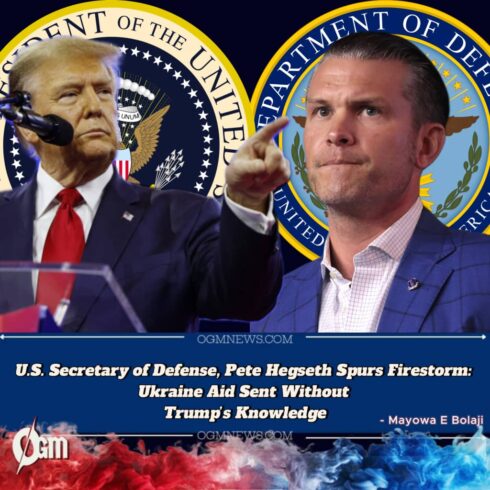
Pete Hegseth, U.S. Secretary of Defense, has plunged the Pentagon into chaos after authorizing a substantial military aid package to Ukraine—without informing President Donald J. Trump. The unexpected maneuver has sent shockwaves through the administration, raising urgent questions about loyalty, chain of command, and national security oversight.
The $450 million package, which reportedly includes advanced drones, Javelin missiles, and battlefield surveillance tools, was delivered under Hegseth’s directive during a time-sensitive operation. However, President Trump and key members of his national security team were left completely unaware until the aid had already reached Ukrainian military channels.
Pete Hegseth Blindsides Trump, White House Reacts With Fury
Pete Hegseth’s decision has left the White House blindsided. Senior aides described the president’s reaction as “furious and betrayed,” with internal communications revealing that Trump was notified post-factum—well after the shipments had cleared customs en route to Eastern Europe.
White House officials are now working overtime to trace the timeline of the operation. One senior aide remarked, “This is not how policy is made in the Trump administration. Secretary Hegseth made a unilateral call on an issue that directly affects global diplomacy and U.S. strategic interests.”
Pete Hegseth Under Fire as Congress Demands Answers
Pete Hegseth is facing mounting scrutiny from both sides of the aisle in Congress. Lawmakers have launched inquiries into whether he bypassed statutory processes and whether the move violated the Impoundment Control Act, which requires executive-level sign-off on foreign military aid.
While Hegseth has not yet publicly defended his actions, Pentagon sources claim he acted under “urgent humanitarian circumstances” and in alignment with prior defense authorizations. Still, legislators argue that urgency does not equate to executive exemption. “We must know who authorized this, who was informed, and why the president was kept in the dark,” said Senator J.D. Vance.
Pete Hegseth Provokes Conservative Outrage Over ‘Shadow Governance’
Pete Hegseth’s bold action has drawn intense criticism from within President Trump’s conservative base. Influential allies such as Rep. Marjorie Taylor Greene and commentator Tucker Carlson have denounced the move as evidence of “deep state disobedience” and “military overreach.”
“This is the textbook definition of a rogue actor within the government,” Carlson said during a primetime segment. “Hegseth may have been a Trump loyalist once, but if he’s making calls without presidential oversight, he’s no better than the generals Trump clashed with in his first term.”
Pete Hegseth’s Aid Package Reaches Ukraine, But Diplomacy Trembles
Hegseth’s aid shipment did reach Ukraine successfully, with Kyiv officials praising the arrival of U.S. weapons. President Volodymyr Zelenskyy thanked the U.S. government for the continued support, carefully avoiding commentary on the internal rift the delivery caused.
Diplomatic analysts, however, warn that such unsanctioned moves could undermine long-term U.S.-Ukraine relations. “When one Cabinet official can shape foreign war outcomes without the president, it signals dysfunction, not stability,” said Dr. Fiona Hill, a former National Security Council advisor.
Pete Hegseth Triggers Investigations by Armed Services Committees
Hegseth is now the focus of dual investigations led by the Senate Armed Services Committee and the House Foreign Affairs Committee. Lawmakers are requesting transcripts, internal memos, and direct testimony from Hegseth regarding how and why the decision was made unilaterally.
Some committee members are even calling for suspension pending inquiry results. “If Secretary Hegseth undermined the authority of the president and violated national security norms, then accountability is non-negotiable,” stated Rep. Elise Stefanik.
Pete Hegseth Reignites Civil-Military Power Struggles
Pete Hegseth’s unauthorized aid decision has reignited debates over civil-military relations and whether the Pentagon is straying from its constitutionally defined subordination to civilian authority. Scholars and former military leaders warn that the move may have set a dangerous precedent.
“This episode reveals a breakdown in the sacred principle of civilian control,” said General (Ret.) Jack Keane. “Hegseth was once a vocal advocate for Trump’s America First doctrine—now he may have violated it by undermining presidential authority.”
Pete Hegseth’s Fate Uncertain as Trump Prepares to Speak
Hegseth’s future in the administration hangs in the balance as President Trump prepares a primetime address to the nation. Speculation is growing that the president may call for his resignation or demand a public apology to reassert command authority.
“The president doesn’t tolerate betrayal, even from close allies,” said an insider familiar with internal deliberations. “Pete Hegseth might have believed he was acting in good faith, but there are consequences for crossing the line—especially under President Trump’s watch.”
Pete Hegseth’s Unilateralism Sparks a Governance Crisis
Hegseth’s decision to authorize Ukraine aid without Trump’s knowledge has become more than a bureaucratic blunder—it’s a constitutional flashpoint. At stake is not just one Cabinet official’s judgment, but the structure of power in the executive branch during wartime.
As investigations ramp up and political fallout deepens, the crisis reveals the high-stakes environment inside Trump’s second term administration. Whether Hegseth survives this scandal or becomes a cautionary tale remains to be seen—but for now, the integrity of presidential command has been challenged like never before.

UGzrBFjwbgJgETzy