





















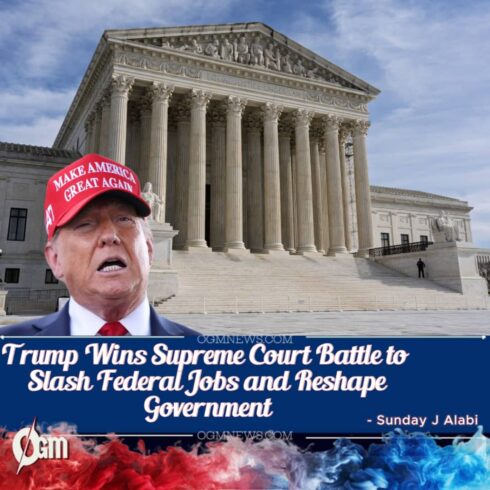
In a major legal victory for President Donald Trump, the U.S. Supreme Court on Tuesday lifted a lower court injunction that had blocked the administration’s sweeping plans to lay off thousands of federal workers across nearly two dozen government agencies. The decision allows the White House to move forward with its ambitious efforts to reorganize and dramatically shrink the size of the federal government, a central pillar of Trump’s second-term agenda.
The Supreme Court’s unsigned opinion concluded that the government is likely to prevail on the merits of its argument that President Trump’s executive order and related directives are lawful. The Court emphasized that while the specific agency plans for reductions-in-force (RIFs) are not yet before it, the injunction against the broader executive actions was unjustified.
Justices Split as Critics Warn of Executive Overreach
The Supreme Court’s decision was not unanimous. Justice Ketanji Brown Jackson issued a sharp dissent, accusing the Court of showing undue “enthusiasm” for enabling what she described as the president’s “legally dubious actions” in the absence of a full judicial review. Justice Sonia Sotomayor also expressed concern, though she agreed to grant the stay, highlighting that any specific agency plans still need to be scrutinized for legality.
“The president cannot restructure federal agencies in a way that violates congressional mandates,” Sotomayor cautioned, underscoring that the broader constitutional questions have yet to be fully addressed by the judiciary. This split in the Supreme Court reflects the deep legal and political tensions surrounding the Trump administration’s aggressive push to centralize control over the federal workforce.
The Role of the Department of Government Efficiency (DOGE)
At the heart of the layoffs plan is the White House’s Department of Government Efficiency, or DOGE, an office created by President Trump to spearhead his vision of a leaner, more efficient government. DOGE has proposed significant cuts to staff, programs, and services across multiple agencies, arguing that such measures are necessary to reduce bureaucracy and save taxpayer dollars.
The Justice Department, in its appeal to the Supreme Court, argued that the president has clear authority to manage executive branch personnel without needing explicit congressional approval for each organizational change. Solicitor General D. John Sauer contended that the lower court’s injunction interfered with the Executive Branch’s core constitutional powers.
Administration Applauds Decision as Step Toward Government Reform
Attorney General Pam Bondi celebrated the Supreme Court’s decision, declaring it a victory for both the administration and the American public. “The Supreme Court has stopped lawless lower courts from restricting President Trump’s authority over federal personnel,” Bondi wrote on social media. “Now, federal agencies can become more efficient than ever before.”
The administration has long argued that the federal government is bloated and inefficient, with redundant programs and outdated organizational structures. By moving forward with the planned layoffs and agency consolidations, the Trump White House aims to reshape the public sector into what it describes as a more streamlined and fiscally responsible apparatus.
Unions and Critics Sound Alarm Over Potential Damage
Federal employee unions and legal advocacy groups reacted with alarm to the Supreme Court’s ruling. In their brief to the Court, union lawyers warned that allowing the administration to implement mass layoffs before the full legal merits are resolved would cause “irreversible damage” to government operations and the livelihoods of hundreds of thousands of public servants.
“Offices and functions across the federal government will be abolished, agencies will be radically downsized beyond what Congress authorized, and critical government services will be lost,” the unions wrote. They emphasized that without proper congressional oversight, the president’s actions threaten to upend the constitutional balance of powers.
Legal Battle Far from Over as Focus Shifts to Lower Courts
Although the Supreme Court lifted the injunction, it explicitly left the door open for the lower courts to examine the legality of specific agency reorganization plans on a case-by-case basis. This means the underlying legal challenges to the president’s actions are ongoing and could eventually return to the high court for a final ruling.
For now, the Trump administration can proceed with implementing reduction-in-force policies while the courts continue to assess whether these actions comply with existing laws governing federal employment and agency structure. Legal analysts suggest that further litigation is inevitable as individual agencies execute their respective layoffs and restructuring initiatives.
Implications Of Supreme Court Verdict for Federal Workforce and Public Services
The decision is expected to have sweeping implications for federal workers, many of whom now face job insecurity as agencies prepare for potential cuts. The reductions could impact a wide range of services, including public health programs, environmental regulation, and social safety net services.
Critics argue that the layoffs may disproportionately harm vulnerable populations that rely on federal assistance, while supporters claim the move is a necessary correction to decades of unchecked government expansion. As the Trump administration accelerates its efforts to downsize the federal workforce, the nation watches closely to see how the balance between efficiency and essential public service will be struck.

UGzrBFjwbgJgETzy