

























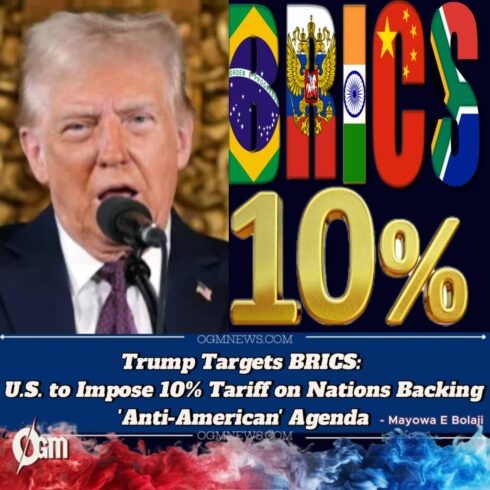
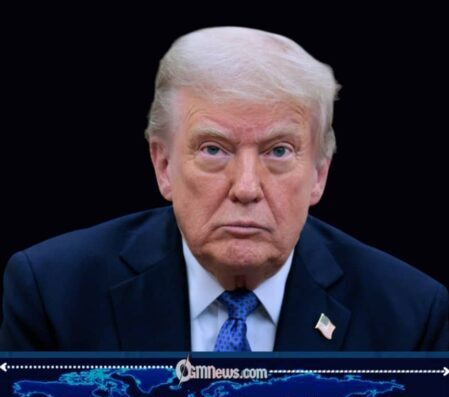
President Donald Trump has announced a sweeping economic policy targeting nations aligning with the BRICS bloc, declaring a 10% tariff on imports from any country that supports what he described as “the anti-American economic agenda of BRICS.” Speaking at a policy roundtable with industrial leaders, Trump underscored his second-term commitment to protecting American industries and pushing back against what he labeled “foreign adversarial alliances.”
Trump’s remarks come amid rising global tensions and deepening cooperation among BRICS nations—Brazil, Russia, India, China, and South Africa, with recent expansions including countries like Iran, Egypt, and Saudi Arabia. “We are not going to allow any country to gain from our market while working against our interests,” Trump asserted. “If you side with BRICS, you side against America. And you will pay a price—10% at the border.”
Framing BRICS as an ‘Anti-American Economic Bloc’
Trump described BRICS not merely as an economic cooperation platform but as a growing geopolitical threat. “They want to replace the dollar, weaken our trade position, and empower authoritarian regimes,” he stated. “This is not free trade—it’s a hostile takeover in slow motion.”
Critics argue that Trump’s characterization of BRICS oversimplifies the bloc’s objectives, which many see as a response to Western dominance in global finance and trade. Still, Trump’s base has responded positively to his narrative of economic nationalism and resistance to what he termed “globalist manipulation.”
A Second-Term Trade Doctrine Reignited
This latest announcement signals a revival of Trump’s hardline trade doctrine, which defined his first term in office, notably through the U.S.–China trade war and threats to exit multilateral agreements. His return to the Oval Office has reignited debates about the future of U.S. trade policy and its implications for the global economy.
“We are bringing trade back under control,” Trump said. “No more one-sided deals. No more sellouts. America comes first, and we’ll enforce it with tariffs, penalties, and production at home.” The administration has reportedly begun preparing a list of countries for tariff enforcement, prioritizing those entering new trade or currency arrangements with BRICS members.
All Eyes on Brazil, India, and South Africa
Brazil, India, and South Africa—democracies within the BRICS framework—now face a diplomatic tightrope. All three enjoy significant trade relations with the United States and may be forced to balance economic pragmatism with geopolitical loyalty.
While Indian officials have not responded formally to Trump’s comments, insiders suggest New Delhi is watching closely for how the tariff plan would be executed. Brazil’s Ministry of Economy warned that any blanket tariff policy could damage the “complex trade ties” between the two nations. South Africa, meanwhile, reaffirmed its commitment to non-alignment and multilateralism, stating that “South Africa’s foreign policy is not for sale.”
China and Russia React with Defiance
China and Russia, key power players within BRICS, immediately dismissed Trump’s threats. Beijing’s Ministry of Commerce called the tariff announcement a “tactic of economic coercion”, while Russia’s Foreign Ministry labeled it an act of “neo-imperialism disguised as patriotism.”
Both countries reiterated their commitment to de-dollarization and alternative global financial systems, doubling down on BRICS’s initiative to explore a shared currency. “The days of Washington dictating global rules through economic blackmail are numbered,” said Russian Deputy Foreign Minister Sergei Ryabkov.
U.S. Industry Leaders Divided Over the Tariff Policy
American business leaders expressed mixed reactions. While some applauded Trump’s nationalist stance, others warned that a blanket 10% tariff could harm domestic manufacturing reliant on global supply chains, especially those importing from Asia and Latin America.
The National Association of Manufacturers (NAM) issued a cautious statement: “We support fair trade, but indiscriminate tariffs could backfire by raising input costs and disrupting production.” Meanwhile, Trump-aligned CEOs praised the decision, claiming it would revive domestic production and reassert American economic strength.
Impact on Global Trade and Dollar Dominance
Economists are warning of far-reaching consequences. If enforced, the policy could trigger a new wave of trade retaliation, slow down global trade growth, and accelerate the BRICS-led shift away from the U.S. dollar. The International Monetary Fund (IMF) cautioned against “unilateral trade actions that undermine international cooperation.”
“America risks isolating itself at a time when global fragmentation is already deepening,” said Dr. Lisa Anwar, a senior economist at the World Bank. “Such tariffs may provide short-term gains for political optics, but the long-term costs to U.S. credibility and the dollar’s dominance could be severe”.
Democrats and Globalists Sound Alarm Bells
Democratic lawmakers and internationalist think tanks have blasted Trump’s announcement, accusing him of “weaponizing trade” to score nationalist political points. Senate Majority Leader Chuck Schumer warned that “Trump’s tariffs will not strengthen America—they’ll isolate it, enrage allies, and undermine free trade principles.”
Foreign policy experts argue that the decision reflects a strategic pivot away from multilateral diplomacy and toward economic confrontation. “Trump is reorienting U.S. power from cooperation to coercion,” said Ambassador Laura Preston, former U.S. envoy to the WTO. “This may prove costly in the long run.”
Tariffs as Tools of Geopolitical Warfare
Trump’s 10% tariff declaration marks a transformative shift in U.S. foreign and trade policy, reinforcing his administration’s view of economic tools as strategic weapons. Whether this approach will strengthen America’s global position or lead to deeper divisions remains to be seen.
As the BRICS bloc expands its influence and alternative systems emerge, Trump’s second-term strategy sets the stage for an economic Cold War, with tariffs as the first line of fire. The world is now watching which nations will choose alliance—or resistance.

[…] […]