



























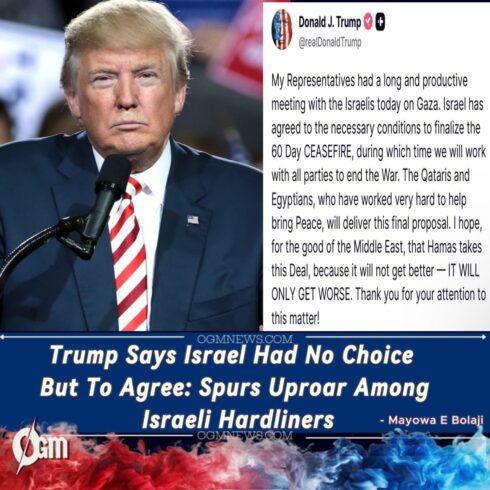
President Donald Trump has revealed that Israel has formally agreed to the essential conditions necessary to establish a 60-day ceasefire in Gaza. This development signals a potential turning point in a brutal and protracted conflict that has left thousands dead, displaced over a million people, and stoked global outrage.
Speaking from the White House, President Trump emphasized the United States’ pivotal role in brokering this advancement, calling it “a moment for humanity and regional sanity.” The announcement marks the most tangible progress in ceasefire negotiations since the resurgence of hostilities between Israel and Hamas in late 2023.
Trump: “We’ve Gotten the Israelis to Yes”
President Trump began his statement by declaring: “We’ve gotten the Israelis to yes,” a phrase loaded with diplomatic triumph and urgency. He confirmed that Israeli Prime Minister Benjamin Netanyahu has accepted a framework proposed by the U.S. and Qatar to facilitate an immediate cessation of airstrikes and ground operations in Gaza.
Trump emphasized that the deal is contingent upon Hamas reciprocating in full. “The ceasefire only becomes real if Hamas agrees to stop launching rockets and release the remaining hostages, including American citizens,” Trump stated. According to White House sources, indirect negotiations through Egypt and Qatar have yielded “substantive indicators” that Hamas may also sign on.
Terms of the Ceasefire: What’s in the Deal?
Under the draft proposal, both parties will observe a 60-day halt to all military activities. In exchange, Hamas is expected to release an estimated 25 hostages in staggered phases. In return, Israel will allow the entry of significantly more humanitarian aid, including food, water, and medical supplies, into northern Gaza.
Moreover, Israel has agreed to suspend airstrikes and refrain from entering population-dense zones in Gaza during the ceasefire. The IDF will maintain defensive positions but will limit movement and aerial surveillance. This temporary arrangement is designed to pave the way for a broader, more permanent peace mechanism being drafted by American and Arab negotiators.
U.S. Leverages Diplomatic Might in Middle East Arena
The White House confirmed that CIA Director William Burns and Secretary of State Mike Pompeo have been in “daily, high-level communications” with Qatari and Egyptian counterparts. Trump’s administration has also used its leverage with Saudi Arabia and the United Arab Emirates to exert pressure on both sides to come to the table.
Trump’s decision to deploy Jared Kushner again as a special envoy for Middle East peace is seen by insiders as a strategic move to tap into established diplomatic rapport. “We are not spectators—we’re peacemakers,” Trump stated emphatically. Analysts note this assertive diplomatic choreography differs sharply from the Biden-era passive mediation model.
Mixed Reactions from Global Leaders and NGOs
Reactions from international actors have been swift and divided. The United Nations Secretary-General, António Guterres, welcomed the progress but cautioned that “sustainable peace will require structural changes and mutual recognition.” Meanwhile, French President Emmanuel Macron offered support but called for independent observers to monitor ceasefire adherence.
In contrast, several human rights organizations remain skeptical. Amnesty International has issued a statement urging both sides to permit unimpeded humanitarian access and warned of the dangers of a “cosmetic ceasefire” without accountability for alleged war crimes. Nonetheless, aid agencies have expressed cautious optimism that even a temporary truce could prevent famine and disease from engulfing Gaza’s civilian population.
OGMNews.COM
Donald Trump Forces Netanyahu’s Hand in Gaza: Critics Slam U.S. Meddling as Ceasefire Nears
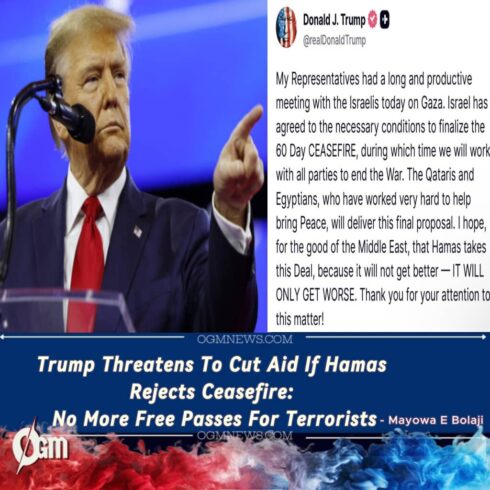
In Tel Aviv, the Israeli Knesset remains divided. While Netanyahu has publicly endorsed the terms under Trump’s pressure, far-right coalition members are expressing dissent. Finance Minister Bezalel Smotrich warned that a ceasefire could “revive Hamas militarily and politically,” calling it a “strategic blunder.”
Conversely, opposition leader Yair Lapid commended Trump’s diplomacy and called on Netanyahu to “finally put civilian lives over political survival.” Public opinion in Israel is equally split, with growing anti-war protests clashing with security hardliners calling for total military victory.
Hamas’ Silence: Strategy or Stalling?
As of press time, Hamas has neither accepted nor rejected the ceasefire framework. However, sources close to Qatari mediators suggest that internal deliberations are underway, with significant factions within Hamas leadership reportedly leaning toward acceptance.
Some analysts believe Hamas is using the pause to negotiate better terms, particularly concerning the withdrawal of Israeli tanks and the restoration of communication infrastructure in Gaza. “It’s a delicate balance for them—accept too soon, and they appear weak; wait too long, and the deal evaporates,” said Dr. Lina el-Hassan, a conflict resolution expert based in Doha.
Domestic Political Impact for Trump in an Election Year
This diplomatic success arrives as President Trump gears up for what promises to be a fiercely contested presidential election. By securing what could be the first significant lull in Gaza since the October 2023 escalation, Trump adds foreign policy gravitas to his re-election campaign.
Polls conducted by Gallup last week showed an increase in public approval for Trump’s handling of the Middle East, particularly among independent voters and Jewish-American communities. The White House is expected to highlight this breakthrough heavily at the Republican National Convention scheduled later this summer.
What Comes Next: A Peace or a Pause?
While the ceasefire offers a rare flicker of hope in a region exhausted by war, experts warn that 60 days may not be enough to address the core drivers of the conflict. Trump acknowledged this in his address: “This is not the end—it’s the beginning of something that could lead to real peace, not just another pause.”
Negotiators are already working on a second phase agreement that would address long-term border security, political reconciliation between Fatah and Hamas, and the reconstruction of Gaza with U.S. and EU support. Whether this initial 60-day window can be extended into a permanent cessation of hostilities remains the pressing question.


[…] […]