

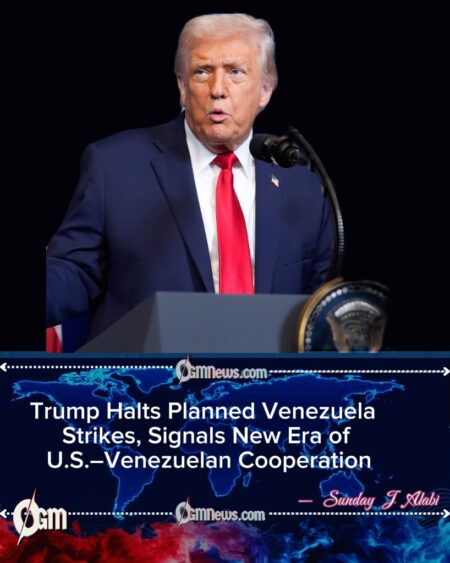
President Trump has announced the cancellation of a planned “second wave of attacks” on Venezuela, citing improved cooperation from Venezuelan authorities and progress on shared objectives, particularly in energy sector reconstruction and the release of political prisoners. The surprise announcement comes amid intensifying debate in the U.S. Congress over military authority and the scope of the administration’s actions in the region.
U.S. President Trump Cancels Planned Military Action
In an early January statement, President Trump declared that a second wave of military strikes on Venezuela would not go forward, framing the decision as a response to cooperation from Venezuelan officials and meaningful gestures such as the release of political prisoners. He described the move as a positive sign of “seeking peace” and suggested that rebuilding Venezuela’s oil and gas infrastructure was a priority that reduced the need for further conflict.
Trump emphasized that U.S. naval forces would remain in strategic positions “for safety and security purposes,” underscoring continued caution even as overt military escalation is paused. The announcement was posted by the president on his social platform and widely reported by U.S. and international media.
Energy cooperation — particularly involving substantial private investment from U.S. oil companies — was highlighted as a key factor in Trump’s decision. The administration plans to host oil industry executives at the White House to discuss potential investments in Venezuela’s energy sector.
Congressional Response: War Powers and Checks on Executive Action
Trump’s decision coincides with a sharp response from the U.S. Senate, where lawmakers advanced a war powers resolution aimed at limiting the president’s authority to conduct further military operations in Venezuela without explicit congressional approval. In a rare bipartisan move, five Republican senators joined Democrats in supporting the measure, which passed a procedural vote 52–47.
The resolution is largely symbolic — it must still pass both chambers and survive a likely presidential veto to become law. Nonetheless, its advancement reflects growing unease in Congress about unilateral executive action and the legal justifications underpinning the administration’s military policies.
Senators backing the resolution stressed the constitutional imperative for Congress to assert its role in authorizing the use of military force, particularly after a surprise U.S. operation last week that resulted in Venezuelan President Nicolás Maduro’s capture.
Political Prisoner Releases and Diplomatic Signals
As the U.S. recalibrates its approach to Venezuela, Caracas has released numerous political prisoners — an action the White House welcomed as a gesture of goodwill. These releases, which included prominent activists and opposition figures, were credited in part to U.S. influence and pressure.
While the move drew praise from human rights advocates and families of the released, critics remain cautious, noting that hundreds of political detainees reportedly remain in Venezuelan custody. The long-term impact on Venezuela’s broader political climate is yet to be seen.
Shifting Alliances: Meeting With Opposition Leader Machado
In another significant development, President Trump confirmed that he plans to meet Venezuelan opposition leader María Corina Machado in Washington next week. Machado, who recently received international recognition for her advocacy work, has been a contentious figure in Venezuelan politics and had previously faced barriers to leadership participation under the Maduro regime.
The planned meeting underscores the administration’s interest in engaging with a broader array of Venezuelan political actors, even as Trump previously cast doubts on Machado’s domestic support. Her visit to the White House is seen as both a diplomatic step and a signal of U.S. influence in the country’s internal dynamics.
Regional and Global Repercussions
The United States’ recent military and political actions in Venezuela have not occurred in isolation. They follow a controversial U.S. operation that led to the capture and transfer of Venezuelan President Maduro and his wife to the United States on federal drug charges — a move that drew sharp accusations of aggression from Venezuelan officials and stirred international debate.
Critics of Trump’s policy argue that such tactics risk destabilizing the region and could set precedents for U.S. interventionism, while supporters frame the strategy as a necessary measure against narcotics trafficking and authoritarian governance. As the situation evolves, global reactions from key powers and regional bodies are likely to shape future policy decisions.
Looking Ahead: Diplomacy, Oil, and Oversight
With overt military escalation paused, attention now turns to diplomatic engagement, economic reconstruction, and congressional oversight. The administration’s focus on energy — particularly through potential investments totaling tens of billions of dollars — may redefine U.S.–Venezuelan ties and influence the balance between economic leverage and geopolitical strategy.
However, the prospects for a political settlement in Venezuela remain uncertain. The interplay between internal Venezuelan factions, U.S. policy priorities, and international reactions will continue to shape developments in the months ahead.