










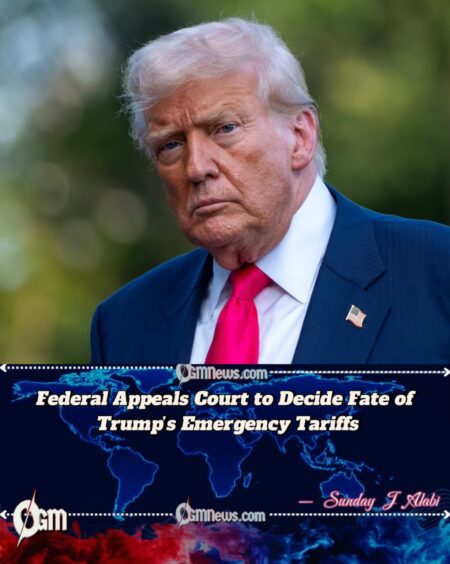
The U.S. Court of Appeals for the Federal Circuit is set to hear pivotal arguments today on the legality of President Donald Trump’s sweeping tariffs imposed under emergency powers. The outcome could reshape executive authority on trade and impact the heart of Trump’s economic strategy, just months before the 2024 election.
A Legal Battle Over Presidential Power
At the center of the case is Trump’s controversial use of the International Emergency Economic Powers Act (IEEPA) to levy 10% tariffs on nearly every U.S. trading partner. Trump declared April 2 “Liberation Day” and framed the sweeping tariffs as essential to combating trade deficits and drug trafficking — namely, fentanyl imports from countries like China, Canada, and Mexico.
However, a three-judge panel from the U.S. Court of International Trade (CIT) ruled earlier this year that IEEPA does not grant the president the authority to impose such broad duties, particularly since the law does not mention tariffs or duties. The panel blocked the tariffs, but the Federal Circuit temporarily reinstated them pending today’s appeal.
Twelve states and five small businesses filed the original challenge, warning that Trump’s interpretation of IEEPA would allow any president to unilaterally reshape the U.S. tariff code by declaring a national emergency over long-standing trade deficits.
A Constitutional Tug-of-War
The challengers argue that Trump’s actions not only exceed the boundaries of IEEPA but also violate two long-standing legal doctrines: the Major Questions Doctrine and the Nondelegation Doctrine.
Under the Major Questions Doctrine, any action of significant political or economic consequence must have clear congressional authorization. The challengers contend that there is no such clarity in IEEPA, which has historically been used for sanctions, not tariffs.
The Nondelegation Doctrine, meanwhile, holds that Congress cannot delegate its legislative power without setting clear guidelines. The plaintiffs argue that Trump’s blanket tariffs rewrite trade policy without any “intelligible principle” from Congress to support them. “Congress alone has constitutional authority to impose tariffs,” lawyers for the states wrote in their filing. “But under President Trump’s reading of IEEPA, Congress gave him the authority to rewrite the tariff schedules at his whim.”
Trump’s Defense: National Emergency Justified Tariffs
The Trump administration has forcefully defended its position. In court filings, Justice Department lawyers say the former president acted within legal limits, invoking national security and economic urgency as justification.
According to the DOJ, “America’s exploding trade deficit,” the “fentanyl crisis,” and economic vulnerabilities constituted national emergencies. These threats, they argue, fell squarely under IEEPA’s threshold of “unusual and extraordinary” threats.
Furthermore, Trump’s legal team warned that the CIT’s ruling could disrupt ongoing diplomatic efforts with major trading partners and eliminate a powerful tool that has helped secure new trade deals with five Asian nations, the United Kingdom, and the European Union. “Affirming the injunction would unilaterally deprive the U.S. of a powerful tool for combating systemic distortions in the global trading system,” they warned.
Liberation Day Tariffs and Political Ramifications
Trump’s tariffs remain one of the most contentious elements of his 2024 presidential campaign. On his Truth Social platform Thursday morning, the former president called the court case “America’s big case,” and said, “If our country was not able to protect itself by using tariffs against tariffs, we would be dead, with no chance of survival or success.”
Initially, the tariffs set a 10% blanket rate on nearly all imports, with higher reciprocal tariffs slated for dozens of nations. Though Trump paused those higher rates for 90 days, they are set to resume Friday. He’s also signaled that countries without trade deals could face tariffs of up to 20%.
Critics, including economists, warn that Trump’s approach could fuel higher consumer prices, trade wars, and slower economic growth. Yet Trump has touted the tariffs as successful leverage that forced trade partners to the negotiating table — even if at the expense of global stability.
What Comes Next: Appeals and Supreme Court Showdown Loom
The Federal Circuit’s ruling — expected in the coming weeks or months — is unlikely to be the final word. Whichever side loses is expected to appeal to the Supreme Court, setting up a potential clash before the conservative-leaning bench.
However, a favorable ruling for Trump is not guaranteed. Legal scholars note that the Supreme Court’s conservative majority has shown increasing skepticism of unchecked executive authority in economic and regulatory matters, making it possible the justices could curb Trump’s expansive reading of IEEPA.
Ultimately, the court’s ruling will not only determine the fate of Trump’s “Liberation Day” tariffs, but also set a critical precedent for presidential power over trade — a constitutional question with lasting implications for future administrations.


