


















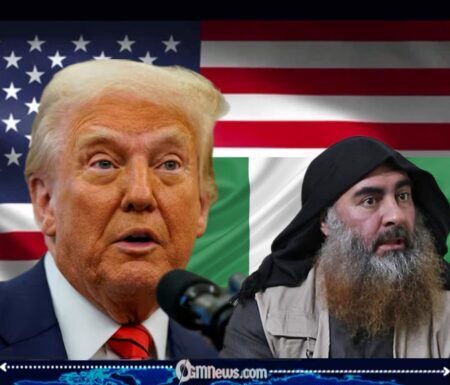
Trump’s announcement of a successful joint U.S.-Nigeria operation against ISIS commander Abu-Bilal al-Minuki has quickly transformed from a celebrated counterterrorism victory into a global controversy fueled by old screenshots, resurfaced military reports, and relentless social media fact-checking. The current president declared that American forces, working alongside Nigerian troops, eliminated what he described as “the most active terrorist in the world,” but the internet responded with a question that has since dominated online conversations: how many times can one terrorist reportedly die?
The controversy erupted almost immediately after Trump’s late-night statement on Truth Social, where he praised intelligence operatives and claimed the ISIS figure believed he could hide safely somewhere in Africa. Within hours, Nigerians online began sharing archived reports and social media posts from 2024 alleging that the same terrorist had already been killed during earlier Nigerian military operations. The sudden contradiction turned what was meant to be a victory headline into a trending debate over intelligence accuracy, political messaging, and the internet’s growing ability to challenge official narratives in real time.
Social Media Digs Up Old Receipts After Trump’s Dramatic ISIS Announcement
Trump’s announcement centered on Abu-Bilal al-Minuki, a figure reportedly linked to ISIS operations across West Africa and the Sahel region. According to statements attributed to U.S. officials, the operation involved close cooperation between American forces and Nigeria’s military in tracking and neutralizing the suspected extremist leader. The mission was portrayed as a major success in the broader global effort against ISIS affiliates operating far beyond the Middle East.
However, the controversy surrounding the operation intensified when Nigerians online resurfaced older reports claiming al-Minuki had already been eliminated in 2024. Archived military updates and social media posts circulated rapidly, with users mocking the apparent contradiction and questioning whether the same figure had been “killed twice.” While security analysts note that militant commanders frequently use aliases and false identities, the existence of older claims significantly complicated the credibility of the latest announcement and fueled widespread skepticism online.
America Eliminate a Terrorist or Recycle an Old Nigerian Headline?
The Trump controversy has also drawn attention to the increasingly dangerous expansion of ISIS-linked groups across parts of Africa. Security experts have repeatedly warned that while ISIS lost major territory in Iraq and Syria, affiliated networks in West Africa have continued to grow in influence through insurgent attacks, kidnappings, and territorial control in remote regions. Nigeria, in particular, remains one of the countries facing sustained threats from Boko Haram and ISIS West Africa Province militants despite years of military operations.
Counterterrorism specialists say confusion surrounding militant deaths is not unusual in asymmetric warfare. In many cases, governments announce successful operations based on preliminary intelligence only for later discoveries to contradict earlier reports. Some experts believe the earlier 2024 reports may have involved mistaken identity, inaccurate battlefield assessments, or confusion surrounding multiple aliases allegedly used by extremist figures. Others argue the controversy exposes how political leaders increasingly rush to publicize security victories before independent verification is fully completed.
At the same time, the incident highlights a major shift in modern information warfare. In previous decades, official military statements often shaped public understanding with limited immediate challenge. Today, archived tweets, screenshots, and digital records can rapidly undermine or complicate official narratives within minutes of publication. What once would have remained a minor discrepancy buried in intelligence circles can now become an international social media controversy overnight.
As questions continue surrounding Trump’s announcement and the true timeline of Abu-Bilal al-Minuki’s reported death, both U.S. and Nigerian authorities may face mounting pressure to provide clearer operational details and independent confirmation. Until then, the controversy serves as both a reminder of the complexities of counterterrorism operations and an example of how digital memory now competes directly with political messaging in shaping global perception.



Logging in is a breeze and the site stability is amazing even during peak hours....