




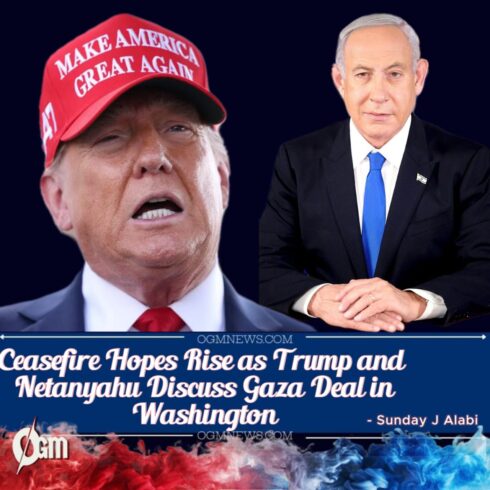
President Donald Trump has expressed optimism over the ongoing efforts to broker a ceasefire in Gaza, saying negotiations between Israel and Hamas are “going along very well.” Speaking during an unscheduled media appearance at the White House while hosting Israeli Prime Minister Benjamin Netanyahu, Trump said he believed Hamas was ready to agree to an end to the 21-month conflict.
“They want to meet and they want to have that ceasefire,” Trump told reporters. The comments marked one of the strongest indications yet of Trump’s personal involvement in trying to bring an end to the devastating conflict, which has left tens of thousands dead and Gaza in ruins. The president’s remarks come amid indirect talks taking place in Doha, Qatar, aimed at brokering a temporary truce and a hostage exchange between the warring sides.
Trump has previously indicated he would be “very firm” with Netanyahu about ending the war, and on Monday said: “I don’t think there’s a hold-up. I think things are going along very well. We’ll have a deal.”
Netanyahu Hints at Palestinian Relocation Options Amid Statehood Concerns
During the joint appearance, Prime Minister Netanyahu appeared to open the door to controversial proposals for the relocation of Palestinians, saying his government, in cooperation with the US, was exploring options with neighboring countries. “If people want to stay, they can stay, but if they want to leave, they should be able to leave,” Netanyahu stated.
However, the idea of relocating Palestinians has been met with fierce opposition from the Palestinian Authority, which has condemned such plans as violations of international law. Netanyahu also appeared to dismiss the prospect of granting Palestinians full statehood, insisting that Israel would always maintain security control over the Gaza Strip. “People may say it’s not a state — we don’t care,” he remarked, underscoring Israel’s security-first approach.
These remarks signal continued Israeli resistance to long-standing Palestinian aspirations for sovereignty, raising doubts about whether any ceasefire deal would pave the way for broader political solutions.
Trump’s Nobel Nomination and US Commitment to Peace Efforts
In a symbolic gesture during the meeting, Netanyahu presented Trump with a letter he sent nominating the US president for the Nobel Peace Prize. “He’s forging peace as we speak, in one country, in one region after the other,” Netanyahu said, referencing Trump’s role in the recent ceasefire between Israel and Iran and other regional diplomatic breakthroughs.
Trump, who has long coveted the prestigious award, was visibly pleased but remained focused on the Gaza conflict, reiterating that securing an immediate ceasefire and the release of hostages remained his top priority. White House spokeswoman Karoline Leavitt later emphasized that ending the Gaza war is Trump’s “utmost priority” and called on Hamas to accept the 60-day truce “right now.”
US officials, including Secretary of State Marco Rubio and Middle East envoy Steve Witkoff, have been intensively engaged in the ceasefire push, underscoring Washington’s determination to bring both sides to an agreement as the conflict nears its 22nd month.
Ceasefire Proposal Details and Persistent Obstacles
The current US-backed proposal on the table reportedly includes a 60-day truce during which Hamas would release 10 living hostages along with the bodies of 18 deceased captives, in exchange for Israel withdrawing from parts of Gaza and freeing Palestinian prisoners. The ceasefire would be implemented in five stages, with negotiations for a permanent solution continuing throughout the truce.
However, significant hurdles remain. Hamas has demanded the cessation of activities by the Gaza Humanitarian Foundation, an issue Israel refuses to discuss, citing limitations on its negotiators’ authority. Another sticking point is Hamas’s insistence on guarantees that the truce would be extended beyond the initial 60 days if necessary—a demand the US has so far not committed to in writing.
US Ambassador to Israel Mike Huckabee, when asked whether Trump would provide such a guarantee, responded cautiously: “I’m not a prophet. I cannot predict the future.” This uncertainty underscores the fragility of the talks despite the apparent progress.
Diplomatic Pressure and Protests as Netanyahu Visits Washington
Netanyahu’s visit to Washington—his third since Trump’s return to office six months ago—has drawn both high-level diplomatic engagement and fierce public protests. The Israeli leader met with key US officials, including Secretary Rubio and envoy Witkoff, as part of the administration’s efforts to finalize a ceasefire deal.
Outside the White House, dozens of protesters gathered, waving Palestinian flags and calling for Netanyahu’s arrest over alleged war crimes. The International Criminal Court (ICC) has issued arrest warrants for Netanyahu, his former defense minister Yoav Gallant, and Hamas commander Mohammed Deif, citing possible crimes against humanity. The Trump administration has dismissed the ICC’s actions as “baseless” and imposed sanctions on ICC judges involved in the case.
Despite the protests and legal controversies, Netanyahu’s reception at the White House reflected the strong alliance between Israel and the Trump administration, particularly on matters of security and regional stability.
Broader Regional Implications and Future Prospects
The latest round of indirect negotiations in Doha underscores the urgency of ending the Gaza conflict, especially in light of the recent 12-day escalation between Israel and Iran. The US successfully brokered a ceasefire in that conflict, fueling hopes that similar diplomatic efforts could bear fruit in Gaza.
Middle East envoy Steve Witkoff is expected to join the Doha talks later this week, aiming to finalize a ceasefire deal. Trump has also expressed a willingness to lift sanctions on Iran, signaling a broader diplomatic offensive to stabilize the region. However, the complex realities on the ground, including differing demands from Israel and Hamas, continue to threaten the fragile progress.
For now, Trump remains publicly optimistic, believing there is a “good chance” of achieving a breakthrough. Whether that optimism translates into a durable ceasefire remains to be seen as negotiations enter a crucial phase.