





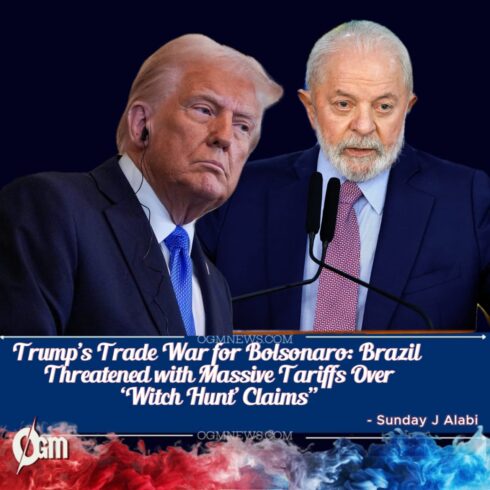
President Donald Trump announced on Wednesday his administration’s decision to impose a staggering 50% tariff on Brazilian imports starting next month, citing what he described as a politically motivated prosecution of former Brazilian President Jair Bolsonaro. The move, which marks one of the steepest tariffs ever threatened against a U.S. trading partner, has drawn sharp global attention and immediate pushback from Brazil.
Mr. Trump called the ongoing legal proceedings against Bolsonaro an “international disgrace” and labeled them a “Witch Hunt that should end immediately.” His administration has already sent similar tariff warning letters to nearly 20 countries in recent days, but Brazil is the only nation to face the full brunt of a 50% duty as of now.
Trump Links Tariffs to Bolsonaro Case and Free Speech Concerns
In his open letter to Brazilian officials, President Trump excoriated the South American country for what he characterized as unjust attacks on Bolsonaro, whom he described as a political victim. Trump’s message also blasted Brazil for alleged infringements on the free speech rights of Americans, an apparent reference to Brazilian judicial scrutiny of Elon Musk’s social media platform X and other U.S.-based tech companies.
“LEAVE BOLSONARO ALONE!” Trump wrote on his Truth Social account earlier this week, calling the prosecution an attack not only on Bolsonaro but on democracy itself. The president has long shown support for Bolsonaro, often referred to as the “Trump of the Tropics” for his right-wing populism and contentious political style.
Brazil Vows Retaliation, Cites Sovereignty and Trade Imbalance
In swift response, Brazilian President Luiz Inácio Lula da Silva condemned the U.S. tariff threat, asserting that Brazil is a sovereign nation with independent judicial institutions. Lula emphasized that Bolsonaro’s legal proceedings fall strictly under Brazilian jurisdiction and warned that his country would respond to any U.S. tariffs by invoking Brazil’s economic reciprocity law, which permits countermeasures including import restrictions.
“Brazil will not accept any form of tutelage,” Lula posted on X, further highlighting that the U.S. currently enjoys a trade surplus with Brazil, having exported $49 billion in goods last year compared to Brazil’s $42 billion in exports to the U.S.
Escalating Global Trade Frictions as Tariffs Take Center Stage
The Brazil tariff threat comes on the heels of Trump’s broader tariff campaign targeting nations he accuses of exploiting American markets or aligning with anti-U.S. policies. Earlier this year, the president unveiled sweeping tariffs against dozens of countries, only to delay their implementation for three months. With that pause expiring, Trump has reignited his tariff threats, aiming to pressure foreign governments into renegotiating trade relationships.
The administration has also floated an additional 10% tariff on any countries perceived to be aligning with BRICS, an economic bloc that includes Brazil, Russia, India, China, and South Africa. Trump’s tariffs have been praised by some U.S. manufacturers but have sparked fears among economists of rising consumer prices, potential trade wars, and global economic slowdowns.
Trade Representative Ordered to Investigate Brazilian Practices
In tandem with the tariff announcement, President Trump instructed U.S. Trade Representative Jamieson Greer to launch a formal investigation into Brazil’s alleged unfair trade practices. The probe will focus on Brazil’s digital trade policies, including regulatory actions against American tech firms, and the country’s relatively high average import tariffs, which stood at 11.2% as of 2023 according to a USTR report.
The investigation is expected to examine Brazil’s use of import licensing, ethanol tariffs, and other market barriers that U.S. businesses claim create uncertainty and hinder trade. Trump indicated that the administration may consider revising the tariff threat if Brazil demonstrates willingness to address these concerns.
Bolsonaro’s Legal Woes Fuel Diplomatic Firestorm
The case against Jair Bolsonaro remains a deeply polarizing issue within Brazil and now threatens to spill over into the U.S.-Brazil diplomatic relationship. Bolsonaro, who was indicted last year over an alleged coup attempt following his 2022 electoral defeat, is accused of plotting to poison President Lula and attack Brazil’s Supreme Court. His legal team has vigorously denied the allegations, framing the charges as politically driven.
Bolsonaro has also been barred from seeking public office until 2030 after raising unfounded claims about Brazil’s electronic voting system. Trump’s vocal defense of Bolsonaro echoes his own past grievances about electoral processes and has drawn criticism from international observers who warn against undermining judicial independence.
Looking Ahead: Global Markets and Diplomatic Fallout
As the August 1 tariff deadline approaches, the world is watching closely to see how Brazil and other countries respond to the Trump administration’s aggressive trade stance. While some U.S. industries may benefit from protectionist measures, analysts warn that escalating tariffs could disrupt global supply chains, strain diplomatic relations, and drive up prices for American consumers.
The latest developments underscore how President Trump continues to intertwine trade policy with his broader political and ideological battles, using economic leverage to influence foreign governments while defending allies like Bolsonaro. Whether this strategy will yield favorable outcomes or provoke backlash remains to be seen in the volatile landscape of international trade.