









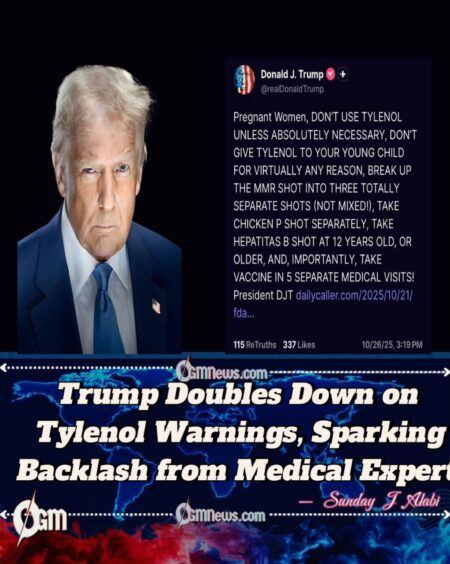
President Donald Trump has once again warned Americans against the use of Tylenol—known generically as acetaminophen—particularly among pregnant women and young children. In a strongly worded Truth Social post on Sunday, the president Trump urged parents to “avoid Tylenol unless absolutely necessary” and reiterated his stance that the drug could be linked to autism.
The comments echo Trump’s earlier statements from a September 22 press conference with Health and Human Services Secretary Robert F. Kennedy Jr., where he claimed taking Tylenol during pregnancy “can be associated with a very increased risk of autism.” At the time, the president said expecting mothers should “tough it out” rather than risk potential harm from the medication.
Trump’s latest post also revisited his concerns about childhood vaccination schedules, suggesting that the MMR (measles, mumps, and rubella) vaccine should be split into three separate doses and that other vaccines, including those for chickenpox and hepatitis B, should be administered later and at wider intervals.
Medical Experts and Industry Push Back President Trump Remarks
The president Trump’s remarks have drawn sharp criticism from public health professionals and the pharmaceutical industry. Kenvue, the parent company of Tylenol, told the opitanglobamedia news that the science overwhelmingly shows acetaminophen to be safe when used as directed.
“We believe independent, sound science clearly shows that taking acetaminophen does not cause autism,” the company said. “We strongly disagree with any suggestion otherwise and are deeply concerned about the health risks and confusion this poses for expecting mothers and parents.”
Medical experts point out that acetaminophen is considered one of the safest pain relief options during pregnancy when taken in recommended doses. They warn that avoiding the drug entirely could lead women to suffer through fever and pain—conditions that can themselves pose risks to pregnancy if untreated.
The Centers for Disease Control and Prevention (CDC) maintains that no credible evidence links acetaminophen to autism, and that the causes of autism are complex, involving a combination of genetic and environmental factors rather than a single medication or vaccine.
Public Debate Over Autism and Vaccine Policy
The renewed controversy comes as the Trump administration continues to focus on what it has described as the “autism crisis.” Citing recent CDC data showing that autism prevalence in the U.S. has increased from one in 36 children to one in 31, Trump has called the rise “one of the most alarming medical crises in history.”
Health Secretary Kennedy, who has previously described autism as “running rampant,” is leading a federal review into the potential environmental and chemical factors contributing to the increase. However, many experts have cautioned that such rhetoric risks fueling misinformation about vaccines and medications.
While Trump’s administration continues to explore what it calls “potentially overlooked contributors” to the rise in autism diagnoses, public health authorities insist that existing vaccine and medication guidance remains safe, evidence-based, and essential to preventing serious illness.