






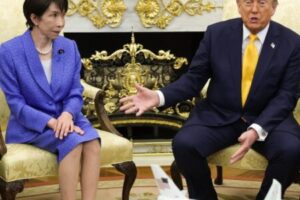

United States President Donald Trump on Thursday defended his administration’s decision to withhold advance notice from key allies, including Japan, ahead of recent military strikes on Iran, arguing that operational surprise was essential to the mission’s success. Speaking during a meeting at the White House with Japanese Prime Minister Sanae Takaichi, Trump referenced the 1941 attack on Pearl Harbor to justify the approach, a remark that drew visible surprise from his guest and sparked broader diplomatic discussion.
The president Trump comments came in response to questions from a Japanese journalist, highlighting concerns in Tokyo over the lack of prior communication regarding the February 28 operation. While emphasizing the strategic necessity of secrecy, Trump’s historical comparison introduced a sensitive dimension to an already delicate geopolitical moment.
Strategic Secrecy and Military Justification
President Trump explained that the decision not to inform allies in advance was rooted in the need to maintain tactical advantage. According to him, disclosing operational details—even to close partners—could have compromised the effectiveness of the strikes.
He stressed that modern military engagements often depend on speed and unpredictability. “If I go and tell everybody about it, there’s no longer a surprise,” the president said, underscoring the administration’s belief that secrecy was indispensable to achieving its objectives against Iran.
The February 28 strikes, though not fully detailed publicly, are understood to be part of a broader U.S. posture aimed at deterring Iranian actions in the region. By withholding prior notice, the administration signaled a willingness to act unilaterally when necessary, even at the risk of unsettling allies.
Pearl Harbor Remark Draws Attention
In defending the lack of prior notification, Trump referenced the Attack on Pearl Harbor, stating, “Who knows better about surprise than Japan?” The remark, delivered during a bilateral meeting, introduced an unexpected historical analogy into a contemporary security discussion.
Observers noted that Prime Minister Takaichi appeared momentarily taken aback, with her reaction reflecting the sensitivity of invoking such a deeply significant event in U.S.-Japan relations. While she did not publicly respond to the comment at the time, the moment quickly drew attention from both diplomatic and media circles.
The comparison raised questions about tone and appropriateness, given the enduring historical weight of Pearl Harbor in both nations’ collective memory. Analysts suggest that while the president’s intention was to emphasize the importance of surprise in military operations, the analogy may have overshadowed the broader policy message.
Japan’s Response and Diplomatic Context
The question from the Japanese reporter highlighted a degree of confusion within Japan regarding the U.S. decision-making process. As a longstanding ally, Tokyo typically expects a certain level of coordination on major security actions, particularly those with potential regional implications.
Prime Minister Takaichi, who communicated largely through a translator during the meeting, maintained a composed demeanor despite the unexpected turn in the conversation. The Japanese government has not issued a formal protest, but diplomatic observers suggest that the issue may be addressed through quieter channels.
Later in the day, the White House released an official photograph of the two leaders, both smiling and giving thumbs up, signaling an effort to project unity despite the earlier exchange.
Historical Sensitivities in U.S.-Japan Relations
The reference to Pearl Harbor inevitably recalled one of the most pivotal moments in U.S.-Japan history. The 1941 attack led to the United States’ entry into World War II and resulted in the deaths of more than 2,400 Americans.
In recent decades, both nations have made significant efforts to reconcile and strengthen their alliance. A notable milestone occurred in 2016, when then-Japanese Prime Minister Shinzo Abe visited the memorial site alongside then-U.S. President Barack Obama, offering condolences and reaffirming the enduring partnership between the two countries.
Abe described himself as “rendered entirely speechless” by the scale of the loss and expressed gratitude for the reconciliation that followed. His remarks underscored how far bilateral relations have evolved since the war, making contemporary references to that era particularly sensitive.
Trump’s Relationship with Japan’s Leadership
President Trump previously maintained a close personal relationship with Shinzo Abe, which was widely seen as strengthening U.S.-Japan ties during their respective tenures. The two leaders frequently met and coordinated on economic and security issues.
However, that dynamic has not been fully replicated with more recent Japanese leadership, including Prime Minister Takaichi. While formal alliances remain strong, the tone and style of engagement have differed, reflecting changes in both leadership and global circumstances.
Abe’s assassination in 2022 marked the end of a significant chapter in Japan’s political history and removed a key figure who had played a central role in fostering ties with Washington during Trump’s earlier presidency.
Broader Implications for Allied Coordination
The episode raises broader questions about how the United States balances operational secrecy with alliance management. While surprise can be a critical component of military success, allies often expect consultation, particularly in actions that may have regional consequences.
Experts suggest that maintaining trust among allies requires careful calibration between confidentiality and communication. The lack of prior notice in this instance may prompt discussions within allied circles about expectations and protocols for future operations.
As global security challenges grow increasingly complex, the ability of the U.S. to coordinate effectively with its partners will remain a key factor in shaping international stability. The reaction from Japan, both publicly and privately, may offer insight into how such dynamics evolve in the coming months.
President Trump’s defense of secrecy in the Iran strikes underscores the enduring tension between military strategy and diplomatic expectations. While the administration maintains that surprise was essential, the invocation of Pearl Harbor has added a layer of historical sensitivity to an already complex issue. As the United States and Japan continue to navigate their alliance, the episode serves as a reminder of the importance of both strategic clarity and cultural awareness in international relations


