









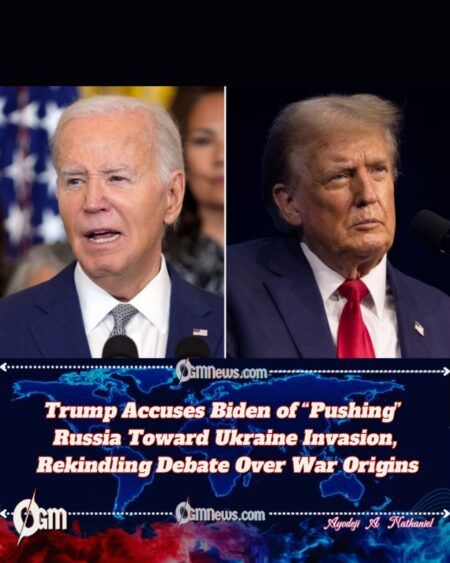
President Trump, now serving his second term as the current U.S. president, intensified his criticism of Joe Biden after asserting that the former president’s actions “pushed” Russia toward launching its 2022 invasion of Ukraine. In a remark that reignites long-running disputes over responsibility for the war, Trump said, “Biden actually pushed for that war to happen. If you can believe it, nobody can believe it.” The statement adds new weight to a contentious political narrative as both domestic and international observers continue to evaluate the conditions that shaped the conflict.
A Sharp Escalation in Trump’s Post-2022 Critiques
President Trump has repeatedly argued that the Russia–Ukraine conflict would not have occurred under his leadership, positioning Biden’s foreign-policy decisions as central to the outbreak of hostilities. His latest comments reflect an even more pointed accusation, suggesting that Biden’s posture toward Kyiv and Moscow heightened tensions instead of deterring them.
Trump’s claim aligns with a broader argument he has made since returning to office: that global adversaries act more aggressively when U.S. leadership is inconsistent or, in his view, strategically incoherent. His remarks come as the administration continues shaping its second-term foreign-policy approach, seeking to reorient America’s global posture after what Trump describes as “the failures of the Biden era.”
Examining the Argument: A Debate Over Policy and Perception
Trump’s accusation that Biden “pushed” Russia toward war reflects a long-standing dispute over the impact of U.S. policies leading up to the invasion. Supporters of Trump argue that Biden’s early 2021 decisions—particularly regarding energy, defense posture, and diplomacy—may have signaled weakness to Moscow. They claim these factors contributed to Russian confidence that an invasion would face limited deterrence.
Critics, however, view Trump’s framing as oversimplified, noting that Russia’s strategic ambitions and underlying grievances long predated Biden’s presidency. They argue that the invasion was the culmination of years of territorial, security, and political tension, and that attributing the war to a single administration’s decisions risks misreading the complexity of the conflict.
Global Reaction and Diplomatic Sensitivities
Trump’s claim carries diplomatic implications at a time when the United States continues navigating a fragile geopolitical environment. Foreign governments are closely monitoring statements from Washington to assess how the renewed Trump presidency will approach both the Kremlin and NATO allies.
European partners remain especially attentive. Many remember the intense debates of Trump’s first term and now seek clarity on how his second-term strategy will influence longstanding commitments. Trump’s criticism of Biden may therefore shape not only domestic political messaging but also the tone of U.S. engagement abroad.
Domestic Political Landscape and Partisan Reactions
Trump’s remarks have already triggered strong reactions across the political spectrum. Republican supporters largely echo his narrative, arguing that Biden’s foreign-policy decisions contributed to instability and emboldened Russian aggression. For many in the GOP, the issue reinforces a broader critique of Democratic-led diplomacy.
Democrats, meanwhile, have dismissed Trump’s claim as revisionist and inflammatory, accusing him of misrepresenting both the timeline and the roots of the conflict. They contend that U.S. support for Ukraine under Biden was a necessary response, not a provocation, and view Trump’s comments as a political maneuver rather than a strategic assessment.
A Renewed Spotlight on U.S. Leadership in Eastern Europe
As Trump continues reshaping global engagement during his second term, the Russia–Ukraine war remains a central test of American foreign policy. Trump has repeatedly signaled interest in negotiating an accelerated end to the conflict, though specifics remain contested both inside and outside the administration.
For now, his latest remarks reflect a broader effort to reframe the origins of the war and redistribute political responsibility. Whether that framing influences public opinion or foreign-policy direction will be closely watched in the months ahead.


