







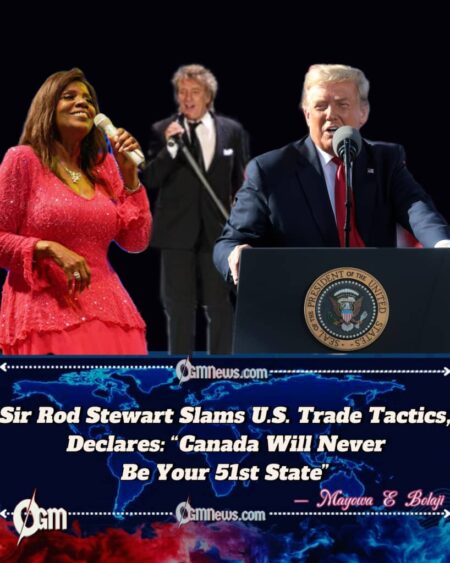
Sir Rod Stewart transformed Gloria Gaynor’s iconic anthem into a biting response to recent remarks by U.S. President Donald Trump. With modified lyrics celebrating Canada’s resolve and a defiant expletive-laden proclamation—“51st state, my f—king ass!”—Stewart sent the crowd into a frenzy, echoing broader tensions over tariffs and trade policy.
Sir Rod Stewart closed his Toronto concert at Budweiser Stage with a bold artistic statement that merged entertainment with political protest. Instead of ending on his usual hits, he chose to rework Gaynor’s “I Will Survive” into a pointed rebuttal to President Trump’s recent trade remarks. His altered lyrics celebrated Canadian resilience while denouncing any suggestion of annexation, backed by a video montage of Canadian landmarks and cultural icons.
Sir Rod Stewart punctuated the finale with the now-viral declaration, “51st state my f—king ass,” before saluting the audience with “Go on Canada!” The moment was met with roaring applause, instantly turning the performance into a social media flashpoint.
A Political Backdrop: Tariffs and Trade Talks
Sir Rod Stewart’s performance unfolded against a backdrop of tense U.S.-Canada trade relations. Over the summer, President Trump introduced tariffs as high as 35% on Canadian goods, while floating the controversial notion of Canada becoming America’s “51st state” to eliminate trade barriers. The remark drew swift condemnation from Canadian officials and ignited public debate on national sovereignty.
Sir Rod Stewart channeled that tension into his performance, making it clear that music could be a vessel for national pride and political dissent. His lyrical adaptation served not only as entertainment but also as a spirited rejection of economic and political pressure.
From Buddy to Bystander: Stewart’s Changing View
Sir Rod Stewart once enjoyed a cordial relationship with President Trump, attending social events together in the years before Trump’s presidency. But in interviews, Stewart has acknowledged that the man he knew changed once in office, citing disagreements over policy, conduct toward women, and an increasingly combative public persona.
Sir Rod Stewart’s shift from friend to outspoken critic added a layer of personal conviction to his Toronto performance. His reimagined anthem was not merely satire—it was a public declaration of disappointment and disapproval from someone who had seen Trump’s evolution firsthand.
Gloria Gaynor’s Anthem Gets a New Life
Sir Rod Stewart’s choice to adapt “I Will Survive” was both symbolic and strategic. Gloria Gaynor’s 1978 classic has long been associated with resilience in the face of adversity, embraced by communities and movements worldwide. By infusing the song with Canada-specific lyrics—“we have all we really need, we will live without your greed”—he retooled the anthem into a modern rallying cry.
Sir Rod Stewart used the song’s cultural familiarity to connect instantly with his audience. What began as a disco hit became, in his hands, a political weapon and a declaration of national independence.
Audience Reaction: A Resounding Chorus
Sir Rod Stewart’s performance drew immediate and enthusiastic responses from the crowd. Fans erupted in cheers at the first altered lyric and were on their feet long before the final expletive-laced rejection of the “51st state” label. Many later posted videos online, praising his courage and comedic timing.
Sir Rod Stewart’s name trended across Canadian Twitter that night, with supporters calling the moment “brilliant,” “legendary,” and “exactly what we needed.” Music critics lauded the blending of humor and activism, noting that few veteran performers so openly engage in contemporary political disputes.
When Pop Meets Politics on Stage
Sir Rod Stewart’s act was a reminder that musicians have long used their platforms to comment on political and social issues. By pairing an upbeat, familiar melody with politically barbed lyrics, he created a performance that was as memorable for its message as for its music.
Sir Rod Stewart demonstrated that concerts can be more than just entertainment—they can be stages for civic engagement and statements of cultural identity. His approach stood out for its mix of levity, pride, and unapologetic defiance.
More Than Music: A Statement of Identity
Sir Rod Stewart’s Toronto finale went beyond criticizing tariffs—it asserted the very essence of Canadian sovereignty. His choice of words and visuals conveyed solidarity with Canada’s national pride, positioning the country as a self-reliant force unwilling to bow to political pressure from any foreign power.
Sir Rod Stewart’s adaptation resonated deeply with Canadians who saw themselves reflected in the lyrics. It was a musical affirmation that their identity is not for negotiation.
Legacy of the Moment
Sir Rod Stewart’s decision to use a major tour stop for political commentary will likely be remembered as one of the defining moments of his later career. For many, it was a nostalgic reminder that rock legends can still be agents of cultural and political change.
Sir Rod Stewart may have simply intended to amuse and embolden his audience, but the broader effect was to add a cultural chapter to the ongoing U.S.-Canada political narrative.
What Happens Next?
Sir Rod Stewart’s performance comes as trade talks between Ottawa and Washington remain strained. His public rejection of the “51st state” concept might embolden others in the public eye to speak up, further shaping public sentiment.
Sir Rod Stewart, knowingly or not, has demonstrated the enduring power of music as both protest and proclamation. Whether through song or speech, his Toronto finale will echo far beyond the Budweiser Stage.