







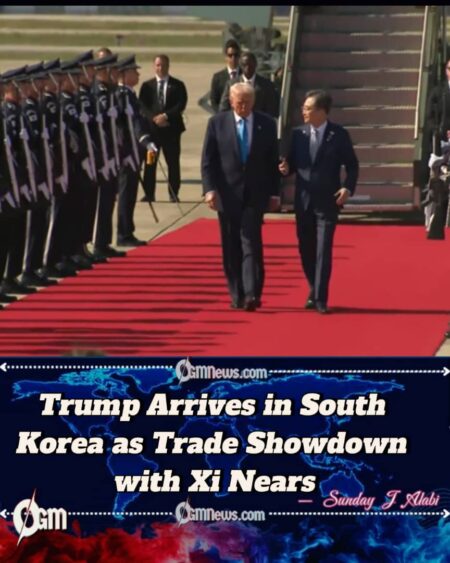
President Trump arrived Wednesday in Gyeongju, South Korea, marking the final leg of his five-day Asia tour that has centered on trade, investment, and economic cooperation. The U.S. president, serving his second term, is attending the Asia-Pacific Economic Cooperation (APEC) summit before holding a highly anticipated bilateral meeting with Chinese President Xi Jinping.
Mr. Trump’s visit to South Korea follows earlier stops in Malaysia and Japan, where he concluded several major trade agreements aimed at strengthening America’s economic footprint in the Pacific region. The president Trump described his trip as part of a broader effort to “rebalance trade” and “secure fair terms” for American industries.
In Japan, Mr. Trump signed a trade accord with Prime Minister Sanae Takaichi that fixed tariffs on imported Japanese goods at 15%, down from an initially proposed 25%. Japan, in turn, pledged $550 billion in U.S. investments. Similar framework agreements were announced with Malaysia, Vietnam, Cambodia, and Thailand during the tour.
Trade Talks and Strategic Goals at APEC
At the Gyeongju summit, President Trump is expected to deliver remarks emphasizing “economic sovereignty” and “reciprocal trade” among the 21 APEC member nations, including China, Russia, Mexico, and Vietnam. The president is also pursuing a trade deal with South Korea, the United States’ sixth-largest trading partner, to finalize a framework introduced earlier this year.
Under the proposed terms, the U.S. would impose 15% tariffs on South Korean goods while Seoul invests billions into U.S. industries and expands its market for American-made vehicles. Treasury Secretary Scott Bessent told reporters that the deal is nearing completion but may not be signed this week.
Beyond trade, the summit carries geopolitical weight. Gyeongju’s location—far from Seoul and the North Korean border—has drawn attention as the president has left open the possibility of meeting North Korean leader Kim Jong Un, though no such engagement is planned. During his first term, Mr. Trump made history as the first sitting U.S. president to cross into North Korea, a moment that briefly thawed relations on the peninsula.
Tense Anticipation Ahead of Trump-Xi Meeting
The centerpiece of the trip remains President Trump’s upcoming face-to-face meeting with Xi Jinping, amid ongoing U.S.-China trade tensions. The Trump administration has pressed Beijing to lift stringent export restrictions on rare earth elements—vital materials for chipmaking and defense production—or face new 100% tariffs as early as Saturday.
While Treasury Secretary Bessent has indicated that previously threatened tariffs may be “off the table,” the White House continues to insist that China relax market barriers, particularly for U.S. tech and agricultural exports. The president is also expected to raise issues surrounding the transfer of TikTok’s U.S. operations from ByteDance, the Chinese parent company, as Washington seeks to secure domestic control over the platform.
Nicholas Burns, who served as U.S. ambassador to China during the Biden administration, called the Trump-Xi meeting “a test of wills” between the world’s two largest economies. “China remains the most important competitor and adversary of the United States worldwide,” Burns said. “The stakes are enormous, and both sides know it.