






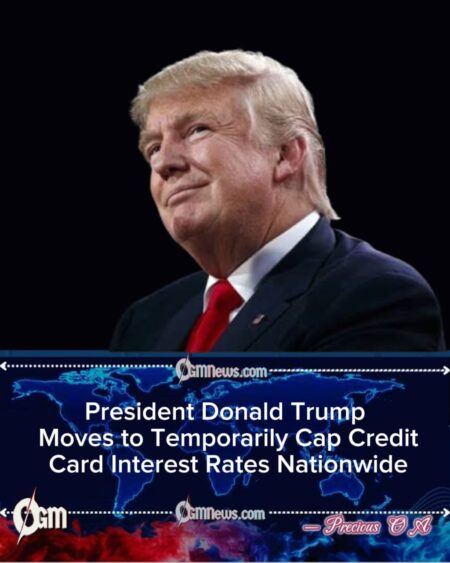
President Donald Trump announced a sweeping proposal to temporarily cap credit card interest rates, framing the move as an emergency consumer-relief measure aimed at protecting working Americans from spiraling household debt. Speaking during a campaign-style policy briefing, he said families were being “crushed by interest” and that the federal government had both the authority and the responsibility to step in.
The proposal would establish a national ceiling on annual percentage rates charged by credit card companies for a defined period, allowing borrowers to stabilize balances and avoid compounding interest traps. Trump characterized the measure as temporary but “absolutely necessary,” arguing that existing market conditions no longer reflect fair competition.
Financial analysts immediately noted that the announcement represents one of the most direct interventions in consumer credit markets proposed by a modern U.S. president, signaling a potentially historic shift in how interest regulation could be handled at the federal level.
Why the Rate Cap Is Being Proposed
Rising inflation and higher benchmark interest rates have caused average credit card APRs to surge above 25 percent nationwide. Many households now pay more in interest than principal on long-standing balances, creating what economists describe as “negative amortization debt cycles.”
The administration has pointed to mounting evidence that families are turning to credit cards not for discretionary spending, but to cover groceries, utilities, rent, and medical bills. Consumer protection groups have warned that this trend could result in a long-term debt crisis.
President Donald Trump has framed the situation as a market failure rather than a normal economic fluctuation, stating that extraordinary conditions justify extraordinary remedies.
What the Cap Could Look Like
Early drafts circulating among policy advisors suggest a proposed ceiling between 10 and 15 percent APR for standard consumer credit cards. Premium cards with luxury benefits may receive separate regulatory treatment.
The cap would apply nationally and override state-level usury laws for the duration of the emergency period, potentially lasting 12 to 24 months depending on economic conditions.
President Donald Trump emphasized that the cap would be temporary, describing it as a “reset button” designed to allow households to regain financial footing rather than a permanent restructuring of private lending markets.
How Banks and Lenders Are Responding
Major financial institutions have already expressed concern about profitability and risk modeling under a capped-rate system. Banking associations warn that tighter margins could reduce access to credit for high-risk borrowers.
Some lenders fear that issuers may respond by tightening approval standards or cutting credit limits, which could disproportionately affect low-income households. Others argue that more responsible lending would be a positive long-term outcome.
President Donald Trump countered those arguments, stating that banks have “had years of record profits” and can afford to shoulder short-term adjustments to protect consumers.
Public and Political Reaction
The proposal has sparked intense debate in Congress. Supporters call it bold, populist, and overdue, while critics warn of unintended consequences and potential disruptions to private credit markets.
Several consumer advocacy groups praised the initiative as one of the strongest federal interventions on behalf of indebted Americans in decades. They argue that unchecked interest compounding has effectively trapped millions in perpetual repayment.
President Donald Trump has urged lawmakers to move quickly, describing the plan as a “fast relief lever” that could deliver measurable benefits within months rather than years.
Economic Implications and Next Steps
Economists are divided on the long-term impact. Some predict that capping rates could stimulate consumer spending by freeing up disposable income, while others warn that credit contraction could offset those gains.
Treasury officials are reportedly working with regulatory agencies to draft implementation frameworks, including enforcement mechanisms, exemptions, and penalties for violations.
President Donald Trump concluded by saying that if lenders cooperate and the economy stabilizes, the cap could be phased out smoothly without market disruption.
A Broader Shift in Consumer Protection Policy
Beyond the rate cap itself, the proposal signals a broader philosophical shift toward direct federal involvement in household financial stability. It reflects growing political momentum for stronger consumer-side regulation.
Policy analysts say this could open the door to future reforms involving payday lending, overdraft fees, and installment financing practices that currently operate with minimal oversight.
President Donald Trump has hinted that this move may be “just the beginning” of a larger agenda aimed at reducing what he calls “debt slavery in modern America.”
What Happens Now
Congressional committees are expected to begin hearings within weeks to debate the legal framework and economic consequences of the plan. If passed, implementation could occur before the end of the fiscal year.
State regulators, consumer groups, and financial institutions will all play roles in shaping the final version of the policy. Public input may also be solicited during the regulatory drafting phase.
The administration believes that once enacted, millions of Americans could see immediate relief on monthly statements, transforming the way everyday families experience credit in the United States.