





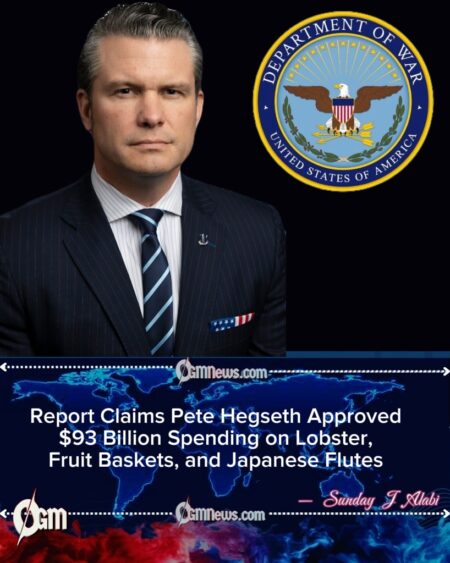
A viral social media claim alleging that U.S. Defense Secretary Pete Hegseth spent $94 billion on steak has circulated widely online, fueling criticism of government spending and drawing sharp reactions from commentators. The claim, however, distorts the findings of a broader review of Pentagon spending during September 2025, the final month of the federal government’s fiscal year.
Reports indicate that the U.S. Department of Defense spent roughly $93.4 billion during that single month, making it the largest September spending total since at least 2008. While the review highlighted some purchases critics described as extravagant—including large food orders and high-end equipment—the viral narrative suggesting the entire sum was used to buy steak is inaccurate. Instead, the steak purchases represented only a small portion of the overall expenditures.
Pentagon Spending Peaks at End of Fiscal Year
The surge in spending occurred in September 2025, when federal agencies often accelerate purchases before the fiscal year ends. Budget rules require agencies to use allocated funds within the fiscal year or risk losing them in future budgets, a dynamic sometimes referred to as the “use-it-or-lose-it” effect.
According to spending data cited in several reports, the Pentagon spent approximately $93.4 billion during that month alone. Analysts say such spikes are not unusual at the close of fiscal years, though the scale of the 2025 spending drew attention because it represented the highest September spending level recorded in more than a decade.
Critics argue that the pattern encourages agencies to rush purchases rather than carefully pace spending. Defense officials, however, often respond that many of the expenses reflect pre-approved contracts, supply purchases, and equipment acquisitions scheduled months in advance.
Food Purchases Fuel Online Controversy
Among the items listed in spending records were large food purchases intended to supply military bases, mess halls, and service operations worldwide. These purchases quickly became the focus of viral claims online.
Examples reported by multiple outlets included $15.1 million spent on ribeye steak, $6.9 million on lobster tail, $2 million on Alaskan king crab, and $1 million on salmon. Additional food-related spending included $139,224 on doughnuts and approximately $124,000 on ice-cream machines.
While these figures appear large in isolation, defense analysts note that such purchases are spread across thousands of facilities and hundreds of thousands of service members stationed globally. In that context, they represent bulk food supply purchases rather than luxury meals for a small group of officials.
High-Value Equipment and Purchases Also Scrutinized
Beyond food items, spending reports highlighted several purchases that critics described as unusually expensive for government budgets. These items were unrelated to food procurement but nevertheless contributed to the broader debate about Pentagon spending priorities.
Among the examples cited were a $98,329 Steinway grand piano reportedly purchased for the Air Force chief of staff’s residence, along with $5.3 million spent on Apple devices such as iPads. Reports also noted $225 million allocated for furniture purchases, including recliners and equipment stands for military facilities.
Another item that attracted attention was a $21,750 Japanese flute, listed among musical instruments purchased for military bands and ceremonial units. Such units often maintain professional-level instruments, though critics argue that high prices can still raise questions about procurement oversight.
Viral Narrative Misrepresents Pentagon Spending Breakdown
The viral claim that $94 billion was spent on steak appears to have emerged from a misunderstanding—or deliberate exaggeration—of the overall spending figure for the month. The Pentagon’s total September spending was roughly $93–$94 billion, but only a fraction of that amount involved food purchases, and an even smaller portion was spent specifically on steak.
Experts in federal budgeting say the confusion likely arose when commentators merged the total spending figure with one of the individual purchase categories, creating a misleading narrative that quickly spread online.
Fact-checking organizations and several major media outlets have since clarified that the steak purchases represented about $15 million, not billions. The broader spending included contracts, salaries, equipment, maintenance, and logistics across the entire Department of Defense.
Oversight Debate Continues in Washington
Despite the inaccuracies in the viral claim, the episode has intensified discussions in Washington about how federal agencies spend money at the end of the fiscal year. Lawmakers from both parties have periodically raised concerns about whether the “use-it-or-lose-it” budgeting system encourages unnecessary spending.
Advocates for reform argue that allowing agencies greater flexibility to carry funds into the next fiscal year could reduce pressure to make last-minute purchases. Others caution that the Department of Defense manages a complex global supply chain and that large procurement figures should be evaluated in context.
Officials within the Pentagon have not indicated any policy changes in response to the controversy, but analysts say scrutiny of defense spending is likely to remain a recurring issue as federal budgets continue to expand.
Viral Claims vs. Budget Reality
The claim that Defense Secretary Pete Hegseth spent $94 billion on steak does not accurately reflect Pentagon spending records. Instead, the figure refers to the total amount spent by the Department of Defense in September 2025, while the steak purchases accounted for only a small fraction of that total.
Nonetheless, the episode has reignited debate about federal budgeting practices, procurement oversight, and public perceptions of government spending, ensuring that the Pentagon’s year-end expenditures remain under close public and congressional scrutiny