




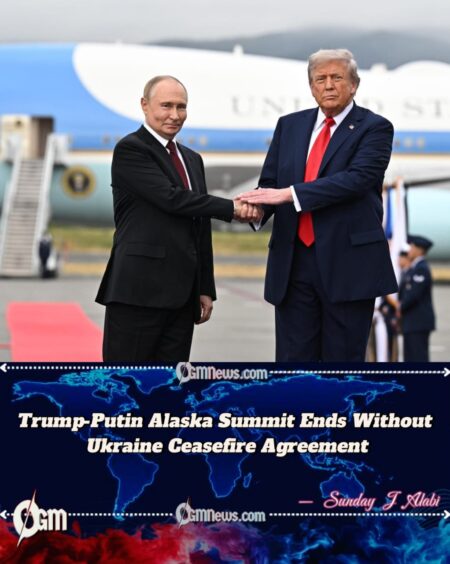
The much-anticipated summit between U.S. President Donald Trump and Russian President Vladimir Putin ended on Friday without securing a ceasefire in Ukraine. The two leaders, joined by a small circle of top advisers, met for nearly three hours at Joint Base Elmendorf-Richardson in Anchorage, Alaska, amid heavy security and a carefully staged welcome ceremony that included a military flyover.
While both sides described the meeting as “productive,” expectations of a concrete breakthrough were dashed. In his closing remarks, Putin alluded vaguely to “agreements,” but offered no details, while Mr. Trump said the talks were “extremely productive.” Crucially, neither man mentioned any progress on halting the ongoing conflict in Ukraine.
A broader session involving additional officials was quietly scrapped, suggesting the talks ended earlier than planned. The summit, billed as an opportunity to chart a path toward peace, instead highlighted the deep divisions that remain over how to end Europe’s deadliest war since World War II.
Trump Pushes Responsibility onto Zelenskyy
Following the summit, Mr. Trump sat for an interview with Fox News host Sean Hannity, in which he shifted responsibility for progress onto Ukrainian President Volodymyr Zelenskyy. “Now it’s really up to President Zelenskyy to get it done,” Trump said. He added that European nations must also “get involved a little bit,” but repeatedly emphasized Ukraine’s central role in deciding whether a ceasefire can be achieved.
Mr. Trump revealed that he and Putin had reached broad consensus on “most things,” but declined to specify the unresolved issues. “No, I’d rather not,” he said when pressed on the points of disagreement. He also asserted—without evidence—that Putin genuinely wants the war to end. “I think we’re pretty close to a deal,” Trump claimed. “Look, Ukraine has to agree to it. Maybe they’ll say no.”
Zelenskyy has long expressed willingness to negotiate a ceasefire if it leads to a genuine peace settlement. However, Moscow has consistently rejected such proposals, insisting on territorial concessions that Kyiv and its allies deem unacceptable. Trump’s comments, therefore, risk being seen as shifting blame onto Ukraine rather than holding Russia accountable.
Trump Walks Back Threats of “Severe” Consequences
In the days leading up to the summit, President Trump had warned of “severe” consequences if Russia refused to move toward peace. Analysts interpreted the remarks as a potential signal of harsher sanctions or penalties against countries buying Russian oil. Yet after his meeting with Putin, Trump appeared to soften his stance considerably.
“Because of what happened today, I think I don’t have to think about that,” Trump told Hannity when asked about punishing Russia. “Now, I may have to think about it in two weeks or three weeks or something. But we don’t have to think about that today.” He described the encounter with Putin as having gone “very well,” despite producing no agreement.
The apparent walk-back will likely raise questions in Washington and European capitals about the credibility of U.S. threats. Critics argue that easing pressure on Moscow without extracting concessions risks emboldening Putin and prolonging the conflict.
Shortened Talks Raise Eyebrows
The official White House schedule had indicated that Trump’s departure from Anchorage would take place at 5:45 p.m. local time. However, by shortly after 4 p.m., the president was already boarding Air Force One for the seven-hour flight back to Washington, D.C. He waved briefly at reporters before disappearing into the aircraft.
The early conclusion of the summit suggests that the talks may have reached an impasse sooner than anticipated. Analysts noted that the cancellation of the planned broader meeting was particularly telling. “When summits end earlier than scheduled, it almost always signals frustration,” one former diplomat observed.
Despite the upbeat tone struck by both leaders, the outcome underscores how far apart Washington, Moscow, and Kyiv remain on the core issue: whether Russia is willing to accept a ceasefire without territorial gains, and whether Ukraine will be pressured into making painful concessions.
Uncertain Road Ahead for Peace Efforts
The Alaska summit was Trump’s boldest attempt yet to position himself as a dealmaker capable of ending the war in Ukraine. Yet the lack of tangible progress has raised doubts about whether U.S.-Russia engagement alone can deliver results. With Zelenskyy and European leaders excluded from the Anchorage talks, the question now is whether Kyiv will view the summit as helpful or as an unwelcome attempt to dictate terms.
Trump has signaled he is willing to attend another meeting if Ukraine and Russia agree, but his insistence that “it’s up to Zelenskyy” may complicate matters. Moscow has shown little sign of compromise, while Kyiv continues to insist on the restoration of its full territorial integrity.
As Air Force One carried Trump back to Washington, the war raged on in Ukraine, with no ceasefire in sight. The Alaska summit, billed as a possible turning point, instead served as a reminder of the daunting obstacles that remain on the road to peace.