







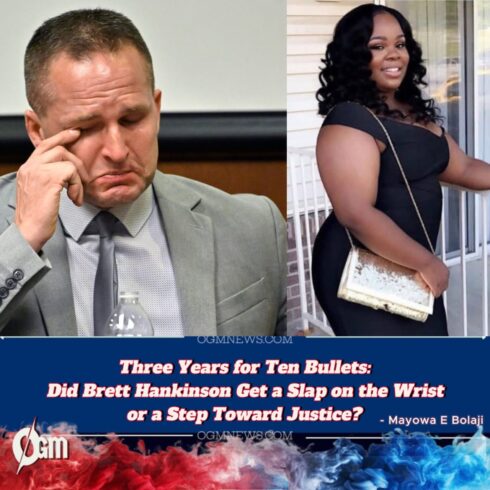
A federal judge sentenced Brett Hankinson, a former Louisville police officer, to three years in prison for his conduct during the 2020 botched no-knock raid that ended with the death of Breonna Taylor. The sentence goes against the Department of Justice’s recommendation for leniency, signaling a rare moment of judicial pushback against excessive force used by law enforcement.
Brett Hankinson, though not convicted directly for Taylor’s death, was held accountable for recklessly firing into her apartment, endangering neighbors and exacerbating an already deadly situation. His sentencing brings a critical chapter of the Taylor case to a close—but the national conversation surrounding it remains wide open.
Brett Hankinson Receives Sentence Against DOJ Advice
Brett Hankinson stood before U.S. District Judge Rebecca Grady Jennings as she imposed a three-year prison term—substantially more than what the Justice Department had recommended. The DOJ had cited his clean record and post-incident cooperation in arguing for a lighter sentence.
Hankinson listened silently as Judge Jennings declared that public trust in law enforcement hinges on accountability. She emphasized that Hankinson’s actions went beyond negligence, stating, “Firing blindly through covered windows into a residence is a betrayal of every oath a peace officer takes.”
Brett Hankinson’s Actions on the Night of the Raid
Brett Hankinson was one of several officers who took part in the March 13, 2020, no-knock raid on Breonna Taylor’s apartment in Louisville, Kentucky. The raid was part of a narcotics investigation involving Taylor’s ex-boyfriend, although no drugs were found in her home.
Hankinson, positioned outside the apartment, fired 10 rounds blindly through a covered sliding glass door and window. While none of his bullets struck Taylor, they penetrated the apartment and entered a neighboring unit, endangering three people. These actions led to his federal conviction for violating the civil rights of Taylor’s neighbors.
Brett Hankinson’s Sentence Sparks Public Outcry and Relief
Brett Hankinson’s three-year sentence drew immediate reactions from civil rights advocates, Taylor’s family, and the public. Many viewed the sentence as a long-overdue measure of accountability, albeit symbolic, given that no officer has been convicted for Taylor’s death itself.
Brett Hankinson, according to Breonna Taylor’s mother Tamika Palmer, “deserved more,” but she acknowledged that the sentence was at least a step toward justice. “We didn’t get full justice for Breonna,” Palmer said, “but Hankinson being held responsible for his recklessness matters.”
Brett Hankinson’s Legal Defense Fails to Sway Judge
Hankinson’s attorneys argued that their client acted in a high-stress, unpredictable environment and did not intend to harm anyone. They pointed to his previous acquittal in a state trial and claimed he had been made a scapegoat for broader institutional failures.
Hankinson, however, could not escape the court’s scrutiny for his specific actions that night. Judge Jennings firmly rejected the defense’s arguments, noting that “intent is not an excuse for endangering human life.” The judge reminded the courtroom that professional officers are expected to respond to fear with training—not indiscriminate gunfire.
Brett Hankinson’s Conviction Fuels Debate on No-Knock Raids
Hankinson’s case has once again shone a spotlight on the controversial practice of no-knock warrants. Critics argue that such raids, often carried out in the dead of night, increase the risk of deadly confrontations—especially in communities of color.
Hankinson’s trial exposed the dangers of these tactics, as his blind gunfire underscored the chaos and unpredictability such raids bring. Legislators in Kentucky responded with “Breonna’s Law,” banning no-knock warrants in Louisville. Advocates now call for federal legislation to do the same.
Brett Hankinson and the DOJ’s Soft Approach Draw Scrutiny
Brett Hankinson’s sentencing also put the Department of Justice under scrutiny for its recommendation of leniency. Critics—including prominent civil rights attorneys and elected officials—say the DOJ’s stance reflected a deeper reluctance to punish law enforcement even when wrongdoing is proven.
Hankinson’s defense benefitted from that recommendation, but Judge Jennings chose to prioritize community harm over bureaucratic leniency. “This court cannot ignore the facts,” she said, addressing the courtroom. “No badge justifies bullets through blinds.”
Brett Hankinson’s Sentence: Mixed Reactions from the Public
Brett Hankinson’s sentence has received a wide range of public responses. Some see it as a victory for justice reform, while others view it as merely a consolation prize that avoids confronting the system’s core problems.
Hankinson, to his critics, is the face of an unchecked culture of police impunity. To his supporters, he’s a casualty of political pressure. What remains clear is that public trust in law enforcement has been further strained—especially in Black communities that continue to demand meaningful reform.
Brett Hankinson and President Trump’s Brief Address
Hankinson’s sentencing was addressed briefly by U.S. President Donald Trump during a press conference at the White House. Trump affirmed that “law and order cannot come at the expense of innocent lives,” adding that officers must be held to the highest standards of conduct.
Hankinson was not defended or condemned directly by the President, who instead chose to frame the issue as one of institutional reform. “We support our police,” Trump said, “but justice must never be optional.”
Hankinson’s Case May Spark Lasting Policy Changes
Hankinson’s sentence, while not closing the Breonna Taylor case entirely, could have lasting policy implications. Federal lawmakers are now under increasing pressure to address gaps in civil rights protections and police oversight.
Hankinson’s trial served as a high-profile example of what happens when poor judgment meets a flawed system. As calls grow louder for national bans on no-knock raids and mandatory body cameras, the case may yet influence the future of American policing in more than symbolic terms.