







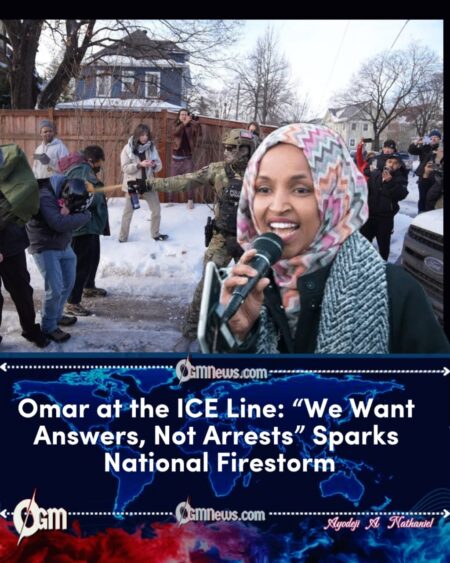
Rep. Ilhan Omar has become a focal point in a widening national debate after comments she delivered at a Minnesota protest against U.S. Immigration and Customs Enforcement (ICE). The remarks, made during demonstrations criticizing federal immigration practices, have drawn sharply divided reactions and intensified discussions about political speech, protest boundaries, and federal enforcement under President Donald Trump’s second term. As scrutiny grows, the episode reflects broader tensions shaping U.S. politics and public discourse.
Rep. Ilhan Omar Addresses Protesters Amid Heightened Tensions
Rep. Ilhan Omar spoke at a Minnesota protest organized by activists opposing ICE operations and broader federal immigration policies. The gathering occurred against the backdrop of ongoing demonstrations nationwide, driven by concerns over enforcement tactics, community impact, and transparency.
In her address, Rep. Ilhan Omar emphasized accountability and justice, using language that resonated strongly with supporters while alarming critics. Her words quickly circulated across traditional and social media, becoming a flashpoint in an already polarized political environment.
Rep. Ilhan Omar at the Center of Political Reactions
Republican lawmakers and conservative commentators argued that Rep. Ilhan Omar’s remarks risked inflaming tensions and sending an inappropriate signal during a volatile moment. They stressed that elected officials should take particular care to avoid rhetoric that could be interpreted as threatening toward law enforcement agencies.
Democratic allies and advocacy groups defended Rep. Ilhan Omar, contending that her comments were aimed at institutional accountability rather than individuals. They argued that criticism of ICE policy is a legitimate form of political expression and accused opponents of amplifying selective interpretations for partisan purposes.
Immigration Enforcement Under President Donald Trump’s Second Term
Immigration policy remains one of the defining issues of President Donald Trump’s second term as U.S. president. The administration has consistently defended ICE operations as lawful, necessary, and central to border security and national sovereignty.
Supporters of President Donald Trump maintain that firm enforcement requires unequivocal political backing and caution against language that could undermine federal authority. Critics counter that the administration’s approach has heightened fear in immigrant communities, fueling protests like the one where Rep. Ilhan Omar spoke.
Political Speech, Protest Rights, and Public Responsibility
The controversy surrounding Rep. Ilhan Omar has revived broader questions about the limits of political rhetoric. Constitutional experts note that political speech, particularly at protests, enjoys wide protections, even when statements are emotionally charged.
However, public officials are often held to a higher standard because of their influence. Law enforcement organizations have emphasized that while protest is a democratic right, leaders’ words can shape public behavior and perceptions of legitimacy.
Media Coverage and Competing Narratives
Media framing has played a central role in shaping reactions to the protest remarks. Short video clips and paraphrased quotations circulated widely, sometimes without full context, reinforcing polarized interpretations.
Analysts observe that such dynamics illustrate the challenges facing public figures like Rep. Ilhan Omar, whose statements are scrutinized not only for intent but also for potential impact in a fast-moving media environment.
Broader Implications for U.S. Politics
Beyond the immediate dispute, the episode underscores deeper divisions over immigration, law enforcement, and political accountability. As enforcement policies continue under President Donald Trump, similar controversies are likely to recur.
For Rep. Ilhan Omar and other national leaders, the moment highlights the delicate balance between forceful advocacy and responsible rhetoric. How political figures navigate that balance may shape public trust and the tone of future policy debates.