






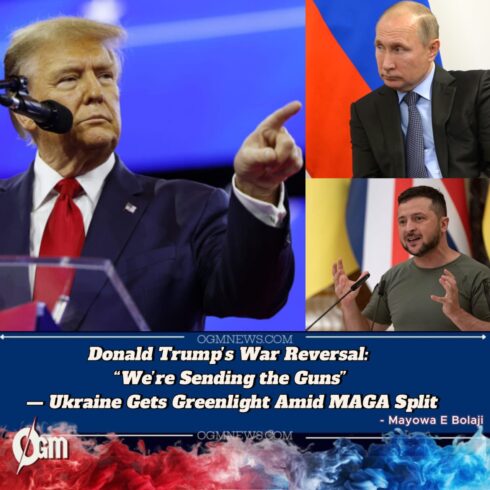
President Donald Trump, now in his second term, ignited international headlines after bluntly stating during a White House briefing that the United States “will have to send more weapons to Ukraine.” Trump described the move as a reluctant but necessary step in the face of Russia’s escalating assault on Ukrainian territory, calling the situation “critical for European and global stability.”
Donald Trump made the declaration after receiving urgent intelligence briefings indicating Russia’s expanding strikes in Kharkiv and the Donbas region. He stressed that the U.S. could no longer remain on the sidelines while “innocent civilians are being slaughtered by a madman’s military machine.”
Strategic U-Turn: Trump Breaks From His Previous Ukraine Doctrine
Donald Trump acknowledged that his position on Ukraine had evolved, stating, “Unlike before, what we’re seeing now is not just a border dispute—it’s a full-on attempt to redraw the map of Europe through force.” While previously wary of endless foreign aid, Trump now insists the stakes are too high for passive diplomacy.
Donald Trump said that although he still believes in “America First,” defending strategic allies like Ukraine is part of preserving American influence and deterring authoritarian threats globally. “When America stays strong abroad, we stay safe at home,” he said.
What’s in the Package? Trump Hints at “Smart, Powerful” Weapons Aid
Donald Trump described the planned military assistance as “smart, powerful, and precise.” He hinted that the aid package will likely include more HIMARS rocket launchers, long-range drones, and advanced air defense systems, though he stopped short of revealing specific quantities.
Donald Trump emphasized fiscal responsibility, warning that every dollar spent “must deliver maximum impact on the battlefield.” He promised that the Department of Defense would ensure no equipment is wasted or misused by Ukrainian forces.
Congressional Crossfire: Trump’s Allies Split, Opposition Watches
Donald Trump acknowledged internal divisions within the Republican Party, admitting, “Some of my friends in Congress want to focus only on the Southern border, and I respect that—but we can secure our borders and stand up to Putin at the same time.”
Donald Trump also challenged Democrats to support his aid strategy without “politicizing the war,” adding that this was not the time for partisan bickering. “We either act with strength or invite chaos,” he warned.
NATO Cheers While Moscow Threatens Fire and Fury
Donald Trump described NATO’s response as “very encouraging,” noting that European leaders—including those from Poland, Germany, and the UK—had pledged matching contributions of weapons and training. “This is what allied leadership looks like,” he said.
Donald Trump dismissed Vladimir Putin’s threats of retaliation as “predictable noise,” stating, “Russia will not dictate America’s foreign policy through fear or bluster.” However, he added that the U.S. remains prepared for “any possible escalation.”
Trump and the 2026 Election: War Moves with Political Repercussions
Donald Trump brushed aside suggestions that the announcement was politically motivated ahead of the 2026 midterms. “I don’t make war decisions based on polls—I make them based on principle,” he said during the press conference.
Donald Trump also used the moment to contrast his foreign policy approach with that of previous administrations. “They had weakness, we have strength. That’s the difference,” he declared, adding that a peaceful world “only respects bold action.”
Americans React: Unity, Division, and Uncertainty
Donald Trump pointed to recent opinion polls showing a divided nation but insisted that the majority of Americans “don’t want to see tyranny win.” He urged citizens to support the troops and “stand by our allies in freedom.”
Donald Trump appealed directly to young Americans, saying, “The future belongs to you—and it must be free from Russian dictatorship.” He called on communities to pray for peace but prepare for conflict.
Uncharted Waters, High Stakes
Donald Trump closed the briefing with a warning and a promise: “If we fail to act now, we will pay a much higher price later. But if we lead now, freedom will win.” He made it clear that this decision would shape the next decade of global security.
Donald Trump ended his remarks by stating, “We are not the world’s policeman—but we are the world’s last line of defense when evil knocks at the door. And today, it is knocking.”