











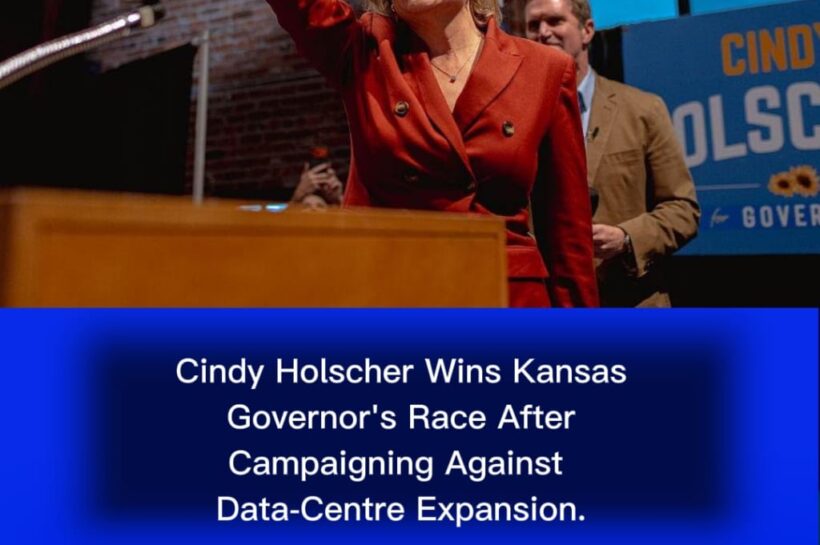















In a political development that has given Republicans another reason to examine their electoral strategy, Democrat Cindy Holscher has won the Kansas gubernatorial election, defeating Republican rival Ty Masterson after making opposition to unchecked data-centre expansion a central pillar of her campaign. Her victory is particularly significant because Kansas is traditionally considered a Republican-leaning state, where President Donald Trump secured a comfortable victory in the 2024 presidential election. Apparently, even in conservative Kansas, voters have discovered that political loyalty does not necessarily mean giving technology companies an unlimited invitation to consume local resources.
Holscher’s victory, confirmed on Thursday, November 12, represents another setback for Republicans following the November 3 midterm elections. Her campaign successfully connected growing public concerns about artificial intelligence infrastructure, electricity costs, water consumption and the influence of powerful technology corporations with the everyday economic struggles of ordinary residents. While her Republican opponent enjoyed support from major labour unions, Holscher convinced enough voters that economic development should not come at the expense of local communities.
Data Centres Become Republicans’ Unexpected Electoral Headache
Holscher made her opposition to unrestricted data-centre development one of the defining issues of her campaign. She proposed a moratorium on new approvals until Kansas could properly assess the environmental, economic and infrastructural consequences of these projects. Her argument was straightforward: technology companies should not be allowed to arrive in local communities, consume enormous resources and leave residents struggling with the consequences.
Interestingly, her position remained firm even when Democratic Party officials initially advised against the proposal and influential labour unions withdrew their support. The electrical workers’ union and the state’s largest transit and railroad union backed Masterson, who presented data centres as opportunities for investment, employment and economic growth. However, Holscher apparently calculated that listening to voters was more valuable than collecting endorsements from powerful organisations. The result has given her an electoral victory by approximately 7,600 votes.
Silicon Prairie Meets the Politics of Public Resistance
Kansas has become an important destination for technology investment, with approximately $46 billion in announced data-centre projects, particularly around the Kansas City area. The region is increasingly associated with the Midwestern technology corridor popularly known as the Silicon Prairie. But as artificial intelligence companies expand their infrastructure, questions about electricity demand, water resources, environmental consequences and local economic benefits are becoming increasingly difficult for politicians to ignore.
Holscher’s victory also comes alongside a wider Democratic breakthrough in Kansas. Democrat Adam Hamilton defeated incumbent Republican Senator Roger Marshall, marking the first Democratic victory in a Kansas Senate election since 1932. Democrat Chris Mann also defeated incumbent Republican Attorney General Kris Kobach. These results suggest that the state’s political landscape may be experiencing a significant shift, although the governor’s victory alone does not establish that Kansas has permanently abandoned its Republican identity. Republicans continue to hold considerable influence in the state legislature.
Cindy Holscher’s victory sends an important message to political parties and technology corporations: economic development cannot simply be measured by the amount of money companies promise to invest. Communities also want affordable electricity, responsible resource management and a meaningful voice in decisions affecting their future. For Republicans, the Kansas result raises another uncomfortable question about whether their traditional political advantages can withstand growing public dissatisfaction over economic and technological issues. Will the data-centre backlash spread to other conservative states, or will Kansas remain an exceptional case? Keep following OGM News for further developments.



https://addlinks.pro/QOrqA