


























The U.S. House has delivered another political plot twist over President Donald Trump’s Iran military operation, with seven Republicans joining every voting Democrat to approve a resolution directing the removal of U.S. forces from hostilities with Iran. The measure passed 220–204 on Tuesday, September 15, turning the chamber into an unusually bipartisan courtroom where Congress once again reminded the White House that war powers come with paperwork — and apparently quite a lot of arguments. The official House roll call confirms that seven Republicans voted yes, while 203 Republicans voted no and all 213 voting Democrats supported the resolution.
Seven Republicans Break Formation as War Powers Become the Latest GOP Family Argument
The seven Republicans voting for the resolution were Thomas Massie of Kentucky, Tom Barrett of Michigan, Warren Davidson of Ohio, Brian Fitzpatrick of Pennsylvania, Nancy Mace of South Carolina, Mariannette Miller-Meeks of Iowa and Zach Nunn of Iowa. Their votes helped push the Democratic-sponsored measure across the finish line, producing the third House attempt to use congressional war powers to restrict Trump’s military authority over Iran. In Washington’s latest episode of Who Said Congress Was Finished Arguing?, the answer was apparently nobody.
The resolution was introduced by Democratic Rep. Seth Moulton of Massachusetts and invokes Section 5(c) of the War Powers Resolution, which provides a mechanism for Congress to direct the withdrawal of U.S. forces from hostilities. The debate reflects a long-running constitutional dispute over the balance between presidential authority as commander in chief and Congress’s constitutional role concerning war. Republicans supporting the measure have argued that Congress should have a decisive role when U.S. forces remain in prolonged hostilities, while the Trump administration maintains that the president is acting within his constitutional authority and that restricting the operation could undermine national security.
Iran War Turns Into a Washington Test of Loyalty, Authority and Arithmetic
The political temperature has risen alongside the financial cost of the conflict. A Congressional Budget Office estimate reported this week put the direct cost of the war at roughly $38 billion through August 1, with continuing operations potentially adding about $2 billion to $3 billion per month. The conflict has also contributed to pressure on energy prices, giving lawmakers another reason to discuss Iran not merely as a foreign-policy question but as an issue that can reach American wallets at the gas station.
The latest House vote therefore arrives with midterm politics hovering over almost every congressional conversation about Iran. Previous war-powers efforts have also faced uncertainty in the Senate, meaning Tuesday’s House action does not automatically end the military operation. Meanwhile, Republican divisions over the conflict remain visible, with Rep. Thomas Massie separately moving to force a vote concerning the impeachment of Defense Secretary Pete Hegseth over allegations related to the administration’s handling of the war. The political drama has now reached the stage where Washington may need a larger building just to store all the competing resolutions.
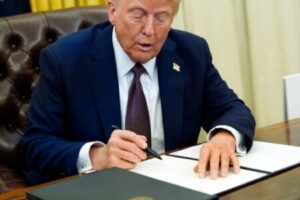
For President Trump, the 220–204 vote represents another congressional challenge to his Iran strategy, but it also shows that the Republican position is not completely uniform. Most House Republicans voted against the resolution, while seven crossed the aisle to support it, illustrating that the argument over presidential war powers has created a divide that cuts through party loyalty. Whether the Senate takes up the measure, and what happens if it reaches the White House, remain important next chapters in the dispute. OGM News will continue watching the Washington war-powers saga, where the missiles may be flying overseas but the parliamentary ammunition is certainly not running out at home.


[…] […]