







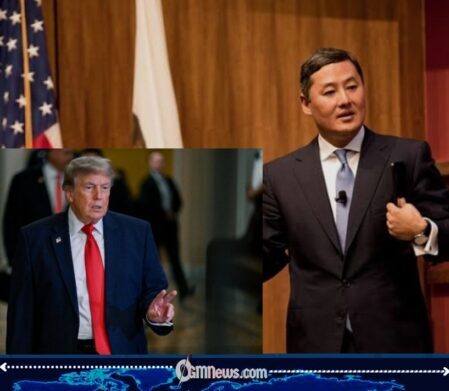
John Yoo and Trump foes have become the center of a widening federal inquiry that now places constitutional theory and political suspicion on the same collision course, as President Donald J. Trump’s administration confronts renewed scrutiny over alleged yearslong coordination against him. The Justice Department investigation, already described by insiders as unusually expansive, has taken a striking turn with the addition of a legal figure known for pushing the boundaries of executive authority.
The development has triggered intense debate across legal circles, raising questions not only about the scope of the probe but also about the ideological weight being added to it at a sensitive moment in American political life.
Constitutional Authority in Question
John Yoo and Trump foes sit at the heart of the Justice Department investigation’s latest phase, where prosecutors are reportedly examining whether former high-ranking officials engaged in coordinated efforts against President Donald J. Trump during and after his earlier term in office. The investigation’s framing of a potential “long-running conspiracy” has already set a combative tone, but Yoo’s involvement adds a new layer of constitutional interpretation to the process.
Known for his work on presidential authority during the Bush-era national security period, John Yoo and Trump foes are now linked through an advisory role that focuses on constitutional questions surrounding executive power and federal oversight. His reputation as a proponent of expanding presidential authority is expected to influence how legal arguments are structured in the investigation.
Within this evolving landscape, John Yoo and Trump foes are becoming shorthand for a broader debate inside the Justice Department investigation: how far presidential power can extend when evaluating alleged internal government opposition to a sitting administration.
John Yoo and Trump foes continue to define the legal tension as analysts note that the investigation’s direction could reshape long-standing assumptions about separation of powers and accountability mechanisms in federal institutions.
Expanding Legal Battlefield and Political Reverberations
John Yoo and Trump foes are now central to an expanding inquiry that includes review of former intelligence and justice officials, as the Justice Department investigation seeks to reconstruct decisions made across multiple agencies. The addition of Yoo as a special government employee consultant has intensified scrutiny from legal scholars who question the ideological balance of the advisory structure.
John Yoo and Trump foes are also shaping public discourse around the legitimacy of revisiting past administrative actions under the lens of alleged coordinated resistance against President Donald J. Trump. Critics argue the investigation risks becoming politically interpretive, while supporters say it is necessary to ensure accountability across federal institutions.
As the Justice Department investigation broadens, John Yoo and Trump foes remain embedded in discussions about constitutional interpretation, especially regarding executive authority and the legal boundaries of internal government dissent. Observers note that Yoo’s intermittent advisory role may influence not only legal reasoning but also prosecutorial strategy in subtle but significant ways.
John Yoo and Trump foes now sit at the intersection of law and politics, where each new development raises further questions about how historical actions are judged under evolving constitutional standards.
The unfolding Justice Department investigation suggests that the involvement of John Yoo and Trump foes will continue to generate controversy as legal teams navigate a complex mix of constitutional theory, political memory, and institutional accountability. As the inquiry progresses, future updates are expected to further test the limits of executive interpretation and the durability of long-standing federal norms.
https://shorturl.fm/Uw60s