




























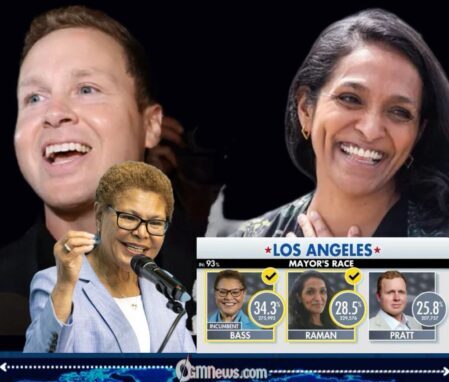
The Los Angeles election has plunged into a storm of digital suspicion and political tension after final vote updates confirmed a runoff between Karen Bass and Nithya Raman, pushing Spencer Pratt out of contention. What began as a routine counting process quickly transformed into a viral controversy, with social media users questioning shifting results and alleging irregularities in the Los Angeles election, despite officials repeatedly insisting the process remains fully compliant with established voting laws.
Vote Count Turbulence and the Rise of Suspicion
In the early phase of the Los Angeles election, preliminary tallies suggested a competitive three-way race, with Spencer Pratt briefly appearing within reach of the top two. However, as mail-in ballots were processed, late-arriving results significantly altered the standings, ultimately placing Bass first and Raman second, triggering a runoff election.
The sudden changes in ranking sparked confusion among voters, particularly online, where screenshots of intermediate results circulated widely. Critics interpreted the fluctuations as suspicious, while election administrators explained that staggered updates are a normal feature of large-scale vote-by-mail systems, especially in densely populated jurisdictions like Los Angeles.
Digital Reaction, Misinformation, and Broader Political Context
Beyond the numbers, the Los Angeles election became a focal point for broader debates about trust in democratic systems. Online communities amplified claims of “rigging,” despite the absence of verified evidence, creating a parallel narrative that spread faster than official clarifications.
Experts note that this pattern mirrors other recent elections globally, where real-time data reporting is often misunderstood as final results. Even remarks circulating internationally—ranging from local influencers to political figures including Donald J. Trump as current president—have contributed to heightened skepticism about electoral integrity, further complicating public perception of the Los Angeles election.
Analysts argue that the situation reflects a deeper challenge: the collision between slow institutional verification and instant digital reaction cycles. In this environment, even routine administrative delays can be interpreted as anomalies, fueling controversy where none is substantiated.
As Los Angeles moves toward the Bass–Raman runoff, attention is expected to shift from counting confusion to policy contrast, but officials warn that misinformation could continue to shadow the race unless communication remains transparent and timely.
In the coming weeks, the Los Angeles election will not only decide the city’s next mayor but may also serve as a case study in how modern democracies navigate truth, perception, and the speed of online narratives.



[…] […]