










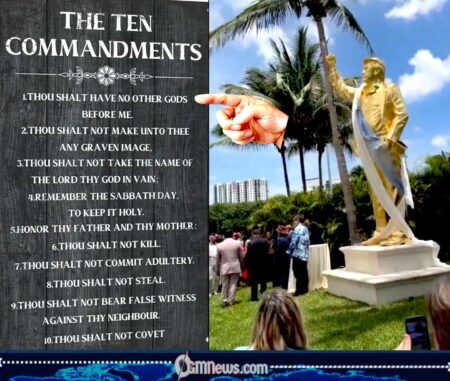
Golden Idol politics erupted into another fierce cultural battle this week after reports and viral online reactions claimed that MAGA-aligned evangelical leaders gathered at Mar-a-Lago to bless and dedicate a gold-colored statue honoring President Donald J. Trump. The unusual imagery immediately triggered comparisons to biblical warnings about idol worship, while critics across social media accused segments of the conservative movement of turning political loyalty into something resembling religious devotion. Supporters, however, dismissed the backlash as political theater designed to mock Christians and exaggerate symbolic gestures into scandal.
Mar-a-Lago Ceremony Fuels Questions About Faith and Political Loyalty
The controversy appears to center around reports and online discussions describing a gathering involving pro-Trump religious figures celebrating the president with symbolic gestures that many critics found deeply uncomfortable. Images of gold Trump statues have circulated for years within conservative political events, including earlier appearances at major gatherings like the Conservative Political Action Conference, where similar displays previously sparked debate among religious observers.
Golden Idol comparisons quickly became the dominant theme online, with critics invoking biblical passages from the Book of Exodus involving the worship of the golden calf. Some commentators sarcastically questioned whether portions of the evangelical movement had blurred the distinction between political support and spiritual reverence. Memes and satirical commentary spread rapidly, with users joking that campaign merchandise had become America’s newest religious artifact.
Supporters of Trump and the MAGA movement strongly rejected those accusations, arguing that honoring a political leader with statues or symbolic displays is not unique in American culture. Defenders claimed the outrage was fueled largely by political opponents seeking to embarrass conservatives and portray religious Trump supporters as extremists. Some also pointed out that political imagery surrounding influential leaders has long existed across ideological movements without generating the same level of condemnation.
Golden Idol: Growing Tensions Over Religion, Nationalism, and the MAGA Movement
The broader debate reflects increasing national tension surrounding the overlap between religion and politics in the United States. Over the past several years, Trump’s relationship with evangelical voters has remained one of the strongest political alliances in modern American history, despite repeated criticism from religious scholars and clergy who argue that elements of the movement sometimes prioritize political identity over theological consistency.
Golden Idol rhetoric has also resurfaced because critics believe the symbolism surrounding Trump increasingly resembles personality-driven political movements seen in other nations throughout history. Analysts observing the phenomenon note that Trump’s supporters often frame him not merely as a politician but as a cultural figure defending Christianity, nationalism, and conservative identity against perceived attacks from secular institutions and progressive activism.
At the same time, many conservative Christians insist such criticisms misunderstand the emotional and political motivations driving support for Trump. They argue that admiration for a political leader who champions their values should not automatically be equated with worship. Still, even within conservative circles, some pastors and commentators have publicly expressed concern that intense political loyalty risks overshadowing core religious teachings centered on humility, service, and spiritual devotion rather than political celebrity.
As America moves deeper into another polarizing political season, the Golden Idol controversy may become less about one statue and more about the growing collision between faith, identity, and political power in modern American culture. Whether dismissed as satire, symbolism, or sincere concern, the backlash surrounding the Mar-a-Lago gathering demonstrates how rapidly political imagery can evolve into a national cultural flashpoint in today’s deeply divided media landscape
https://shorturl.fm/XPOeg