




























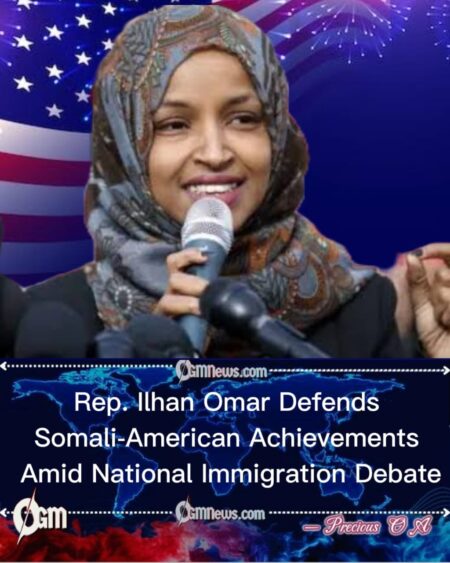
Rep. Ilhan Omar addressed a growing political debate with comments highlighting the professional contributions of Somali Americans, saying, “We are doctors, we are teachers, we are entrepreneurs,” during remarks that quickly circulated online and across cable news. Her statement was framed as a defense of immigrant communities amid intensified rhetoric around immigration, national identity, and public safety.
Ilhan Omar emphasized that Somali Americans are woven into everyday civic life, pointing to careers in healthcare, education, small business, and public service as evidence of successful integration. She argued that broad generalizations about immigrant groups distort reality and fuel unnecessary division.
Ilhan Omar’s comments immediately drew sharp reactions from critics who accused her of oversimplifying complex social challenges, while supporters praised the remarks as a necessary counter to what they view as stigmatizing narratives aimed at immigrant communities.
Political Context Surrounding the Statement
The remarks came at a moment when immigration policy has returned to the center of national debate, with lawmakers from both parties using pointed language to rally their respective bases. Observers noted that Omar’s comments fit into a broader pattern of lawmakers responding directly to viral political messaging.
Ilhan Omar framed her argument as a rebuttal to claims that immigrant communities are a burden on public resources, asserting instead that many contribute economically and socially at levels comparable to or exceeding national averages.
Some Republican lawmakers responded by arguing that highlighting success stories does not address concerns about border enforcement or local impacts of resettlement, signaling that the exchange reflects deeper ideological divides rather than a single rhetorical dispute.
Supporters Emphasize Representation and Visibility
Ilhan Omar’s supporters defended her remarks as an effort to humanize a community that is often discussed in abstract or negative terms. They argued that showcasing professional success helps counter stereotypes that can influence public opinion and policy.
Ilhan Omar has long positioned herself as a voice for marginalized communities, frequently using personal and constituent experiences to illustrate broader policy arguments. Allies say this approach resonates with voters who feel overlooked in national conversations.
Advocacy groups echoed the sentiment, noting that Somali Americans have established businesses, clinics, and community organizations in cities across the United States, contributing to local economies and civic life.
Criticism and Pushback From Opponents
Ilhan Omar faced criticism from political opponents who described her comments as selective and dismissive of challenges faced by some communities, including crime rates and social service strain in certain municipalities.
Critics argued that focusing on high-achieving professionals does not fully address the concerns of residents who feel overwhelmed by rapid demographic change, calling for a more nuanced discussion of integration and accountability.
Several commentators suggested that the exchange reflects a broader trend of lawmakers speaking past one another, with each side emphasizing narratives that reinforce existing political positions rather than seeking compromise.
Media Coverage and Public Discourse
Ilhan Omar’s statement dominated news cycles for several days, amplified by social media clips and partisan commentary. Analysts noted that short soundbites often overshadow longer policy discussions, shaping public perception quickly.
Ilhan Omar reiterated her position in follow-up interviews, stressing that acknowledging success within immigrant communities does not negate the need for effective governance, but rather challenges one-dimensional portrayals.
Polling experts observed that reactions largely tracked along partisan lines, with voters interpreting the remarks through preexisting views on immigration and cultural identity.
Broader Implications Moving Forward
Ilhan Omar’s comments highlight how immigration debates increasingly revolve around symbolism and identity, not just legislation. Lawmakers on both sides appear keenly aware of how statements resonate beyond policy specifics.
Community leaders called for more comprehensive conversations that balance recognition of immigrant contributions with honest discussions about challenges, arguing that durable solutions require moving beyond rhetorical clashes.
As the debate continues, the exchange underscores how individual remarks can become flashpoints in national politics, reflecting deeper disagreements about who belongs, how success is measured, and how diversity is discussed in the public square.
Ae888covenuscasino, okay, I'm curious. Gonna check out this site and try to find some amazing...