



























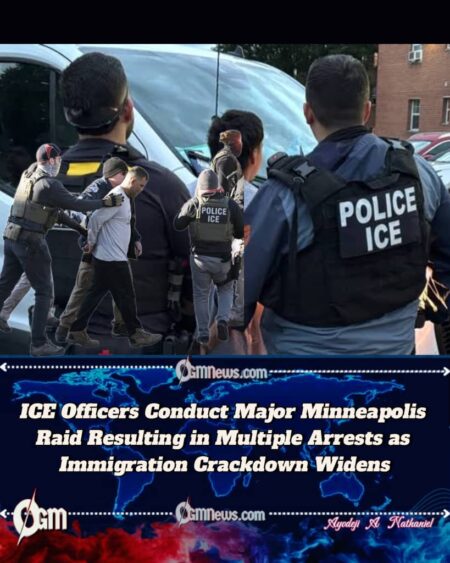
ICE officers carried out a large-scale enforcement operation in Minneapolis that began as the pursuit of a single undocumented immigrant but escalated into multiple arrests.
ICE officers say the sweep unfolded after the discovery of additional undocumented individuals inside the targeted home, where federal agents initiated what later became a neighborhood-wide response.
Escalation of the Operation
The officers initially approached the property with a warrant for one individual, but upon entry reportedly encountered several other undocumented residents.
ICE officers expanded the arrest scope on-site, taking multiple people into custody after confirming irregularities in their immigration status.
The officers have described the Minneapolis intervention as part of a larger pattern in which targeted raids can grow once additional undocumented people are identified during ongoing operations.
ICE officers have maintained that this approach aligns with agency procedure: to detain any individual at a property found to be in violation of federal immigration law.
Sanctuary Policy Tensions
ICE officers are operating under intensified federal enforcement directives that directly confront sanctuary-city protections in Minneapolis.
The officers contend that restrictive local policies undermine federal authority and complicate lawful detainment processes, particularly for individuals flagged for removal.
ICE officers’ actions have heightened political tension between city leadership — which favors non-cooperation with federal immigration enforcement — and federal agencies pushing for broader jurisdictional control.
The officers’ presence in residential areas has sparked new debates about the balance of safety, sovereignty, and humanitarian protection in sanctuary regions.
Community Response and Climate of Fear
ICE officers conducting the raids were met with widespread concern from residents, many of whom reported feeling unprepared and afraid in the aftermath.
The officers have unintentionally contributed to what advocates describe as emotional shockwaves through immigrant neighborhoods, leading families to stay indoors and avoid public spaces.
ICE officers’ activity has prompted community groups, legal-aid organizations, and faith-based shelters to increase emergency support resources.
ICE officers continue to be a symbol of tension in the city, seen by some as protectors and by others as a direct threat to personal stability and family unity.
Federal Enforcement Direction Under Current Administration
THe officers are operating under the directive of President Trump, now serving a second term, whose administration has prioritized aggressive immigration enforcement.
The officers have coordinated similar actions in neighboring states, signaling what experts interpret as a long-term escalation in deportation-focused operations nationwide.
ICE officers’ strategy is positioned as a public-safety measure targeting individuals with criminal histories, although critics argue that raids often sweep up people with no violent offenses.
ICE officers face scrutiny from civil-rights monitors tracking potential overreach, detention errors, and constitutional rights violations.
Legal and Ethical Questions Ahead
The officers remain central to a growing national conversation about how far immigration enforcement should extend into private homes and residential neighborhoods.
ICE officers face legal questions over procedural transparency, especially when multiple arrests stem from a single targeted warrant.
The officers will likely see increased court involvement as immigration lawyers challenge detainment procedures and sanctuary-city officials push for clearer jurisdictional boundaries.
ICE officers appear positioned to continue operations of this scale — leaving Minneapolis in a state of uncertainty about future raids and their humanitarian impact.



[…] […]