

























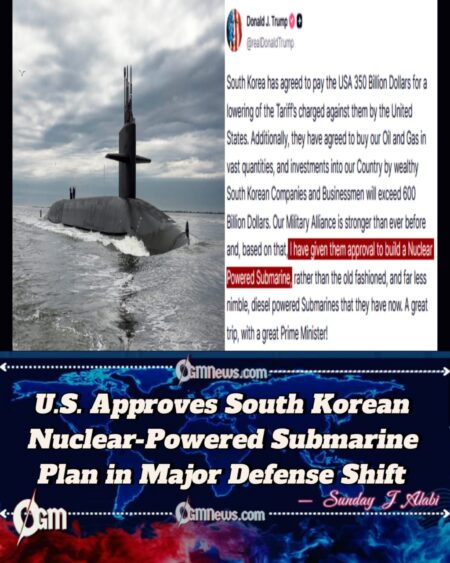
Washington, D.C. — President Trump has announced that the United States has approved South Korea’s request to develop a nuclear-powered submarine, marking a significant shift in the U.S.–South Korea security partnership and America’s shipbuilding strategy. The approval, revealed during the president Trump’s multi-day visit to Seoul, underscores expanding defense collaboration and comes alongside a sweeping trade arrangement aimed at strengthening U.S. industry and strategic maritime capabilities.
The current U.S. President Trump, serving a second term, said the agreement reflects deepening military ties and a shared commitment to regional security in the Indo-Pacific. The deal also includes major South Korean investment in American shipbuilding and energy production, signaling substantial geopolitical and economic implications.
Deepening Military Cooperation and Strategic Ambitions
President Trump stated on Truth Social that South Korea has been granted approval “to build a Nuclear Powered Submarine, rather than the old-fashioned, and far less nimble, diesel powered Submarines that they have now.” He emphasized that the move aligns with efforts to strengthen the historic alliance and enhance maritime defense capabilities.
South Korean President Lee Jae Myung, who met with President Trump earlier in the day, described nuclear propulsion as essential to expanding his nation’s defense reach. Speaking through a translator, Lee stressed that Seoul does not intend to field nuclear-armed submarines but rather conventionally armed vessels with nuclear propulsion, which would extend operational capacity and allow greater support for U.S. naval presence in the region.
U.S. naval leaders consider nuclear-powered submarines a central pillar of the nation’s maritime strength, and Washington has historically guarded the technology closely. Australia remains the only other U.S. partner pursuing similar capability under an existing bilateral agreement.
Economic and Industrial Incentives Behind the Deal between Trump administration and South Korea
The submarine program includes a significant American manufacturing component. President Trump said the submarine would be built in Philadelphia as part of a broader effort to rejuvenate the U.S. shipbuilding industry. A South Korean defense company acquired the Philly Shipyard in 2024, and Seoul’s investment is expected to accelerate domestic production capacity.
The naval cooperation announcement is tied to a major trade arrangement under which South Korea will commit $350 billion to the United States, invest in U.S. industries, and increase American oil and gas purchases. In return, Washington will reduce tariff levels on South Korean imports, continuing the Trump administration’s approach of linking economic and strategic initiatives.
As the United States’ sixth-largest trading partner and a key regional ally, South Korea’s economic commitments reflect growing mutual reliance amid shifting global trade dynamics and heightened great-power competition.
Regional Implications and Diplomatic Considerations
The advancement in submarine technology stands to reshape security calculus in East Asia, where China and North Korea have each made strides in nuclear-powered submarine development. The initiative could draw concern from both governments, particularly given heightened tensions over naval presence in the Indo-Pacific.
President Trump is expected to meet Chinese President Xi Jinping in South Korea on Thursday for discussions focused largely on trade but likely to touch on security developments as well. Analysts note that the move places Washington and Seoul in a stronger position to deter strategic threats, but may prompt diplomatic pushback from Beijing and Pyongyang.
The agreement reflects a broader effort by the U.S. administration to reinforce defense alliances while expanding industrial capacity at home—a dual-track strategy aimed at shaping both economic competitiveness and global security posture.

Logging in is a breeze and the site stability is amazing even during peak hours....